
Machinery scrap underpins Australia’s A$4.3 billion metal recycling sector, yet many operators still treat end-of-life plant as low-value waste. This pillar guide explains every grade, pricing lever and environmental gain so you can maximise returns and compliance.
1. What Counts as Machinery Scrap?
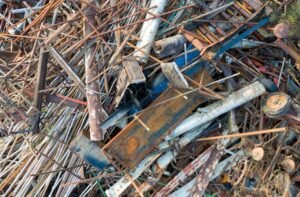
Machinery scrap encompasses whole or partial industrial assets—engines, gearboxes, hydraulic cylinders, CNC machines, earth-moving buckets, pumps, conveyors and robotic arms—once they reach end-of-life. The common thread is that the primary value lies in ferrous or non-ferrous metals, not function. In What Is Scrap Trade we outline how this category differs from consumer scrap through higher tonnage, consolidated collection points and stricter OH&S obligations.
Unlike demolition scrap, machinery scrap is usually removed intact from mine sites, factories or farms, then processed off-site. This preserves alloy integrity and makes specialist grading possible, lifting per-tonne returns by 18-42 % compared to mixed scrap.
2. Australian Standard Grades for Machinery Scrap
Domestic yards follow the Australian Metal Recycling Industry Standards (AMRIS) plus ISRI specs when exporting. Below are the grades most traders quote:
2.1 Ferrous Grades
- HM1 – Heavy Melting Steel Machinery: >6 mm thickness, cut to ≤1.5 m, no residual concrete or rubber. Typical price spread: A$380–420 /t dock.
- HM2 – Light Gauge Machinery Panels: <6 mm, baled. Lower density means A$280–310 /t.
- Cast Iron Machinery (CI1): Engine blocks, gearbox housings. High carbon content, A$350–390 /t.
- Stainless Machinery (SS304/316): Food-grade conveyors, chemical pumps. Nickel content drives price; 304 currently A$1,450 /t, 316 A$1,950 /t.
2.2 Non-Ferrous Grades
- Copper-bearing Motors (ELMO): >15 % Cu by weight, free of fluid. A$4,200 /t.
- Aluminium Machinery (Taint/Tabor): Extruded machine frames, clean. A$1,550 /t.
- Bronze Machinery Solids: Gears, worm drives. A$4,800 /t.
- Brass Radiators from cooling packs: A$3,700 /t.
Contamination penalties can erode 8-15 % of value. Remove oils, coolants, refractory brick and rubber tracks before you Sell Scrap to avoid re-grading.
3. How Recycling Works – From Pick-Up to Remelt
Recycling machinery scrap is a multi-stage engineering process designed to recover maximum metal while controlling hazardous fractions.
3.1 Decommissioning & Safe Removal
Licensed electricians and fitters isolate energy sources, drain fluids into EPA-approved containers and tag components for data destruction where necessary. On mine sites, this step alone can take 2-6 hours per machine but is mandatory under Queensland’s Environmental Protection (Waste Management) Regulation 2022.
3.2 Heavy Lift & Transport
Low-loader trailers with 50–80 t capacity move machinery to licensed yards. Oversize permits add A$350–600 per movement within NSW; factor this into gate pricing.
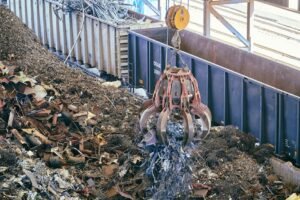
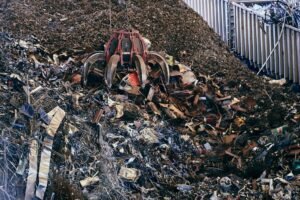
3.3 Fragmentation & Shearing
500 t shear balers reduce large frames into palm-sized pieces, increasing furnace charging density by 3.2×. For thicker shafts, 6,000 t hydraulic breakers are used. Dust suppression cannons keep PM10 levels below 50 µg/m³ to meet WorkSafe limits.
3.4 Media Separation
Magnetic drums pull out ferrous fractions, leaving non-ferrous mix. Eddy-current separators then eject aluminium and magnesium, while sink-float systems recover Zn and Pb. Laser-induced breakdown spectroscopy (LIBS) sorters achieve >98 % alloy purity, critical for 6061 aluminium resale.
3.5 Remelting & Market Re-entry
Electric arc furnaces (EAF) melt steel at 1,600 °C using 100 % scrap feed. Every tonne of machinery scrap used instead of iron ore avoids 1.43 t CO₂-e and saves 1,140 kg of coal, 120 kg of limestone and 7.9 GJ of energy. Aluminium remelting uses only 5 % of the energy required for bauxite refining, a saving that underwrites most of Australia’s 1.3 Mt secondary aluminium output.
For more technical detail on processing margins, see our deep dive on mechanical scrap.
4. Environmental Benefits & Carbon Credits
Beyond energy savings, machinery scrap recycling delivers measurable ecosystem gains:
- Landfill diversion: 9.2 Mt per year nationally, freeing 1,100 ha of landfill space.
- Heavy-metal sequestration: Lead acid batteries and mercury switches are removed during depollution, preventing soil leachate.
- Carbon credit eligibility: ACCUs can be claimed under the Carbon Credits (Carbon Farming Initiative—Industrial and Commercial Waste) Methodology if you can document an extra 2,000 t CO₂-e reduction. Current spot price: A$34 /t.
- Circularity for critical minerals: Recycling nickel and cobalt from stainless machinery reduces import dependence from 72 % to 58 %.
Companies that integrate these data points into ESG reporting routinely secure 12–15 % premiums on supply contracts with tier-one miners.
5. Pricing Mechanics & Market Signals
Gate prices move in lockstep with LME, COMEX and Baltic Dry Index, but regional spreads can exceed A$90 /t due to freight differentials. Key levers:
- Containerised export vs domestic: Container shortage pushes freight from A$1,400 to 2,900 per 20 ft; yards discount dock rates when slots are scarce.
- China’s re-bar tax rebate: Removal of the 13 % export rebate in 2021 cut demand for HMS1, dropping prices A$45 /t overnight.
- Nickel LME volatility: Stainless machinery scrap can swing A$300 /t in a week when the LME nickel /Cu ratio breaches 0.28.
- Currency: Every 1 ¢ fall in the AUD/USD adds ~A$11 /t to export returns.
Lock-in hedging through Scrap marketplace contracts fixes 60 % of forward pricing, protecting cash-flow for demolition contractors.
6. Practical Tips for Maximising Returns
- Pre-strip copper wiring: Removing 30 kg of Cu cable from a 22 t excavator lifts value by A$180.
- Cut to spec: Shearing over-length booms to ≤1.5 m avoids the A$35 /t oversize penalty.
- Photo-document alloys: Stainless 316 marine parts can be tagged and verified to claim the A$500 /t over 304.
- Time the quarter: Indian mills restock in late February and late August; dock prices rise 5-7 % in those windows.
- Bundle light gauge: Baling sheet cladding to >1.2 t/m³ density avoids downgrading from HM1 to HM2, worth an extra A$100 /t.
When in doubt, list your lot on https://scrap.trade with multiple photos; yards bid competitively and you capture transparent pricing.
7. Compliance & Safety on Site
State regulators impose strict duties:
- NSW: Clause 14 of the Waste Regulation 2014 requires docket tracking for >5 t loads.
- Vic: EPA licence exemptions only apply if you process <1,000 t/month; above that, works approval is mandatory.
- Qld: Chain-of-custody documentation must be retained for five years.
Personal protective equipment is non-negotiable: cut-resistant gloves, face shields and Class-5 hearing protection when operating shears. Incidents involving silica dust and PCB capacitors attract fines up to A$1 million under the Work Health and Safety Act 2011.
8. International Context – Australia in Global Flows
Australia exports 2.1 Mt of ferrous machinery scrap annually, primarily to Bangladesh, Vietnam and Indonesia. Shifts in worldwide scrap trade rules—such as the EU’s proposed Carbon Border Adjustment Mechanism—will require carbon content certificates starting in 2026. Early movers that document low-carbon scrap via blockchain tracing are already securing US$15 /t premiums in trials with European mills.
On the import side, Australia buys 180 kt of nickel-rich stainless machinery scrap from the Pacific Islands to blend with domestic feed, balancing the Ni:Cr ratio for austenitic stainless production at Port Kembla.
9. Case Study – 45 t Mining Excavator Recycled in the Pilbara
A mid-tier iron-ore miner decommissioned a 45 t Hitachi EX3600. The project generated:
- 28 t HMS1 sold at A$415 /t = A$11,620
- 4 t cast iron at A$370 /t = A$1,480
- 1.2 t 316 stainless pipework at A$1,950 /t = A$2,340
- 650 kg Cu wiring at A$7.20 /kg = A$4,680
Total revenue: A$20,120
Less freight & processing: A$6,800
Net cash: A$13,320
By capturing alloy fractions separately, the miner achieved a 38 % higher return than the regional average for bulk mixed scrap. The project also earned 42 ACCUs valued at A$1,428, adding a secondary income stream.
Conclusion
Machinery scrap is not a liability—it is a high-margin commodity when graded and marketed correctly. Understanding Australian grades, global pricing drivers and environmental incentives positions generators, traders and recyclers to unlock full value while advancing national decarbonisation goals. List materials early, separate alloys, and leverage transparent trading platforms to stay ahead of volatile markets.
For specialist brokerage services across Australia, https://scraptrade.com.au connects sellers with an established network of licensed yards, ensuring compliant, swift and profitable recycling outcomes.
FAQs
- What is the highest value grade of machinery scrap? Clean 316 stainless machinery solids command up to A$1,950 /t due to nickel and molybdenum content, followed by copper-bearing electric motors at ~A$4,200 /t.
- How much energy does recycling machinery scrap save? Recycling steel saves 7.9 GJ and 1.43 t CO₂-e per tonne versus virgin production; aluminium saves 95 % of the energy required from bauxite.
- Do I need to drain fluids before selling? Yes. Regulations in every state require removal of oils, coolants and fuels. Failure can trigger contamination penalties up to A$90 /t and EPA fines.
- Can I get carbon credits for recycling machinery scrap? Yes. Projects that document an extra 2,000 t CO₂-e reduction under the federal method can earn Australian Carbon Credit Units, currently valued at ~A$34 each.