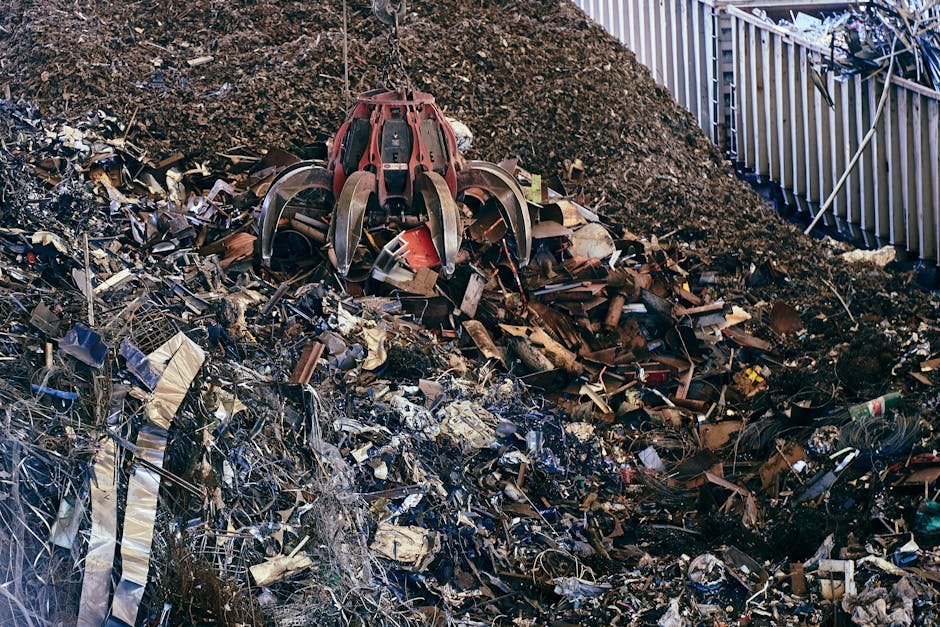

Understanding the scrap metal price per tonne is the fastest way to turn discarded material into profit while lowering emissions. This authoritative guide explains how Australian traders set current scrap prices, what grades matter, where to sell scrap metal near me and how recycling delivers measurable environmental wins.
1. How Scrap Metal Prices Are Set in Australia
Scrap yards do not pick numbers at random. Every morning they benchmark against:
- London Metal Exchange (LME) cash-settled futures in USD
- Regional mill purchase prices published by Argus and SteelBenchmark
- Freight cost from port to consumer
- Foreign exchange—AUD weakness inflates the local price per kg
- Inventory levels at Port Kembla, Whyalla and Geelong
These inputs feed an algorithm that sets the market rate before gates open. Most yards guarantee their quote for 24 h, so checking today’s scrap metal price per tonne early maximises returns. If you want to dig deeper into projections, read our Scrap Price Forecast Guide.
2. Current Scrap Prices per kg and per Tonne (June 2024)
Below are indicative spot ranges collected from Sydney, Melbourne, Brisbane, Adelaide and Perth dealers on 3 June 2024. Values are in Australian dollars and exclude GST.
| Grade | Form | Price per kg | Scrap metal price per tonne |
|---|---|---|---|
| Copper Bright & Shiny (>99% Cu) | Wire <6 mm | $8.40 – $8.90 | $8,400 – $8,900 |
| Copper #2 (>96% Cu) | Painted pipe | $7.60 – $8.00 | $7,600 – $8,000 |
| Aluminium Extrusion 6063 | Clean, no steel | $2.20 – $2.45 | $2,200 – $2,450 |
| Stainless Steel 304 Scrap | 18/8, no magnet | $1.85 – $2.10 | $1,850 – $2,100 |
| Yellow Brass Solids | Valves, taps | $5.30 – $5.60 | $5,300 – $5,600 |
| Lead Scrap | Wheel weights, sheet | $1.95 – $2.15 | $1,950 – $2,150 |
| Light Steel / HMS 2 | <6 mm thick | $0.14 – $0.26 | $140 – $260 |
| Heavy Steel / HMS 1 | >6 mm thick | $0.22 – $0.34 | $220 – $340 |
Prices swing intra-day; always phone ahead or check the yard’s live portal. For stainless-specific detail see our page on Stainless Steel Scrap Price. Lead is tracked separately at lead scrap metal price.
3. Grades Explained: Why Clean Metal Earns More
Grade determines chemistry, density and residual content. Mis-classification can cost over $1,000 per tonne. Dealers use Australian Standard AS 1054-2020 and ISRI (Institute of Scrap Recycling Industries) codes:
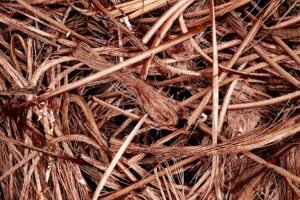
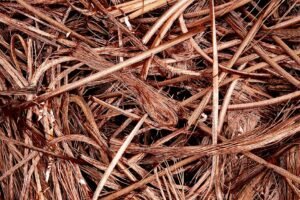
- Copper Bright & Shiny (Millberry): uncoated, untinned, unalloyed copper wire <6 mm. Must be free of hair wire, burnt wire and excessive oils.
- Copper #2 (Candy): copper pipe with minor solder or paint. May include brass fittings if they can be removed.
- Aluminium 6063 Extrusion: architectural window frames, free of steel screws. Contaminated extrusion drops into Taint/Tabor and loses 30 c per kg.
- Stainless 304: 18% Cr, 8% Ni. Magnetic? Then it is 409 and worth 60 c per kg less.
- HMS 1 & 2: obsolete steel thicker than 6 mm, rebar or beams. Must be under 0.3% Cu content or mills reject.
Practical tip: Cut a small window frame into its aluminium and steel parts; the aluminium fetches 2.40 $/kg while the steel is 0.22 $/kg. Mixed loads are priced at the lowest component. For ferrous detail see our scrap metal steel price tracker.
4. Key Factors That Move the Market Rate
Even if LME futures stay flat, the following local drivers can shift the metal prices today:
- Turkish Import Prices: Turkey buys 40% of Australia’s bulk steel scrap; their CFR reference price is converted to ex-yard AUD equivalent every afternoon.
- China’s Copper Import Premium: When Yangshan premium rises above $120/t, Chinese traders absorb more Australian Cu scrap, tightening local supply.
- Energy Costs: Electricity is 30% of an aluminium smelter’s cost; when spot prices exceed A$120 MWh, smelters bid up scrap to avoid primary metal.
- Seasonality: December–January demolition lull lowers supply and supports prices, while June EOFY clean-outs increase arisings and depress rates.
- Freight & Fuel: A $10 rise in diesel adds ~$4 per tonne to the transport component, narrowing yard margins and buy prices.
Set up Google Alerts for “LME copper cash” and “AUD/USD” to anticipate swings. Combine them with our Scrap Price Forecast Guide to decide whether to stockpile or sell immediately.
5. How Scrap Recycling Works: From Bin to Billet
Recycling is a sequence of size-reduction, separation and metallurgical recovery that uses 5–10% of the energy required to dig and refine virgin ores.
Step 1 – Collection & Weighing: Public weighbridges record gross and tare to 20 kg accuracy; keep your docket for tax purposes.
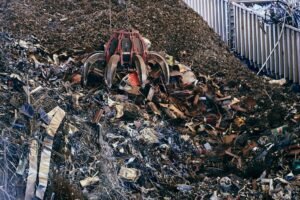
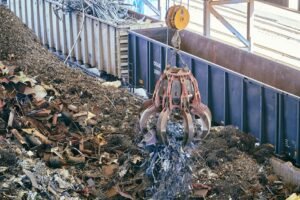
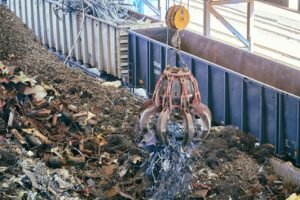
Step 2 – Sorting & Shearing: Excavator magnets pull steel; eddy-current separators eject aluminium; hand picking targets copper and brass. Large steel is cut by 1,000 t guillotine shears into fist-size pieces.
Step 3 – Baling & Shredding: Non-ferrous grades go into closed-loop water baths to remove coatings, then 6,000 hp hammer mills shred them into cookie-size fragments.
Step 4 – Furnace & Refining: Scrap substitutes for 40% of the charge in an electric-arc furnace at 1,600 °C. Oxygen lances remove residual zinc; carbon injectors adjust chemistry. Secondary aluminium is melted at 750 °C in rotary tilting furnaces with a salt flux.
Step 5 – Casting & Rolling: Molten metal is cast into billets, slabs or ingots, then rolled to re-enter commerce as window frames, car panels or reinforcing bar.
Each tonne of recycled steel saves 1,130 kg of iron ore, 630 kg of coal and 54 kg of limestone. Copper recycling saves 85% of the energy versus mining sulfide ores.
6. Environmental & Economic Benefits of Selling Scrap
Beyond the cash in your pocket, recycling lowers Scope 3 emissions for manufacturers and helps Australia meet its 43% 2030 reduction target. One tonne of aluminium scrap avoids 16.6 t CO₂-e, equivalent to taking a passenger car off the road for 41,000 km. Recycled steel cuts emissions by 1.85 t CO₂ per tonne compared with blast-furnace production.
Economically, the sector employs 14,000 Australians and contributes $3.8 bn in export revenue. Councils save landfill airspace fees of $75–$120 per tonne, while foundries lower input costs by 30–50%. By choosing to Sell Scrap Metal Near Me In 2026 you become part of this circular supply chain.
7. Practical Tips to Maximise Your Return
- Strip plastic off copper wire with a manual peeler; Bright & Shiny commands a $1.50 per kg premium over #2.
- Keep stainless away from mild steel; even a 2% steel contamination can downgrade 304 into 409 pricing.
- Drain all fluids from engines; oil residue triggers environmental surcharges of $30 per tonne.
- Stockpile non-ferrous in secure bins and sell when the AUD weakens; copper has gained 14 c per kg in a week after RBA rate cuts.
- Use a handheld XRF analyser (many yards offer free tests) to prove nickel content in stainless; proving 316 over 304 can add 40 c per kg.
Before you haul material, photograph each grade and request a written assay; disputes are easier when you have time-stamped evidence.
8. Where to Track Metal Prices Today
Bookmark these sources for real-time data:
- LME official settlement prices (24-hour delay free)
- Argus Media Ferrous Scrap Daily
- Scrap Trade live dashboard
- Australian Bureau of Statistics Iron & Steel Scrap Trade Tables
Combine them with the Scrap Trade platform alerts to receive SMS when your target scrap metal price per tonne is reached.
9. Frequently Asked Questions
Q: Does GST apply when I sell scrap to a yard?
A: Individuals are not required to charge GST; however, if you operate a business with >$75 k turnover you must remit 10% GST on the full sale price. Always provide your ABN to avoid 47% withholding.
Q: How do I know if my stainless is 304 or 316?
A: Spark test: 316 produces short red sparks with no forks; 304 shows yellow forks. Alternatively, apply 20% nitric acid—316 resists etching due to molybdenum. Most yards offer free XRF testing within two minutes.
Q: Why did the yard downgrade my copper at the gate?
A: Visible solder, paint or ash content triggers reclassification to #2. Remove brass fittings, clean with a wire brush and deliver dry pipe to maintain Bright & Shiny pricing.
Q: Is it worth stripping insulation from wire?
A>Yes. At 2.5 mm household wire you lose 55% of the weight to plastic but gain $6.30 per kg for Bright & Shiny versus $1.90 for insulated. A simple hand stripper pays for itself after 15 kg.
Stay informed, sort correctly and time the market to turn scrap into consistent revenue while helping Australia hit its sustainability goals.