

You do not need a scrapyard to earn from the scrap trade. You need either the knowledge to do the selling and buying work for someone else, or the contacts and the nerve to buy material and resell it. On ScrapTrade those two ways of earning have two names, scrap agent and scrap broker, and they are paid in completely different ways. People mix them up all the time, and the mix-up is expensive, because one role carries almost no stock risk and the other carries plenty.
This article explains how each role is paid, works through the arithmetic with clearly labelled example figures, lists the costs and risks that come out of the money, and helps you decide which role fits you. It is an explanation, not a promise. No income is guaranteed in either role, and every dollar figure below is an invented example to show how the sums work.
The short version: an agent is paid for doing work for someone else, so the pay is a commission that is fixed up front. A broker is paid for taking a position in the material, so the pay is a margin that may be large, small or negative.
At a glance
| Scrap agent | Scrap broker | |
|---|---|---|
| What you do | Sell or buy scrap on behalf of a seller or buyer who hires you | Source scrap from an original seller and resell it as the seller |
| How you are paid | A percentage commission, set when you are hired and locked once confirmed | The difference between what you pay the original seller and what the buyer pays you |
| Who sets the rate | The hirer sets it. The default is 5% and can be changed before the agreement is confirmed | You and the original seller agree it privately |
| Does ScrapTrade calculate it? | Yes, and it shows in the payment breakdown | No. ScrapTrade does not calculate, deduct or pass on a broker's margin |
| Who carries the risk | The client keeps the deal. You carry your own time and costs | You, as the seller on the platform |
| Stock to buy | None | Depends on the deal you strike with the original seller |
The scrap agent: paid a commission for doing the work
What an agent actually does
A scrap agent is hired by a seller or a buyer to do the listing and dealing work for them. A seller who has a load of mixed metal but no time can hand over the describing, photographing, listing and buyer questions. A buyer who needs a particular grade can hand over the searching and shortlisting. The client stays the party to the deal. The agent works for them under a hiring agreement that records who hired whom, the commission and the scope of the work.
That makes the agent's value simple to state: you are selling competence. A seller who cannot tell a clean grade from a contaminated one will leave money on the table, and a seller who lists vague material will attract low offers. If you can grade properly, describe honestly and negotiate calmly, you can charge for it. Our guide to how to grade scrap metal covers the skill that matters most.
How the commission works
The commission is a percentage, and the rules around it are stricter than most people expect:
- The hirer sets the percentage before the hiring agreement is confirmed.
- ScrapTrade suggests a default of 5%, which the hirer can change.
- Once the agreement is confirmed the rate is locked. A different rate means a new agreement, and the original stays on record.
- The commission settles through the platform, so the amount and the calculation appear in the breakdown.
Who pays depends on who did the hiring. A seller's agent is paid out of the seller's proceeds, so the buyer's price does not change. A buyer's agent is paid on top of the purchase price, so the seller's price is not reduced.
Worked example: the seller hires you
These figures are invented to show the arithmetic. They are not a price guide, and platform charges and taxes are not included.
| Line | Amount |
|---|---|
| Sale amount | US$1,000.00 |
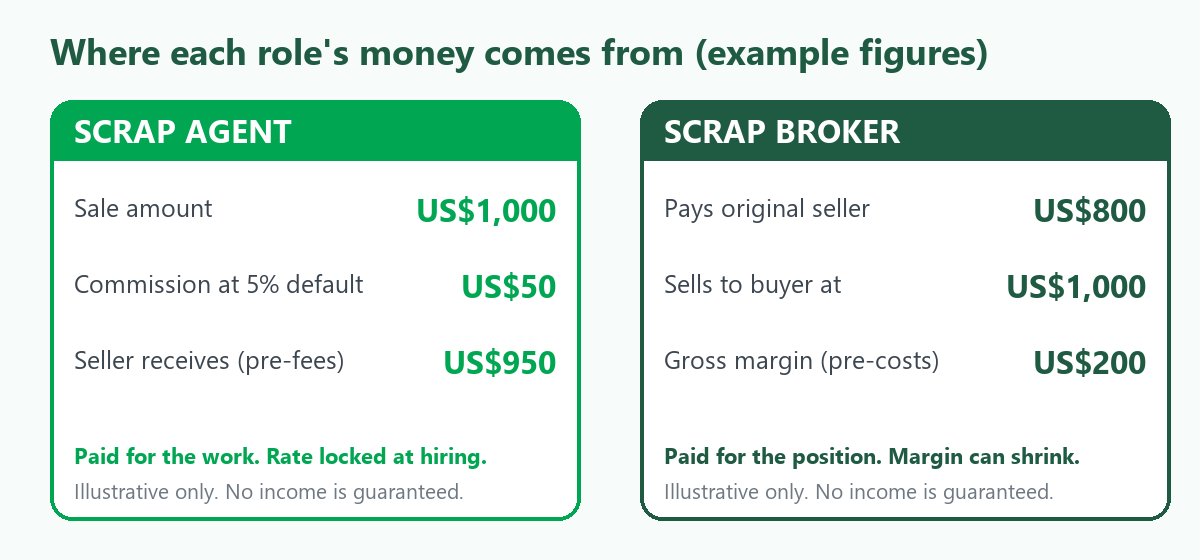
| Agent commission at the 5% default | US$50.00 |
| Seller receives, before platform charges | US$950.00 |
| Buyer pays | US$1,000.00, unchanged |
Worked example: the buyer hires you
| Line | Amount |
|---|---|
| Purchase price of the listing | US$1,000.00 |
| Agent commission at the 5% default | US$50.00 |
| Total payable by the buyer | US$1,050.00 |
| Seller still receives, before platform charges | US$1,000.00 |
What that adds up to over a month
Commission income is volume multiplied by value multiplied by rate, and nothing else. The table below is arithmetic, not a forecast. It shows why the deal size matters as much as the number of deals.
| Deals in a month | Average deal value | Rate | Commission |
|---|---|---|---|
| 4 | US$1,000 | 5% | US$200 |
| 4 | US$5,000 | 5% | US$1,000 |
| 8 | US$5,000 | 5% | US$2,000 |
| 8 | US$5,000 | 3% | US$1,200 |
Two things stand out. Handling fewer, larger loads earns more per hour than chasing many small ones, because the work of describing, listing and negotiating is not much smaller for a small load. And the rate is set by the person hiring you, so a lower rate on a big job can still beat the default on a small one. Do not assume jobs will arrive on schedule. Whether you find enough clients is the real test of this role, and the table cannot answer it.
What comes out of your commission
- Your own costs. Phone, internet, travel to inspect material and your time are yours. The commission is not reduced by them, but your profit is.
- Tax. Commission may be taxable income. Speak to a tax adviser about how it applies where you live.
- Deals that do not complete. When the commission becomes payable, and what happens after a cancellation, refund or dispute, should be written into the agreement. Check it before you confirm, not after a deal falls over.
The scrap broker: paid a margin for taking a position
What a broker actually does
A broker sources scrap from an original seller, then lists and sells it to buyers on ScrapTrade. To the platform the broker is a seller with an extra classification and a reference to the original seller on each listing. The tools are the same as any seller's: listings, order management and payment. What is different is the money. The broker agrees a price or commission with the original seller privately, sells at a higher price, and keeps the difference.
The original seller can be a registered ScrapTrade user or an outside business, subject to the platform's verification requirements. You need their authority to sell the material, and it is best confirmed in writing.
Worked example: the margin
Again, these figures are invented. Platform fees are shown as a line to remember, not as a rate, because they depend on the fee structure that applies to you.
| Line | Amount |
|---|---|
| Original seller's agreed price | US$800 |
| Your listed selling price | US$1,000 |
| Potential gross margin | US$200 |
| Transport to the buyer | -US$70 |
| Handling and storage | -US$30 |
| Standard platform fees and tax | Still to deduct |
| Left before platform fees and tax | US$100 |
A US$200 margin on paper became US$100 once two ordinary costs were counted, and the platform fees and tax still have to come off that. ScrapTrade does not calculate the margin or take a share of it. That is the reason to work out your costs before you agree a price with the original seller, not after.
What can go wrong
A broker is paid for taking a position, and a position can lose money. These are the cases that turn a margin into a loss:
| What happens | Why it hurts | How to protect yourself |
|---|---|---|
| You agree a price before you have a buyer | You are committed to a purchase with no sale behind it | Look at demand first, using the buyer requests and the marketplace, and agree payment timing in writing |
| You pay the original seller, then the buyer cancels or disputes | You hold the cost with no income | Agree when the seller is paid and what happens if the sale falls through |
| The material is not what the original seller described | As the seller on the platform you are responsible for the listing | Describe only what you can support, and say so if you have not seen the material |
| Costs you did not allow for | The margin shrinks, as in the example above | Price transport, handling and fees before you commit |
None of this makes brokering a bad idea. It makes it a different business from agency work, and one where preparation decides the result. The agreement between you and the original seller is your protection, and ScrapTrade does not manage it, so it should cover the parties, the material, your authority to sell, the price or margin, payment timing, collection, disputes and how either side can end it.
Agent or broker: which one fits you?
| If this describes you | Consider | Why |
|---|---|---|
| You know grades and prices but have no money to tie up in material | Agent | You are paid for knowledge and effort, with no stock to buy |
| You have a network of businesses that produce scrap | Either | As an agent you sell their scrap for a commission. As a broker you buy it and take the margin |
| You like certainty about what you will be paid on a deal | Agent | The percentage is locked at hiring |
| You can judge a market, absorb a loss and chase a bigger upside | Broker | The margin is yours, and so is the risk |
| You want to avoid being responsible for the listing's accuracy | Agent | The client remains the party to the deal. A broker is the seller on the platform |
| You want to work across both | Both, with care | Tell everyone which role you are acting in on each deal, to avoid a conflict of interest |
How to earn more in either role
The mechanics differ, but the habits that make money are the same.
Know what the material is worth
Every number in this article depends on the price of the metal that day. Check the live material prices before you quote or agree anything, and read how scrap metal pricing works so you understand why two offers for the same load can differ.
Get the grade right
Grade and contamination move the price more than almost anything else. An agent who describes a load accurately attracts better offers, and a broker who buys at the wrong grade loses the margin before the sale starts. See how to grade scrap metal.
Let buyers compete
One quote is a guess, and several competing offers are a price. Read why reverse auctions beat a single quote and how to choose between a fixed price, an auction and the Wanted Board. For an agent, running a competitive process for a client is the clearest way to justify the commission.
Keep the deal on the platform
Moving a deal or a payment off the platform takes it outside the process that records the order, the commission and the settlement breakdown. It also removes the protections described on the trust and safety page. It is the most common way for an agent or broker to lose their own money or their reputation.
Specialise
An agent who knows copper, aluminium or one regional market can describe, price and place those loads better than a generalist. A broker who sticks to a material they can grade by eye makes fewer expensive mistakes. If you work across borders, start with trading scrap internationally and the real cost of sourcing scrap abroad.
How to start
- Learn the product first. Read how ScrapTrade works and what a scrap trader is, then spend time on the marketplace seeing how listings are described and priced.
- Pick one material to start with. One you can grade and price without help.
- Create your account. Register on ScrapTrade. Brokers register as sellers and carry the broker classification. Check what applies to your account before you list for anyone.
- Read the demand. The buyer requests show what buyers are asking for. Matching supply you can reach to demand that already exists is the shortest route to a first deal.
- Put the terms in writing. As an agent, confirm the scope and commission in the hiring agreement. As a broker, agree authority, price, payment timing and dispute handling with the original seller.
- Start with one small deal. Learn the process on a load where a mistake is cheap.
Mistakes that cost money
- Treating the commission as profit. It is revenue. Your costs and tax come off it.
- Quoting before checking today's price. Scrap prices move daily, and an old number loses you the deal or the margin.
- Overstating the material. A listing that exaggerates grade, quantity or condition leads to disputes and refunds, and the party who sold it carries the consequence.
- Promising a buyer or a price you do not control. If it depends on someone else's agreement, say so.
- Listing material you cannot show the right to sell. Get authority in writing.
- Acting for both sides without saying so. A conflict of interest, even an innocent one, damages trust fast.
- Skipping the rules. Licensing, tax, transport, safety and environmental rules apply to scrap deals and vary by country and state.
What to confirm before you rely on any figure here
- Platform fees. Standard fees apply to the deal and are separate from an agent's commission and a broker's margin. We have not given a fee rate, so check the current fee structure for your account.
- Cancellations and refunds. How a cancelled or refunded deal affects an agent's commission is something to settle in the hiring agreement.
- Local rules. Whether you need a licence or registration to trade scrap, and how commission and margin are taxed, depends on where you operate. Ask the relevant regulator and a tax adviser.
- The examples. Every dollar amount in this article is invented. Your result depends on the price, the grade, your costs and the deals you actually find.
Frequently asked questions
How do scrap agents make money?
They earn a commission percentage agreed with the seller or buyer who hires them. The default is 5%, the hirer can change it before confirming, and it is locked once the hiring agreement is confirmed. The commission settles through the platform.
How do scrap brokers make money?
They earn the margin between what they pay the original seller and the price they sell at, minus their own costs. The margin is arranged privately, and ScrapTrade does not calculate or distribute it.
Does ScrapTrade take a share of a broker's margin?
No. ScrapTrade does not calculate, deduct or distribute a broker's margin. Standard platform fees apply to the sale, as for any seller.
Do I need money to start as a scrap agent?
You do not buy stock, because the material belongs to your client. You still bear your own costs, such as time, phone and travel.
Is the income guaranteed?
No. In either role your income depends on the deals you find, the price of the metal, the grade of the material and your costs.
Can I be both an agent and a broker?
Possibly, but tell everyone which role you are acting in on each deal so there is no conflict of interest.
This article is general information based on how ScrapTrade describes the agent and broker roles as of 21 October 2026. It is not financial, tax or legal advice, and the dollar figures are invented examples. ScrapTrade operates the marketplace described here and has a commercial interest in it.