

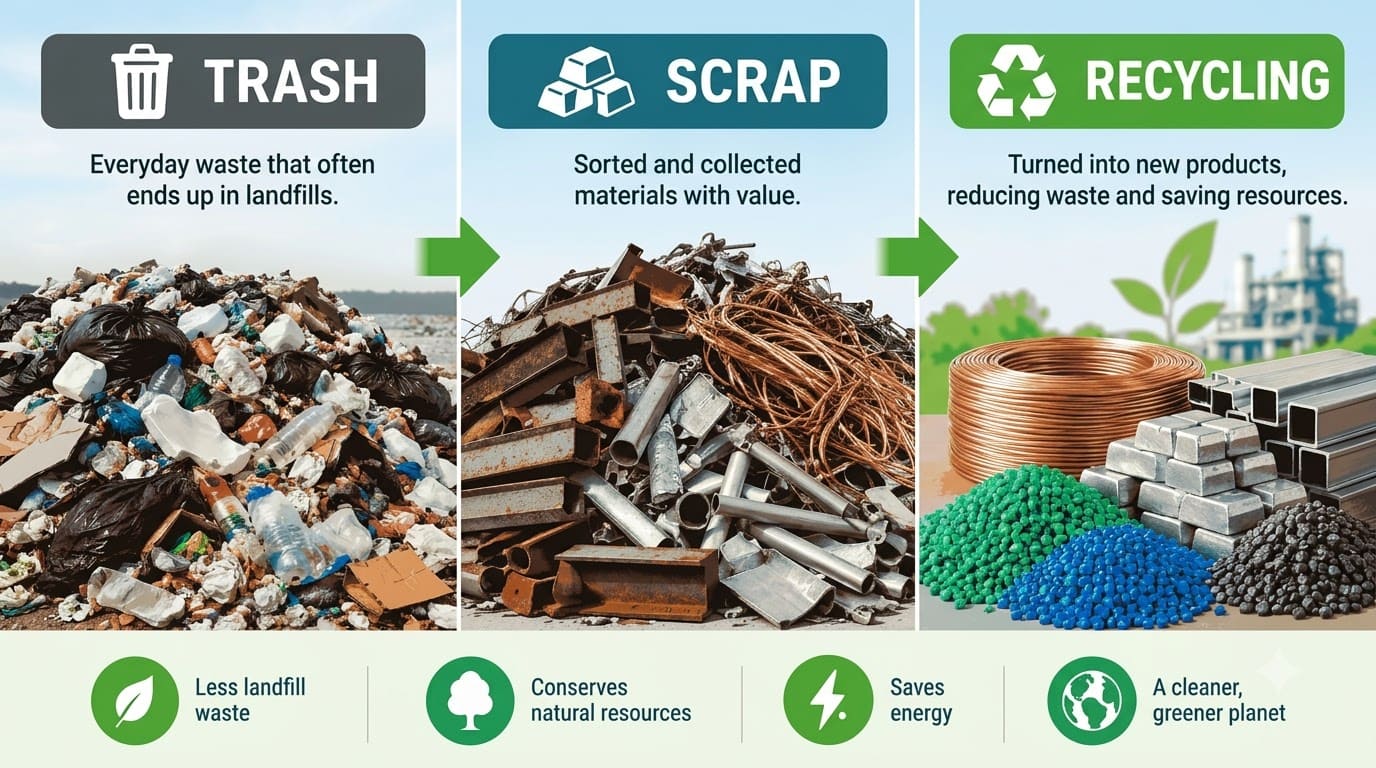
What Do You See When You Look at Scrap?
What do you see when you look at a pile of old metal, cable, machinery, offcuts or damaged equipment?
A person might see rubbish.
A business might see a disposal problem.
A scrap yard might see recoverable material.
A recycler might see feedstock.
A trader might see a commodity.
A manufacturer might see raw material.
And someone starting a scrap business should see something else:
A material flow that needs to be understood, handled safely, priced properly and connected with the right buyer.
The material itself has not changed. The perspective has.
Scrap is not automatically valuable just because it is called scrap. Its value depends on what it is made from, how clean it is, how much there is, where it is located, what it will cost to move and process, and whether a suitable buyer needs it.
That is the central lesson of the scrap economy: what appears to be waste at one point in the chain can become a useful commercial input at another.
Scrap is bigger than a pile in a yard
The global economy uses enormous volumes of materials. UNEP estimates global material extraction reached 106.6 billion tonnes in 2024. That includes metals, minerals, biomass and fossil resources used to build infrastructure, manufacture products, move goods and power economies. UNEP Global Resources Outlook 2024
Scrap matters because it gives some of those materials another route back into the economy.
The Bureau of International Recycling estimates that around 630 million tonnes of recycled steel were used in global steelmaking during 2025. BIR: World Steel Recycling in Figures
That does not mean every business can turn a pile of material into profit. It means that scrap is part of a real, global supply chain.
This guide is for two kinds of readers
This article is useful if you:
- Want to understand why scrap can have value.
- Have surplus material at home or in a business.
- Work in construction, manufacturing, demolition, transport or maintenance.
- Want to start a scrap collection, trading or recycling business.
- Want to understand what happens after material leaves a site.
- Want to buy or sell scrap more confidently.
A simple but important warning
Scrap is a commercial and operational business, not a “buy anything and hope” business.
Some materials require permits, specialist handling, environmental controls, safety processes, testing or licensed transport. Batteries, e-waste, sealed containers, chemicals, radioactive material, medical equipment and hazardous waste can create serious legal and safety obligations.
Always check the laws, licences, environmental rules, tax requirements and export restrictions that apply where you operate.
Scrap Does Not Have One Meaning
The word “scrap” often makes people think something is at the end of its life.
That may be true for the object. It is not always true for the material inside it.
An old car may no longer be roadworthy, but it can contain steel, aluminium, copper, plastics, glass, electronics and reusable components.
A factory offcut may have no use to the factory that produced it, but it may be a clean, known-grade input for another business.
A damaged cable may no longer be usable as cable, while its metal content may still be recoverable.
The object and the material are different things
A useful way to think about scrap is to separate the object from the material.
| Object | What a recycler or buyer may assess |
|---|---|
| Old vehicle | Steel, aluminium, copper, components, fluids, plastics |
| Cable | Copper or aluminium, insulation, connectors, contamination |
| Machinery | Ferrous metal, non-ferrous metal, motors, usable parts |
| Demolition material | Structural steel, rebar, copper, brass, fixtures |
| Factory offcuts | Grade, composition, cleanliness, volume, traceability |
Why this matters for a new scrap business
A beginner often makes the mistake of buying based on appearance.
An experienced operator buys based on information.
Before you quote, collect or list material, ask:
- What is the material?
- What grade is it?
- Is it ferrous or non-ferrous?
- Is it mixed?
- Is it clean or contaminated?
- How much is there?
- Is it loose, bundled, baled, shredded or attached to something else?
- Where is it located?
- What will collection, processing and transport cost?
- Who is likely to buy it?
The beginner’s rule
Never assume the apparent weight of a load equals its saleable weight.
Moisture, insulation, plastic, dirt, attachments, packaging, mixed material and inaccurate descriptions can all change the economics.
The practical lesson
The more clearly you understand the material before you buy it, the fewer surprises you face after collection.
What Scrap Looks Like to Different People
What the average person sees
Most people see the product first.
They see a broken washing machine, a damaged car panel, a pile of pipes, an old generator or construction leftovers.
They may not know whether the material contains copper, brass, aluminium, stainless steel, steel, electronics or mixed contamination.
That is normal. The average person is not expected to understand scrap grades or commodity markets.
What a business sees
A business often sees an operational issue.
Scrap can take up warehouse space, create safety risks, require handling, attract disposal costs or distract staff from core work.
Businesses generate scrap through:
- Manufacturing and fabrication.
- Construction and demolition.
- Warehousing and logistics.
- Equipment upgrades.
- Vehicle maintenance.
- Infrastructure projects.
- Packaging and distribution.
- Maintenance shutdowns.
- End-of-life assets.
The better business question
Instead of asking:
“How do we get rid of this?”
Ask:
“What material do we have, what condition is it in, and who may be able to use it?”
That shift can improve disposal decisions, reduce unnecessary mixing and help a business prepare better information for buyers.
What a scrap yard sees
A scrap yard sees a material stream that needs to be identified, weighed, sorted, priced and directed toward a suitable buyer or processor.
A yard may separate:
- Ferrous metals.
- Aluminium.
- Copper.
- Brass.
- Stainless steel.
- Lead.
- Cable.
- Machinery.
- Batteries.
- Electronic materials.
- Mixed loads.
- Residue and contamination.
Sorting creates value
Sorting does not magically make every load valuable. It reduces uncertainty.
A buyer is more likely to assess a load accurately when the material is clearly described and separated.
For example, “mixed metal” tells a buyer very little.
“Clean copper cable with insulation, estimated quantity, location and photos” gives a buyer much more useful information.
Why two similar piles can have different value
Two loads may look alike from a distance, yet have very different economics.
One may be:
- Consistent in grade.
- Clean and dry.
- Free of attachments.
- Easy to load.
- Located near a buyer.
- Supported by clear photographs and weights.
The other may be mixed, contaminated, poorly described, hard to access or expensive to transport.
That difference is why scrap is not priced by appearance alone.
How Recyclers See Scrap
A recycler is not simply buying a story about where a material came from.
A recycler is assessing what can be recovered from it.
Recyclers see feedstock
A recycler may ask:
- What can be recovered?
- What process is required?
- Can the material be separated mechanically?
- Does it need shredding, baling, shearing, stripping, melting or refining?
- Does it contain contaminants?
- Can the output meet a buyer’s specification?
- Is there enough volume to justify processing?
- Is there demand for the recovered material?
Scrap can become a manufacturing input
This is the point at which “scrap” becomes “secondary raw material.”
The material may be processed into a form that a manufacturer can use: shredded steel, sorted aluminium, processed copper, prepared metal grades or other recovered inputs.
The product may have reached the end of its first life. The material may not have.
Aluminium is a useful example
The International Aluminium Institute estimates that recycled aluminium requires around 95.5% less primary energy than primary aluminium production, based on its global lifecycle modelling. International Aluminium Institute
That does not mean every aluminium item can be recycled without effort. Aluminium grades, coatings, attachments, contamination and collection systems all matter.
It does show why material recovery matters to industry.
Copper shows why collection matters
The International Energy Agency reports that secondary supply, including direct-use scrap, accounted for 33% of total copper demand in 2023. IEA: Recycling of Critical Minerals
Copper is used widely in electrical systems, buildings, motors, infrastructure and energy technologies. Recovering it responsibly is not only about waste reduction; it is also part of material supply.
The Journey of Scrap: From Waste to New Product
This is the centre of the article and the part every new scrap-business operator should understand.
Material is generated ↓ Collected and transported ↓ Sorted, described and assessed ↓ Listed, sold or transferred ↓ Inspected and processed ↓ Recovered material is prepared ↓ Material becomes a manufacturing input ↓ New products are created ↓ The cycle begins again
Stage 1: Material is generated
Scrap is generated when a product, project or process produces surplus material.
This can happen in:
- Homes and households.
- Factories and workshops.
- Construction sites.
- Demolition projects.
- Vehicle fleets.
- Warehouses.
- Infrastructure upgrades.
- Manufacturing lines.
- Maintenance operations.
What a new scrap business should do
Do not try to collect every type of material from every type of customer.
Start by identifying one accessible source stream.
Examples include:
- Clean fabrication offcuts.
- Cable from electrical contractors.
- Non-ferrous metal from workshops.
- Ferrous demolition material.
- End-of-life machinery from industrial sites.
- Packaging or reusable materials from local businesses.
Why focus matters
A new operator who understands one material stream can build better pricing, collection and buyer relationships than someone who collects anything without a plan.
Stage 2: Material is collected and transported
Collection is where the material becomes a real operational responsibility.
It needs safe access, suitable vehicles, labour, loading equipment, documentation and a destination.
Questions to answer before collection
- Is the material safe to handle?
- Is it owned by the seller?
- Are there restricted or hazardous components?
- Is the stated quantity realistic?
- Can a vehicle access the site?
- Is loading equipment available?
- Is the material dry, loose, baled, boxed or attached?
- Will the customer need weight records?
- Where will the material go after collection?
A common beginner mistake
Do not collect material simply because it is “free.”
Free material can still cost money to load, sort, store, transport, process and dispose of.
Your first unit-economics calculation
Before collection, estimate:
Expected sale revenue − purchase price − collection labour − vehicle/fuel cost − loading cost − sorting/processing cost − storage cost − transport to buyer − expected loss or contamination = estimated margin
If you do not understand the likely margin before collection, you are guessing.
Stage 3: Material is sorted, described and assessed
This is where value is often protected or lost.
A mixed load is not always bad, but mixed loads often create more uncertainty and more processing work.
Better material information creates better buyer confidence
A strong description may include:
- Material type.
- Grade, if known.
- Estimated quantity.
- Photos from several angles.
- Location.
- Condition.
- Known contamination or attachments.
- Loading arrangements.
- Whether weights are estimated or verified.
- Whether inspection is available.
Example
Weak listing:
“Scrap metal available.”
Better listing:
“Approximate 4 tonnes of mixed aluminium extrusion and sheet offcuts from fabrication work. Material is dry, stored under cover, loaded in bins, located in Melbourne. Photos available. Buyer to inspect before collection.”
The second listing does not promise more than the seller knows. It gives a buyer enough detail to decide whether to ask questions.
Stage 4: Material enters the market
Once material has been described, it can be offered to known buyers, local yards, processors, traders or a marketplace.
This is where scrap becomes a commercial opportunity rather than just a disposal task.
The buyer is not always the processor
A buyer may be:
- A local yard.
- A trader.
- A recycler.
- A processor.
- A manufacturer.
- A broker.
- A specialist materials buyer.
A buyer may purchase material because they have an immediate end use, because they can aggregate it, because they have a better logistics route or because they know another buyer who needs it.
Stage 5: Buyers assess suitability
A buyer will usually assess more than price.
They may consider:
- Grade.
- Chemistry or composition.
- Quantity.
- Moisture.
- Contamination.
- Documentation.
- Origin.
- Packaging.
- Loading access.
- Distance.
- Payment terms.
- Inspection rights.
- Regulatory requirements.
Inspection protects both sides
Inspection is not a sign of distrust. It is a normal part of many material transactions.
For higher-value or cross-border material, inspection, weighbridge tickets, photographs, sampling, certificates or third-party verification may be important.
A good operator learns to welcome clear inspection processes because they reduce disputes later.
Stage 6: Material is processed
Processing depends on the material.
It can include:
- Cutting.
- Shearing.
- Baling.
- Shredding.
- Sorting.
- Magnetic separation.
- Cable stripping.
- Granulation.
- Cleaning.
- De-coating.
- Sampling.
- Testing.
- Melting.
- Refining.
Not every business needs to process material itself.
Choose your role carefully
A scrap business can operate at different points in the chain:
| Model | Main role | Typical challenge |
|---|---|---|
| Collector | Collects material from generators | Transport and volume |
| Trader | Connects supply with buyers | Information and trust |
| Yard/aggregator | Sorts and combines loads | Storage, equipment, compliance |
| Processor | Upgrades material | Capital, technology, safety |
| Specialist recycler | Recovers specific materials | Technical and regulatory complexity |
A sensible way to start
Many businesses begin with collection, trading or aggregation before investing in expensive processing equipment.
Owning a shredder, shear, baler or specialised separation line may create opportunities, but it also brings maintenance, labour, compliance, energy and capital costs.
Stage 7: Recovered material is prepared
The goal is not always to turn material into a finished product.
The goal may be to prepare a consistent input that meets the next buyer’s requirements.
For example, recovered material may need to be:
- Sized correctly.
- Sorted by grade.
- Free of excessive contamination.
- Packed appropriately.
- Tested or documented.
- Ready for transport.
- Ready for a furnace, mill or manufacturing process.
Stage 8: Material becomes a manufacturing input
This is the point people often miss.
A manufacturer may not describe the input as “scrap.” They may describe it as recycled content, secondary material, metal feedstock or raw material.
The language changes because the material has moved into another part of the supply chain.
Stage 9: New products are created
Recovered material can contribute to new products, equipment, infrastructure, packaging, vehicles and manufactured goods.
The exact outcome depends on the material, quality and processing route.
Steel, aluminium, copper and other metals can have multiple lives when they are collected and processed appropriately.
Stage 10: The cycle begins again
Eventually, many products reach the end of their useful life.
Then the question returns:
Is this waste, or is it material with another possible use?
How to Start a Scrap Business Without Guessing
Starting a scrap business does not begin with buying a truck or renting a yard.
It begins with choosing a clear problem to solve.
Start with one material stream
Do not begin by saying:
“I will buy all scrap.”
Begin by saying something more specific:
“I will help local fabrication businesses move clean aluminium and steel offcuts.”
Or:
“I will connect electrical contractors with cable buyers.”
Or:
“I will help demolition contractors separate and market recoverable metal.”
Why specialisation helps
Specialisation helps you learn:
- Where material comes from.
- What buyers require.
- What contamination looks like.
- What collection costs.
- Which documents matter.
- Which price drivers matter.
- Which suppliers are reliable.
- Which buyers pay on time.
Build supply before you build scale
A scrap business needs reliable material flow.
Potential supply sources include:
- Fabricators.
- Manufacturers.
- Construction contractors.
- Demolition contractors.
- Electricians.
- Plumbers.
- Vehicle workshops.
- Warehouses.
- Property managers.
- Infrastructure contractors.
- Local businesses replacing equipment.
A practical first conversation
Instead of asking:
“Do you have scrap?”
Ask:
“What surplus material do you regularly generate, how is it currently handled, and what is difficult about the process?”
This helps you understand whether the customer needs collection, bins, sorting support, documentation, faster payment, better communication or a reliable buyer.
Build buyer relationships before purchasing heavily
Do not buy large quantities without knowing where the material is likely to go.
Speak with potential buyers first.
Ask:
- What materials do you buy?
- What grades do you accept?
- What contamination is unacceptable?
- What minimum quantities are practical?
- What documentation do you need?
- How do you quote?
- What are your inspection requirements?
- Who arranges transport?
- What are payment terms?
- What causes loads to be rejected or downgraded?
A good scrap business manages risk
Profit can disappear through:
- Misidentified material.
- Contamination.
- Incorrect weights.
- High transport costs.
- Storage costs.
- Price movement.
- Buyer disputes.
- Slow payment.
- Compliance failures.
- Theft.
- Damage.
- Rejected loads.
The business is not just buying metal. It is managing information, operations and risk.
Why Scrap Has Value
Material value
Different materials have different physical properties and end uses.
Copper is valued for conductivity. Aluminium is valued for its low weight and corrosion resistance. Steel is used extensively in infrastructure and manufacturing. Brass, stainless steel and specialised alloys may have particular industrial applications.
Recovery value
Value can exist when material can be recovered and used again.
But recovery requires viable economics. A recoverable material that is too contaminated, too dispersed or too expensive to transport may not be commercially attractive in a particular location.
Market value
Markets change.
Demand can vary based on industrial production, construction activity, regional capacity, trade conditions, transport availability, currency movements and buyer requirements.
Volume value
A small quantity may not justify a truck, labour or processing time.
A larger, consistent stream may be much more useful to a buyer.
Location value
Scrap is physical.
Two identical loads can have different economics because one is near a buyer or processor and the other is far away, difficult to access or expensive to export.
Scrap Is Not Literally Gold
People sometimes call scrap “gold” because valuable material can be hidden in ordinary-looking objects.
It is a useful metaphor, but it should not create false expectations.
Not every pile of scrap is profitable.
Not every metal grade is in strong demand.
Not every buyer is suitable.
Not every transaction works after transport, processing, inspection and payment risks are considered.
The better message is this:
Scrap can have value when the material can be identified, recovered, moved and used again in a commercially viable way.
That is more accurate than hype, and it is more useful to anyone starting a scrap business.
The Circular Economy Needs More Than Recycling
Recycling does not happen simply because a material is recyclable.
It needs:
- Collection.
- Sorting.
- Safe handling.
- Processing.
- Buyers.
- Logistics.
- Market demand.
- Economics.
- Regulation.
- Trust between participants.
The global e-waste challenge demonstrates this clearly. UNITAR and the ITU estimate that 62 million tonnes of e-waste were generated in 2022, but only 22.3% was documented as properly collected and recycled. Global E-waste Monitor 2024
A material can be technically recoverable but still fail to return to the economy if the systems around it do not exist.
That is why collection, trading, processing and manufacturing all matter.
Where ScrapTrade Fits Into the Picture
ScrapTrade is the marketplace layer of the process.
The purpose is to help people and businesses with material put it in front of potential buyers, while helping buyers discover relevant supply opportunities.
A strong marketplace listing should answer practical questions:
- What is available?
- What is it made from?
- How much is there?
- Where is it located?
- What condition is it in?
- Are there photographs?
- Can it be inspected?
- What are the loading arrangements?
- What does the seller expect?
- What does the buyer need to verify?
The platform cannot remove the need for inspection, due diligence, commercial terms or compliance.
It can make the first connection easier.
Frequently Asked Questions
What is scrap?
Scrap is material that is no longer used in its original form but may still be recyclable, recoverable, reusable or tradable.
Why does scrap have value?
Its value can come from the material it contains, recovery potential, buyer demand, quantity, condition, location and processing requirements.
Is all scrap valuable?
No. Value varies significantly. Some material may cost more to collect, process or transport than a buyer is willing to pay.
What happens after scrap is collected?
It may be weighed, sorted, inspected, traded, processed and prepared as a secondary raw material for manufacturing.
How do scrap yards make money?
Scrap yards typically create value through buying, collecting, sorting, aggregating, processing and selling material to suitable downstream buyers.
How can I start a scrap business?
Start with one material stream, identify reliable suppliers, understand buyer requirements, calculate collection and transport costs, follow local regulations and avoid purchasing material you cannot confidently identify or sell.
What is scrap trading?
Scrap trading is the buying and selling of recyclable or recoverable materials between suppliers, collectors, yards, traders, recyclers, processors and manufacturers.
Can scrap become a new product?
Often, yes. Materials such as steel, aluminium and copper can be recovered and used in new manufacturing, subject to quality, technical, economic and regulatory requirements.
Scrap Is Only Waste If We Stop Looking at Its Potential
What looks like waste can become material.
What looks like excess can become inventory.
What looks like a disposal problem can become a supply opportunity.
What looks like an old product can become a recovered raw material.
The most important question is not:
“What is this worth today?”
It is:
“What could this become next, and who may need it?”
For businesses, that question can lead to better material management.
For recyclers, it can lead to better recovery.
For manufacturers, it can lead to more secondary material supply.
For a new scrap-business operator, it can become the starting point for a real business: understand the material, understand the costs, understand the buyer and build trust at every step.
Have material sitting around your business? List it on ScrapTrade, describe it accurately and put it in front of potential buyers.