

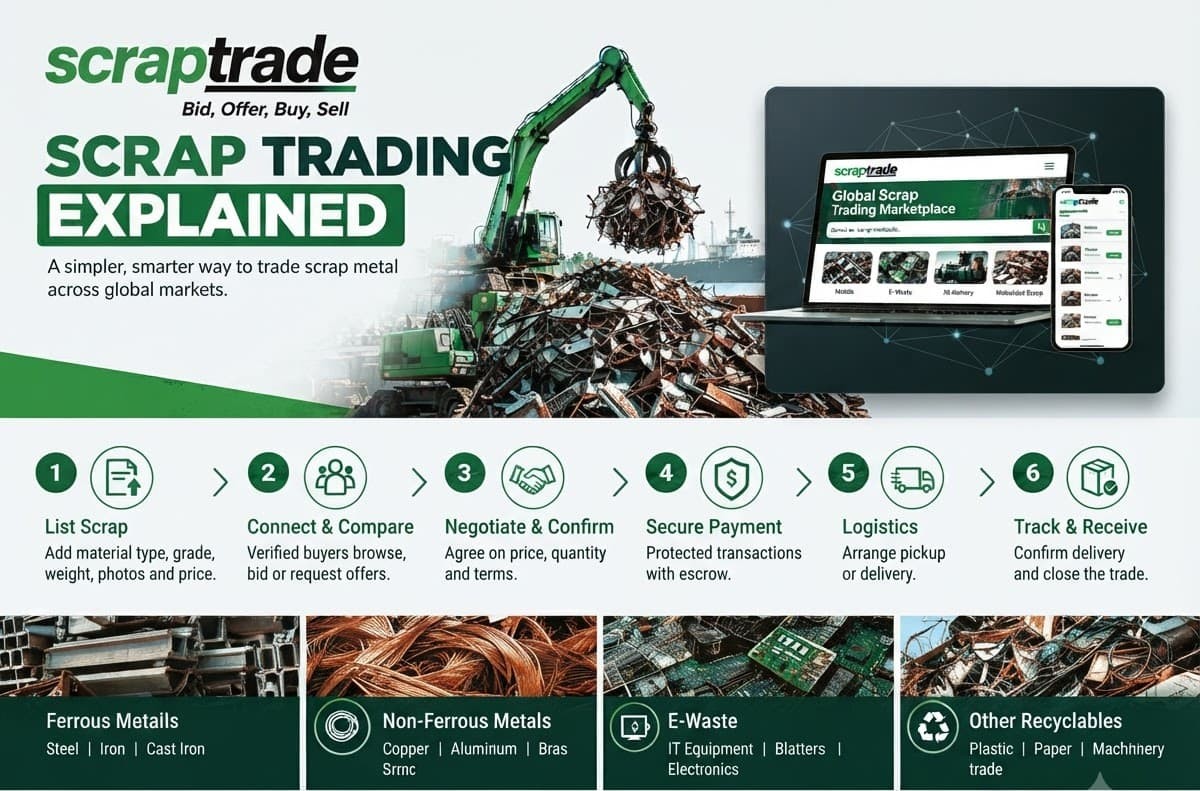
Scrap trading is the process of buying and selling recyclable materials between businesses, traders, recyclers, processors, manufacturers, and other commercial buyers and sellers. It can involve everything from local scrap transactions to large international B2B deals involving containers, trucks, or bulk shipments.
For newcomers, scrap trading can seem complicated because every transaction may involve different materials, grades, quantities, prices, locations, payment terms, and delivery arrangements. However, the basic process is straightforward: a seller makes material available, buyers review the opportunity, both sides negotiate suitable terms, and the transaction moves toward payment and delivery.
Digital marketplaces are making this process more accessible by bringing listings, buyers, sellers, offers, and trading information into one online environment.
What Scrap Trading Means
At its simplest, scrap trading connects available recyclable material with a buyer who wants to purchase it.
A seller may have copper wire, aluminium scrap, steel, brass, e-waste, machinery, vehicles, plastics, paper, or another recyclable material. Instead of keeping the material within a local network, the seller can present the opportunity to potential buyers.
The buyer then evaluates the listing based on factors such as material type, grade, quality, quantity, location, price, and commercial terms.
Scrap trading can happen at different levels. A small business might sell accumulated metal to a local buyer, while a large industrial supplier may trade hundreds of tonnes with an overseas recycling company or processor.
The underlying principle remains the same: buyers seek suitable material, sellers seek suitable buyers, and both parties agree on commercial terms before completing the transaction.
In B2B scrap trade, the transaction can also involve inspections, documentation, logistics, payment arrangements, and verification.
The Scrap Trading Process, Step by Step
Although individual transactions vary, most scrap trading follows a similar sequence.
Listing
The process often starts when a seller creates a listing describing the available material.
A useful listing should provide enough information for potential buyers to understand the opportunity without having to ask basic questions repeatedly.
Important information can include:
- Material type and grade
- Available quantity
- Location
- Quality or specifications
- Photos or supporting information
- Asking price or minimum acceptable price
- Pickup or delivery information
- Relevant commercial terms
For example, a seller listing copper scrap should clearly describe the type of copper, estimated quantity, location, and other information that could affect buyer interest.
The more accurately the material is described, the easier it becomes for relevant buyers to evaluate it.
On a digital scrap marketplace, a listing can be made visible to potential buyers beyond the seller's immediate network. This can be particularly useful for businesses looking to reach buyers in other regions or countries.
Bidding and Negotiation
Once a listing is available, interested buyers can evaluate the material and decide whether to make an offer.
Depending on the trading platform and transaction structure, buyers may submit bids or communicate with the seller about pricing and terms.
Price is only one part of the negotiation. The parties may also need to discuss quantity, grade, inspection, payment, pickup, shipping, delivery terms, and timing.
For international transactions, logistics and trade terms can have a significant impact on the economics of a deal. A price that appears attractive initially may need to be reconsidered after transportation and other transaction costs are understood.
Negotiation therefore involves looking at the complete transaction rather than focusing only on the headline price.
A seller may compare multiple buyer offers, while a buyer may compare several available listings before deciding which opportunity fits its requirements.
Payment and Delivery
After the buyer and seller agree on the commercial terms, the transaction moves toward payment and delivery.
The exact payment process depends on the parties, transaction value, location, and agreed terms. Businesses may establish payment conditions before material is released, while other transactions may involve payment arrangements linked to pickup, delivery, inspection, or other milestones.
Logistics also need to be agreed. Depending on the transaction, the buyer or seller may arrange transportation, or the parties may coordinate with a logistics provider.
For international scrap trading, additional considerations can include export and import documentation, customs requirements, freight arrangements, insurance, and destination requirements.
The important point is that the transaction does not end when a price is agreed. Payment, collection, transportation, documentation, and delivery all need to be handled according to the agreed terms.
Ferrous vs Non-Ferrous Trading Basics
One of the first distinctions newcomers encounter in scrap trading is the difference between ferrous and non-ferrous scrap.
Ferrous scrap contains iron and includes materials such as carbon steel and many forms of steel scrap. It is widely generated through construction, manufacturing, demolition, automotive, and industrial activities.
Non-ferrous scrap does not primarily consist of iron. Common examples include copper, aluminium, brass, and other non-ferrous metals.
The distinction matters because different materials have different grades, specifications, processing requirements, and market values.
| Scrap Category | Common Examples | Trading Considerations |
|---|---|---|
| Ferrous | Steel, iron, HMS | Grade, composition, contamination, quantity |
| Non-ferrous | Copper, aluminium, brass | Purity, grade, attachments, quality |
| E-waste | Electronic components and equipment | Material composition, recovery value, processing |
| Mixed recyclable materials | Plastics, paper, cardboard | Type, quality, contamination, volume |
Within each category, the exact grade can make a major difference to buyer requirements and pricing.
This is why sellers should avoid describing material simply as “metal scrap” when more specific information is available. Clear descriptions help buyers determine whether the material matches their purchasing requirements.
Traditional Trading vs Online Scrap Trading
Traditional scrap trading has historically relied on personal relationships, local contacts, phone calls, emails, brokers, scrap yards, and direct negotiations.
These methods remain important, particularly where physical inspection and established relationships are involved. However, they can make it difficult for businesses to discover new trading partners outside their existing network.
Online scrap trading introduces a digital layer to the process.
Instead of relying only on contacts they already know, buyers and sellers can use an online marketplace to discover listings, present requirements, communicate with potential counterparties, and evaluate opportunities.
The difference can be summarized as follows:
| Traditional Scrap Trading | Online Scrap Trading |
|---|---|
| Relies heavily on existing networks | Expands digital discovery |
| Manual listing and communication | Online listings and communication |
| Often focused on local contacts | Can support wider geographic reach |
| Separate tools for different activities | Trading information can be centralized |
| Buyer searches may be time-consuming | Buyers can browse available listings |
| Negotiations often happen offline | Offers and discussions can begin online |
Online trading does not remove the need for verification, negotiation, inspection, logistics, or commercial judgment. Instead, it provides another channel for finding and managing scrap trading opportunities.
A global marketplace can be particularly useful for businesses looking to connect with buyers and sellers beyond their local market.
FAQs
What is scrap trading?
Scrap trading is the buying and selling of recyclable materials between businesses, traders, recyclers, processors, manufacturers, and other buyers and sellers. It can involve materials such as steel, copper, aluminium, brass, e-waste, vehicles, machinery, plastics, and paper.
How does scrap trading work?
A typical transaction begins with a seller offering material for sale. Buyers review the material, submit an offer or negotiate with the seller, and both parties agree on price and other terms. The transaction then moves to payment, pickup or shipping, documentation, and delivery.
What is the difference between ferrous and non-ferrous scrap?
Ferrous scrap contains iron and includes many types of steel and iron scrap. Non-ferrous scrap does not primarily contain iron and includes materials such as copper, aluminium, and brass. Each category has different grades and buyer requirements.
Can scrap be traded internationally?
Yes. Scrap can be traded across borders when the transaction complies with applicable export, import, customs, environmental, documentation, and transportation requirements. International transactions require more planning than many local trades.
Conclusion
Scrap trading is fundamentally about connecting recyclable material with a suitable buyer and agreeing on workable commercial terms.
The process typically moves from listing and discovery to bidding or negotiation, followed by payment, logistics, and delivery. Material knowledge, accurate descriptions, verification, and clear communication are important at every stage.
Traditional relationships remain valuable, but online marketplaces are giving buyers and sellers another way to discover trading opportunities and expand beyond their existing networks.
For businesses ready to explore digital B2B scrap trading, start trading scrap online with ScrapTrade and discover a global marketplace for buyers and sellers.