

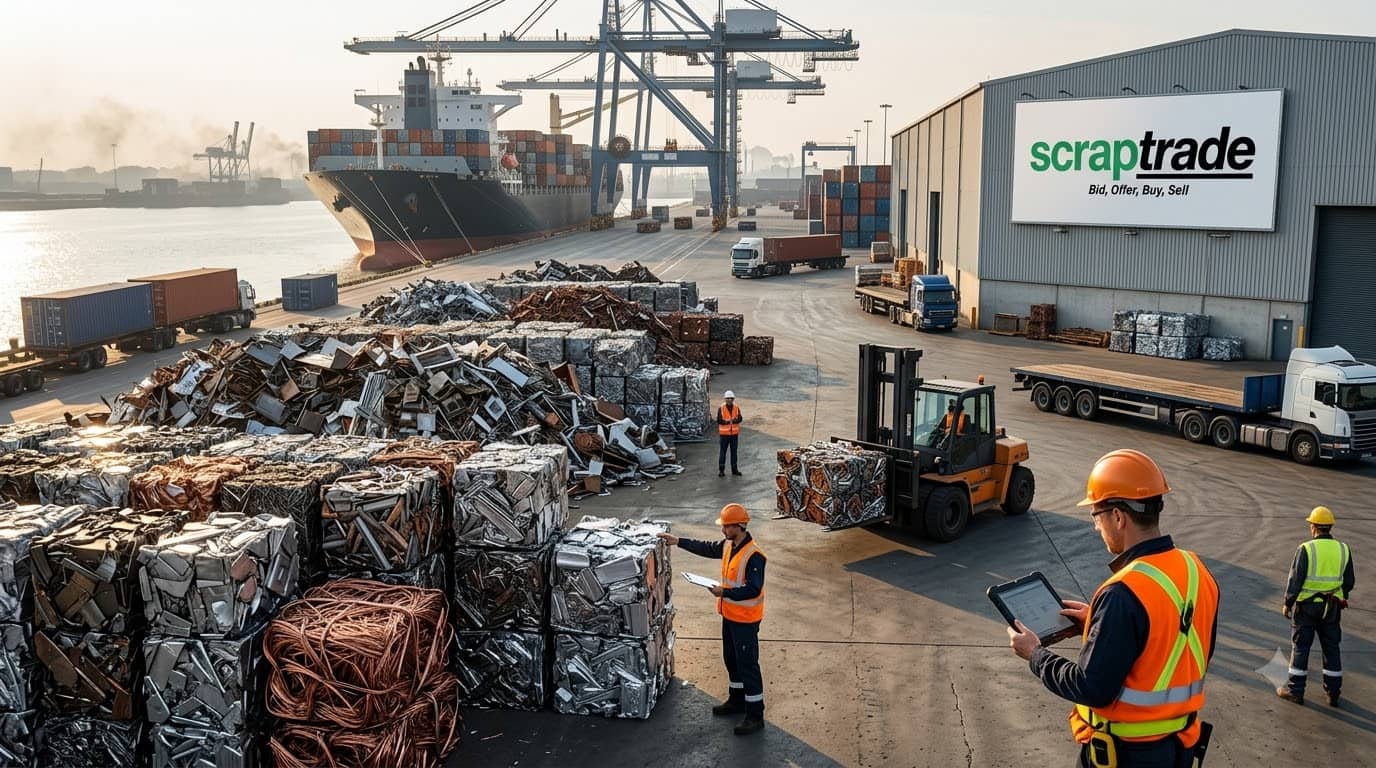
Why Sell Scrap in Bulk?
The global scrap metal recycling market, valued at $436.11 billion in 2025, relies heavily on high-volume distribution channels to satisfy the raw material demands of international industrial manufacturing. Transitioning from localized, small-batch transactions to large-scale bulk trading represents a fundamental operational evolution for scrap processors, recycling yards, and industrial manufacturing facilities. Freight economics form the primary incentive for this operational shift, as transporting metal scrap in small, fragmented lots creates severe cost inefficiencies. Fixed logistics overheads including truck drayage, customs entry filings, terminal handling charges, and ocean container freight remain relatively static regardless of parcel mass. Consequently, shipping a partial load of 2 metric tons (MT) often incurs total handling expenses comparable to shipping a full 20 MT payload, creating a steep per-ton freight penalty that destroys net operating margins. Selling in bulk amortizes these fixed expenditures across maximum container capacities, driving down unit transport costs.
Beyond immediate logistics savings, volume trading unlocks direct access to primary industrial buyers, including secondary aluminum smelters, re-rolling mills, and Electric Arc Furnace (EAF) steelworks. These industrial consumers operate continuous-melt operations requiring steady, high-volume feedstock and consequently bypass small-tier brokers in favor of suppliers capable of delivering standardized bulk lots. Establishing bulk supply capabilities allows recyclers to negotiate directly with tier-1 consumers, capture superior pricing spreads, and secure long-term forward off-take contracts. Broadening commercial reach through a structured B2B scrap trade platform enables suppliers to establish resilient global distribution networks while mitigating exposure to localized demand downturns.
What Counts as a Bulk or Container-Load Lot
In commercial scrap metal trading, a bulk lot refers to a standardized, high-volume shipment of recyclable metal offered as a unified trade consignment. Internationally, bulk metal cargo moves through two main freight configurations: Full Container Load (FCL) shipping via intermodal ocean containers and break-bulk charter vessels for large-scale mill deliveries.
The standard 20-foot General Purpose (20GP) ocean container serves as the primary transport vessel for global scrap logistics, capable of holding payloads between 20 and 27 metric tons depending on metal density and road haulage axle limits at origin and destination ports. Modern container ships carrying over 23,000 TEU require significant draft depths and heavy quay-side gantry crane infrastructure, anchoring the modern supply chain around containerized shipping. High-density commodities such as Heavy Melting Steel (HMS 1&2), shredded scrap, busheling, and cut used rails reach maximum container payload weights within a standard 20GP container long before occupying its cubic volume. Lower-density commodities, such as unbaled aluminum extrusions, often utilize 40-foot containers (40GP) to fit payloads of 22 to 26 metric tons. High-volume items like Used Beverage Cans (UBC) rely on hydraulic baling into 500-kg mill-size bales to maximize payload density up to 24 MT per 20GP container. For large industrial contracts, break-bulk carriers carrying 5,000 to 55,000 MT load loose scrap directly from port facility yards to supply overseas smelters and steel mills.
| Metal Grade & ISRI Designation | Primary Shipping Vessel | Standard Payload / Lot Size | Physical Form & Loading Specifications |
|---|---|---|---|
| Heavy Melting Steel (HMS 1&2) | 20GP Container / Break-Bulk | 25–27 MT (20GP) / 45,000–55,000 MT (Bulker) | Cut sections, heavy structural steel, plate |
| Shredded Steel (ISRI 210/211) | 20GP Container / Break-Bulk | 25–27 MT (20GP) | Magnetically separated, free-flowing fragments |
| Used Steel Rails (R50 / R65) | 20GP Container / Break-Bulk | 25–27 MT (20GP) | Cut to standard 1.5m lengths, bundled |
| Aluminum Extrusion Scrap 6063 | 20GP / 40GP Container | 20–24 MT (20GP) / 22–26 MT (40GP) | Clean profiles, loose or strapped bundles |
| Used Beverage Cans (UBC) | 20GP Container | 24 MT (20GP) | High-density 500-kg mill-size bales, steel strapped |
| Aluminum Dross & Sow Ingots | 20GP Container / Break-Bulk | 22–25 MT (20GP) / 5,000–15,000 MT (Bulker) | Stacked hardwood pallets, PET strapping, desiccant liners |
Minimum Order Quantities Explained
A Minimum Order Quantity (MOQ) defines the smallest operational volume a supplier will process, package, and ship under a single commercial purchase agreement. Sellers establish MOQs to guarantee that every order covers baseline operational overhead, drayage costs, customs documentation fees, and yard handling expenses.
In international maritime trade, the baseline standard MOQ is 20 to 25 metric tons, matching the payload capacity of a single 20GP container. Attempting to trade sub-container volumes via Less than Container Load (LCL) freight creates severe cost penalties, as fixed terminal handling and drayage fees are distributed across fewer tons, inflating per-unit landed costs. While low-MOQ options (1 to 5 MT) exist for market testing or trial shipments via order pooling and freight consolidation, scaling to standard container loads provides the most cost-effective procurement model.
| Procurement Configuration | Typical MOQ Threshold | Per-Unit Cost Impact | Ideal Buyer Application | Key Commercial Considerations |
|---|---|---|---|---|
| Low MOQ (Trial / Spot) | 1–5 Metric Tons | High (+15% to +25% premium) | Market testing, alloy validation, new vendor vetting | Requires order pooling or LCL consolidation; high drayage penalty |
| Low MOQ (Standard ODM) | 1–5 Metric Tons | Medium (+10% to +15% premium) | Standard grade testing, small-scale foundries | Generic specifications, fast lead times, lower QC customizability |
| Standard Container MOQ | 20–25 Metric Tons | Baseline / Optimal Efficiency | Medium scrap yards, regional processors | Standard ocean drayage, single sealed 20GP container |
| High Bulk / Contract MOQ | 50+ to 1,000+ Metric Tons | Low (-5% to -10% discount) | Large secondary smelters, integrated steel mills | Requires substantial working capital, exposes seller to market volatility |
How Bulk Pricing Is Typically Set
Bulk scrap pricing relies on established commodity benchmarks, primarily the London Metal Exchange (LME) for non-ferrous metals and Fastmarkets or Platts indices for ferrous grades. Rather than using fixed retail pricing, commercial contracts apply formulaic pricing models that account for alloy purity, physical preparation, impurity levels, and freight logistics.
Quality factors significantly drive these pricing spreads 1 . In aluminum 6063 scrap trading, clean extruded profiles (minimum 97.5% aluminum content) trade near index levels (LME minus $\$80$ to $\$130$/MT) 2 . Mixed or painted extrusion profiles face wider discounts (LME minus $\$130$ to $\$200$/MT), while fine turnings and swarf face heavy deductions (LME minus $\$200$ to $\$300$/MT) due to higher oxidation rates during remelting 2 . A thorough understanding of how scrap metal pricing works allows sellers to optimize yard processing routines and secure favorable index discounts 1 . Furthermore, agreed Incoterms such as Free on Board (FOB) versus Cost, Insurance, and Freight (CIF) determine whether the buyer or seller assumes transport costs and transit liability 3 .
Preparing a Large Lot (sorting, weighing, loading)
Preparing bulk scrap lots for shipment requires strict quality assurance and standardized operational routines to ensure compliance with contract specifications and prevent port rejections. Effective execution of scrap metal shipping logistics begins at the recycling facility during inventory sorting and consolidation.
Processors must categorize material according to Institute of Scrap Recycling Industries (ISRI) standards. Ferrous streams require magnetic separation to remove residual non-magnetic contaminants, ensuring chemical purity targets are met such as maintaining residual copper levels below 0.25% in shredded steel. Multi-grade orders must be processed and packed into separately sealed containers, each backed by an individual ISRI grade declaration.
Accurate weight verification is critical for financial settlement and customs clearance. Operating facilities must execute calibrated weighbridge protocols, recording the gross weight, empty vehicle tare weight, and net payload weight. Certified weighbridge slips prevent post-shipment quantity disputes at the destination port.
Intermodal containers must be inspected for structural soundness, swept clean, and lined prior to loading. Moisture-sensitive cargoes, such as aluminum dross or loose turnings, require heavy-duty desiccant liners to prevent in-transit oxidation or chemical degradation. Payloads must be evenly distributed across the container floor to satisfy international highway axle-weight laws. Upon completion, every container is photographed sequentially from empty to fully loaded and secured with an ISO/PAS 17712 certified bolt seal.
Finding Buyers for Large Volumes
Securing reliable off-take partners for bulk scrap volumes requires a multi-channel commercial strategy aligned with buyer processing capabilities and geographic demand. Suppliers must diversify their sales channels across direct industrial end-users, digital trading networks, and international trade intermediaries.
Large integrated steel mills and secondary smelters represent the top tier of scrap procurement, requiring thousands of metric tons monthly. These direct end-users require strict chemical consistency and enter long-term supply agreements, providing stable volume off-take at predictable benchmark spreads. Direct contracting with EAF operators eliminates intermediary fees and yields the highest net price realization.
For independent recycling yards lacking the scale for direct mill contracts, digital B2B trading platforms provide access to global buyer networks. These platforms aggregate smaller regional parcels into standard 20–25 MT container lots, giving regional yards access to export pricing previously reserved for major industrial aggregators.
Suppliers can further tailor their outreach by offering OEM or ODM supply configurations. Under OEM arrangements, scrap yards provide custom processing such as specialized sizing, briquetting, or alloy sorting to meet specific foundry melt requirements. Under ODM arrangements, yards supply standard, off-the-shelf ISRI grades, enabling rapid contract execution and streamlined supply chains for price-sensitive buyers.
Payment and Risk on Large Deals
Given the high monetary value of multi-container and break-bulk scrap shipments, establishing secure financial structures and risk mitigation protocols is vital. International trade relies heavily on banking instruments to protect both buyers and sellers across different regulatory jurisdictions.
Documentary Letters of Credit (DLC MT700) and Standby Letters of Credit (SBLC) serve as the standard payment mechanisms in cross-border scrap trade. An irrevocable DLC guarantees payment from the issuing bank upon presentation of verified shipping documents, including ocean bills of lading, weighbridge certificates, customs export declarations, and pre-shipment inspection certificates. Alternative commercial terms may utilize split deposit structures such as a 20% to 30% advance deposit following on-site facility inspection, with the remaining balance settled cash-against-documents (CAD) post-loading.
To eliminate quality disputes, commercial contracts mandate pre-shipment commodity inspections (PSI) conducted by independent testing agencies such as SGS, CCIC, Intertek, or Bureau Veritas. Inspectors audit cargo quality, verify weight, check for impurities, and test for radiation or hazardous materials prior to container sealing.
Sellers often support contract terms by issuing a 2% Performance Bond (PB) to the buyer's bank upon receipt of an operative DLC or SBLC. The performance bond activates the buyer's credit instrument and provides financial recourse in the event of non-delivery, establishing a secure framework for large-scale international scrap trade.
FAQs
What constitutes the standard minimum payload for an export container of scrap metal?
The standard baseline payload for exporting scrap metal in a 20-foot General Purpose (20GP) ocean container is 20 to 25 metric tons. Denser ferrous grades, such as cut used rails or structural steel, routinely reach maximum payload limits of 25 to 27 metric tons per container.
How are official weights determined and verified in bulk scrap transactions?
Commercial weight determination relies on certified weighbridge scale records generated at the origin facility or port terminal. The procedure records the gross weight, empty tare weight, and net payload weight, which are certified by independent inspection agencies like SGS or CCIC to produce final documentation for settlement.
Why do sub-container or low MOQ orders carry significant per-ton price markups?
Sub-container orders incur fixed administrative, drayage, and customs clearance charges that do not decrease for smaller volumes. Distributing these fixed costs over a small parcel of 1 to 5 metric tons creates a 10% to 25% per-ton cost premium compared to a full 25-ton container load.
Which party bears the cost of independent pre-shipment commodity inspections?
Under standard international commercial practice (CIF or FOB terms), pre-shipment commodity inspections (PSI) at the port of loading are paid by the seller. Subsequent post-shipment inspections conducted at the destination discharge port are paid by the buyer.
Sources used in the report
Low MOQ Metal Scrap Sourcing on Alibaba.com
Cargo Work; For Maritime Operations - Mariner Edition
Selling Scrap in Bulk: Container Loads, and Minimum Orders
Aluminum Scrap Supplier | UBC, 6061, 6063 Bulk from Rotterdam
Aluminium Extrusion Scrap 6063 Suppliers - Nautica Metal Scrap B.V.
Ferrous Scrap — HMS 1&2, Shredded, Rails, Busheling Complete
Introduction to Maritime Operations - DOKUMEN.PUB
Cast Iron Buyers & Importers | go4WorldBusiness.com
Copper Wire Scrap Export Offer | PDF | Letter Of Credit - Scribd
Metal Scrap Export Process | Rotterdam Loading to Buyer's Port
Export Controls, Bills of Lading and Arrival Inspection - Guilin Metals
Heavy melting scrap import from Germany to South India - Facebook
Copper Cable Scrap Buyers & Importers in China
Optimizing Cross-Border Trade Finance Through Digital Tracking