

22 October 2026. ScrapTrade has added two roles for people who want to earn from the scrap trade without owning a yard or a fleet: the scrap agent and the scrap broker. An agent works for a seller or buyer and is paid a commission. A broker sources scrap from someone else, resells it on the platform and keeps the margin. Both are built for newcomers who would rather start an online scrap business with a small outlay than with a site, machinery and a lease.
The names sound close but the roles are not. Which one fits you depends mostly on one question: do you want to hold the position in the material, or do you want to be paid for doing the work? This announcement answers that with the rules as ScrapTrade has defined them, worked examples using invented figures, an honest look at the costs, and a list of what to confirm before you begin. It is published by ScrapTrade about its own product and promises no income.
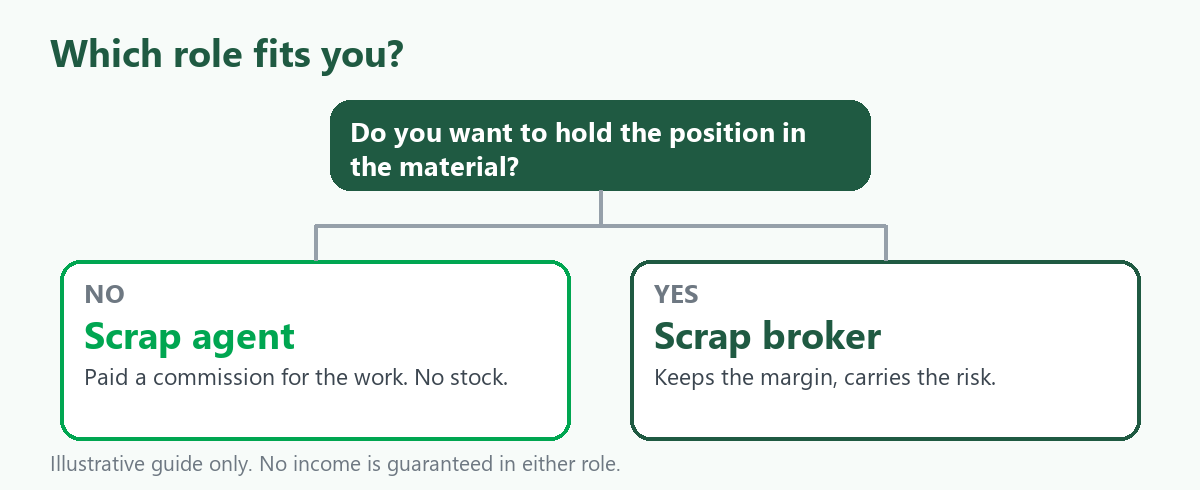
One question decides it: if you do not want to risk money on material, be an agent. If you can judge a market, absorb a loss and want the upside of a margin, consider being a broker.
The two roles side by side
| Scrap agent | Scrap broker | |
|---|---|---|
| Appointed by | A seller or buyer, through a hiring agreement | Nobody. A broker operates independently |
| Main task | Create listings or requests, or run the deal, for the client | Source scrap from an original seller and list it |
| Earns | A percentage commission | A margin between the buying and selling price |
| Rate set by | The hirer, with a 5% default | The broker and original seller, privately |
| Can the rate change? | Only before the agreement is confirmed. Then it is locked | As agreed between the two of them |
| Platform role in the money | Calculates the commission and shows each party a breakdown | Does not calculate, deduct or distribute the margin |
| Who the platform treats as the seller | The client | The broker |
Scrap agent: paid for the work
Who hires an agent and why
Hiring an agent makes sense for a seller who has scrap but not the time to describe, photograph and list it, a seller unsure how to present a mixed load, a buyer who needs specific material and would rather someone screened the options, and a business whose scrap sales are too occasional to justify staff. The agent does the work, and the client keeps the deal.
What the client can hand over
- Listings only. The agent describes, photographs and publishes the material. The client deals with buyers.
- Deal only. The client creates the listing. The agent handles questions, negotiation and collection coordination.
- Both, working within limits the client sets.
How the commission works
The hiring agreement records the hirer, the agent, the commission percentage, the scope, the confirmation date and the status. The commission is set before the agreement is confirmed. ScrapTrade suggests 5% and the hirer can change it. After confirmation it is locked, and a different rate needs a new agreement, with the original kept on record.
| Seller-hired agent | Buyer-hired agent | |
|---|---|---|
| Who pays | The seller | The buyer |
| How | Taken from the seller's proceeds when payment settles | Added on top of the purchase price |
| The other party | The buyer's price does not change | The seller's price is not reduced |
| Who sees the breakdown | Seller and agent | Buyer, seller and agent, each for their own part |
Two examples with invented figures
Platform charges and taxes are not included in either, and neither is a price guide.
| Seller hires an agent at 6% | Amount |
|---|---|
| Sale amount | US$2,000.00 |
| Agent commission (6%) | US$120.00 |
| Seller proceeds, before platform charges | US$1,880.00 |
| Buyer hires an agent at the 5% default | Amount |
|---|---|
| Listing price | US$2,000.00 |
| Agent commission (5%) | US$100.00 |
| Total payable by the buyer | US$2,100.00 |
| Seller still receives, before platform charges | US$2,000.00 |
Scrap broker: paid for the position
How brokering works on the platform
A broker registers with a broker classification, agrees terms with an original seller, then lists the material with a reference to that seller. The original seller can be a registered ScrapTrade user or an outside business, subject to verification requirements. A buyer purchases through the normal process, the platform handles payment as for any seller, and the broker then pays the original seller under their own agreement. The platform does not manage that arrangement.
| Step | Broker | Platform |
|---|---|---|
| Set up | Registers with the broker classification | Marks the account as a broker |
| Terms | Agrees price, margin and authority with the original seller | Not involved |
| Listing | Lists the material and records the represented seller | Displays the listing |
| Sale | Receives the order | Processes payment as a standard seller transaction |
| Settlement | Pays the original seller | Not involved in the broker's arrangement |
An example with invented figures
| Line | Amount |
|---|---|
| Price agreed with the original seller | US$1,500 |
| Listed selling price | US$1,850 |
| Potential gross margin | US$350 |
| Freight to the buyer | -US$140 |
| Handling and storage | -US$60 |
| Left before platform fees and tax | US$150 |
More than half the paper margin went on two ordinary costs, and platform fees and tax still have to come off the remainder. That is why a broker should price freight, handling and fees before agreeing a figure with the seller. When the buyer is in another country, freight is usually the largest of these costs, so read the real cost of sourcing scrap abroad first.
What a broker answers for
- The listing. Material, quantity and condition must match the description, and the listing must be genuine.
- Authority to sell. The broker needs the right to sell, ideally confirmed in writing.
- Delivery. The broker delivers or arranges collection as described and responds to the buyer.
- The original seller's payment, under the broker's own agreement.
What starting up costs in each role
| Item | Agent | Broker |
|---|---|---|
| Yard, machinery, lease | None | None |
| Stock | None. The material is the client's | Depends on the deal. Paying the original seller before the sale puts your money at risk |
| Your time, phone, internet | Yes | Yes |
| Freight, handling, storage | Usually the client's | Usually yours, from the margin |
| Platform fees | Apply to the deal | Standard fees apply |
| Worst realistic case | Time spent on a deal that does not complete | Paying the seller, then a buyer cancels or disputes |
So the claim that you can start without a big investment holds in this narrow sense: no yard, no equipment, and as an agent no stock. It does not mean no cost or no risk, and a broker in particular can lose real money. If you are unsure, start as an agent and move into brokering once you can grade material and read a market. Our guide to how to grade scrap metal is the right first lesson in either role.
Rules that apply to both roles
- Keep deals on the platform. Moving a deal or payment off it takes it outside the process that records the order and its breakdown.
- Describe only what you can support. Overstated grade, quantity or condition causes disputes and refunds.
- Do not promise a price or buyer you do not control.
- Say which role you are in. If you act as both agent and broker, tell everyone which on each deal.
- Know local rules. Licensing, tax, record-keeping, transport and environmental rules vary by country and can change. Where you buy from the public, many places regulate it, so check before you start.
How to start
- Understand the platform. Read how ScrapTrade works and how deals are protected.
- Choose a material. Pick one you can grade and price without help.
- Learn the price. Use the live material prices and read how scrap metal pricing works.
- Study demand. The buyer requests show what buyers are looking for right now.
- Register. Create your account and complete verification.
- Write the terms down, then start with one small deal.
What to confirm first
- Platform fees. Standard fees are separate from an agent's commission and a broker's margin. No rate is stated here, so check the current fees for your account.
- Cancellations and refunds. How a cancelled, refunded or disputed deal affects an agent's commission should be settled in the hiring agreement before you confirm.
- Protections on agent deals. A deal an agent handles still runs on ScrapTrade. Ask the team how the platform's usual protections apply before you confirm an agreement.
- Tax and licensing. These depend on where you live and operate. Ask your regulator and a tax adviser.
Frequently asked questions
What is the difference between a scrap agent and a scrap broker?
An agent is hired by a seller or buyer and paid a commission set at hiring. A broker sources scrap from an original seller and resells it as the seller, with a private margin.
How is an agent's commission set?
The hirer sets it before confirming the hiring agreement. The default is 5%. After confirmation it is locked for that agreement.
Does ScrapTrade take part of a broker's margin?
No. It does not calculate, deduct or distribute it. Standard platform fees apply to the sale.
Can I start with no money?
As an agent you do not buy stock, though you bear your own costs. As a broker you may need to pay the original seller before you are paid, depending on your agreement.
Can I be both?
Possibly, as long as you tell everyone which role you are in on each deal.
Is income guaranteed?
No. It depends on the deals you find, metal prices, material grade and your costs.
This is a company announcement published by ScrapTrade on 22 October 2026. The dollar figures are invented examples, not forecasts. Features, fees and availability can change, so check the site for current details. It is general information, not financial, tax or legal advice.