

22 October 2026. ScrapTrade, the online marketplace for scrap metal and other recyclable materials, is now live as a global platform. Verified sellers can list scrap at a fixed price, in a live auction or in answer to a buyer's request, and buyers anywhere can browse, bid or post exactly what they need. The platform is operated by Mobeius Technologies Pty Ltd, an Australian-registered company, and is available in nine languages.
This announcement explains what the platform does, how a deal moves from listing to payment, which protections are built in, what they do not cover, and what changes when a deal crosses a border. It is published by ScrapTrade about its own product, so treat it as the operator's account and weigh it accordingly.
The problem it targets: scrap changes hands between strangers, often in different countries, with real money and heavy goods involved. The platform's answer is to make the stranger checkable, the material provable and the payment safe until the deal is done.
The launch in brief
| Question | Answer |
|---|---|
| What is it? | An online marketplace for buying and selling scrap metal and other recyclables |
| How can sellers sell? | Fixed price, live auction, or by responding to a buyer's Wanted Board request |
| How is trust handled? | One-time identity (KYC) verification, optional GPS-verified listings, and an escrow-held deposit |
| How is a price checked? | Live material pricing is available before you list or bid |
| Who can use it? | Buyers and sellers worldwide. There is no minimum quantity |
| Languages | English, Spanish, Simplified Chinese, Arabic, Hindi, French, Portuguese, German and Malay |
| Support | Seller support for listing creation and management, and buyer-finding support for sourcing |
Why scrap needed a marketplace
Most scrap is still sold the old way: one seller, one buyer, one quote. The seller rarely knows whether the number is fair, and the buyer rarely knows whether the material matches the description. When the two are in different cities or different countries, the uncertainty compounds, because nobody can walk over and look.
A marketplace changes two things. It puts one listing in front of many buyers, so price comes from competition instead of a single offer. And it puts a shared set of checks between the parties, so a deal does not depend on trusting a stranger's word. Our guide to why competing offers beat a single quote explains the pricing logic in more detail.
Three ways to sell, and one way to source
Fixed price
The seller sets a price, and buyers purchase outright or message a proposal. Fixed-price listings can sell within minutes if the price is competitive.
Live auction
The seller schedules an auction for a duration they choose, commonly a few days, and buyers bid against each other. It suits material you expect several buyers to want.
Wanted Board
This runs the other way round. A buyer states the material, quantity and grade they need, and sellers with matching stock respond directly. It is useful when supply in your area is thin for a specific material. If nothing suitable is listed, buyer-finding support can help match a buyer with sellers. Browse what buyers are asking for on the buyer requests page, or read how to choose between the three methods.
How a deal runs, step by step
| Stage | What happens |
|---|---|
| 1. Verify | The seller completes a one-time KYC identity check, so buyers know a real, checkable person or business is behind the listing |
| 2. List | Clear photos, or a GPS-verified listing for higher-value lots, plus material type, estimated weight and pickup location |
| 3. Choose how it sells | Fixed price, live auction, or open to matching Wanted Board requests |
| 4. Field offers | Buyers purchase, bid or message. The seller can accept, decline or negotiate in the listing's chat |
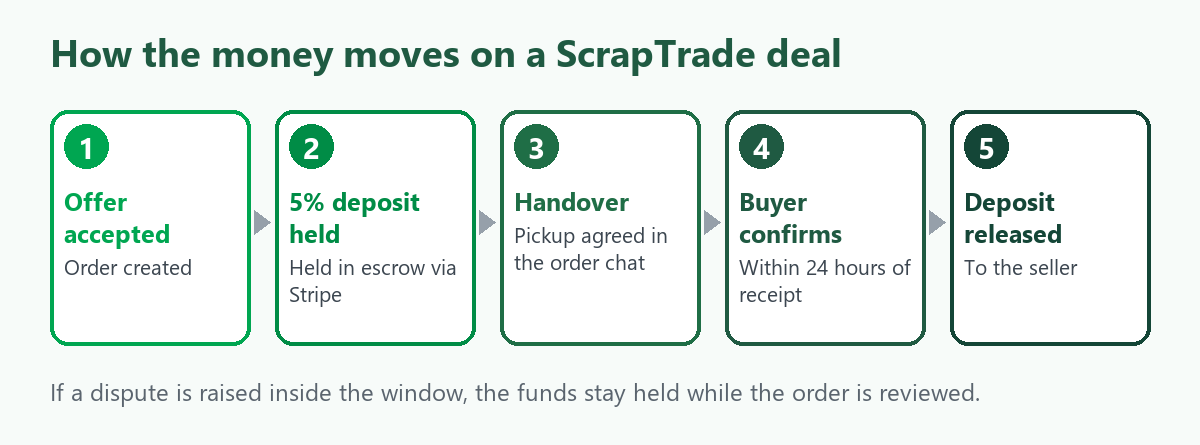
| 5. Accept | An order is created and a 5% deposit of the agreed value is collected from the buyer through Stripe and held in escrow |
| 6. Hand over | Pickup time, access and loading are agreed in the order chat, which keeps a written record |
| 7. Confirm and release | The buyer has 24 hours from receiving the material to confirm it matched. Once confirmed, or once the window passes without a dispute, the held deposit releases to the seller |
Two details are worth reading twice. The seller is deliberately not paid at the moment of acceptance, because the held deposit is what protects the buyer from paying for material that never arrives. And release is tied to the buyer's confirmation, so a fast pickup and a fast confirmation mean funds can move quickly, while a deal involving long-distance shipping takes longer simply because of transit time.
What protects a deal, and what does not
| Protection | What it does | Honest limit |
|---|---|---|
| KYC verification | Confirms a real person or registered business sits behind the account | Confirms identity, not honesty in every future deal |
| GPS-verified listing | Ties the timestamp and coordinates to where the material is when the listing is posted, which makes it much harder to list material that does not exist | It is optional, and it raises the effort needed to fake a listing without making it impossible |
| Escrow deposit | Holds the buyer's 5% deposit until receipt is confirmed or the 24-hour window passes | Protects the payment, not the physical condition of material once it is out of anyone's hands |
If a dispute is raised inside the window, it is opened against that specific order, with its own chat history and any GPS-verified listing evidence attached. The funds stay held while it is reviewed, and the evidence on that order decides where the deposit goes. If a buyer never confirms and never disputes, support steps in to review the order rather than leaving funds held indefinitely. A listing can be cancelled until a buyer has accepted a purchase, won a closed auction or had an offer accepted. After that, cancelling needs both sides to agree. The full explanation is on the trust and safety page.
What changes when a deal crosses a border
The platform works the same way whether the buyer is across town or across an ocean, but the deal itself is different. Freight has to be arranged, transit takes time, and each country has its own rules on importing and exporting scrap. None of that is something an online platform can remove, so it needs planning on top of the process above.
- Freight and transit. A longer journey stretches the gap between acceptance and confirmation.
- Rules on both ends. Licensing, documentation, environmental and customs rules differ by country and change over time. Check them before you commit.
- Grade disputes. The further the material travels, the more it matters that the listing describes it accurately. See how to grade scrap metal.
- Total cost. The price per tonne is not the cost. Read the real cost of sourcing scrap abroad.
For market context, see the guide to the world's biggest scrap metal markets and the trading hub pages for Istanbul, Rotterdam, Dubai and Mumbai. Our overview of trading scrap internationally pulls these together.
Who the platform is for
| You are... | What it offers you |
|---|---|
| A seller with a single load | A way to reach buyers beyond your local yard and compare offers |
| A business with recurring scrap | Repeatable listings and the option to run auctions for in-demand material |
| A buyer with a specific need | The Wanted Board, so sellers come to you with matching stock |
| A trader building a business | A route to market with verification and escrow built in |
There is no minimum quantity, so a listing can be a small lot or a full industrial load. Material categories include ferrous and non-ferrous metals, electronic waste, plastics, paper, glass, rubber and more. Browse the marketplace to see how listings are described.
How to get started
- Read the basics. How ScrapTrade works walks through the process, and what a scrap trader is explains the role.
- Check the price. Use the live material prices before you list or bid.
- Register and verify. Create an account and complete the one-time identity check.
- List or request. Post a listing, or post a Wanted Board request for what you need.
- Ask for help. Seller support can help with your first listing, and buyer-finding support can match you with sellers.
What to keep in mind
- Escrow is not instant payment. Funds release after the buyer confirms receipt or the 24-hour window passes.
- Verification has limits. It confirms who you are dealing with and, where used, where the material is. It does not grade the material.
- Rules vary by country. Check licensing, tax and trade rules wherever you operate.
- Nothing is guaranteed. Prices move daily, and the platform does not guarantee that any listing will sell or at what price.
Frequently asked questions
Is ScrapTrade live?
Yes. Sellers can list by fixed price, live auction or in answer to a buyer request, and buyers can browse, bid and post requests.
Who runs ScrapTrade?
Mobeius Technologies Pty Ltd, an Australian-registered company.
How does payment work?
When an offer is accepted or an auction closes, a 5% deposit of the agreed value is collected from the buyer through Stripe and held in escrow. It releases to the seller once the buyer confirms receipt, or once 24 hours pass after receipt without a dispute.
Is the identity check required?
Sellers complete a one-time KYC check before listing freely. GPS video verification of a listing is optional but is a strong signal for buyers, especially on larger purchases.
Can buyers outside Australia use it?
Yes. The platform is for buyers and sellers worldwide, in nine languages. Cross-border deals involve extra freight, time and rules.
Where can I get help?
Contact the team through the contact page.
This is a company announcement published by ScrapTrade on 22 October 2026, describing its own platform. Features, fees and availability can change, so check the site for current details. It is general information, not financial, tax or legal advice.