

Aluminium sits in the middle of the scrap price ladder: far more valuable than steel, well below copper, and available in huge quantities from windows, cans, vehicles and industrial offcuts. On ScrapTrade's price index, a clean 6063 extrusion is indicated at A$2.63 a kilogram, about 6.6 times the price of heavy melting steel, and Australian exporters declared aluminium scrap at about A$4,059 a tonne in 2025-26. This guide covers the grades that matter, the arithmetic of a lot, who is buying and why the demand is so durable.
As with every price in this series, the ScrapTrade Price Index is an AI-generated indicative estimate refreshed daily, not a quote, and export values are border declarations for mixed shipments, not what a collector is paid. Use them to understand the market, then confirm a price with the buyer.
Aluminium scrap at a glance
| Measure | Figure | Source |
|---|---|---|
| Extrusion (6063), indicative | A$2.63 per kg | ScrapTrade Price Index, 26 October 2026 |
| Sheet, indicative | A$2.13 per kg | ScrapTrade Price Index |
| Used beverage cans, baled, indicative | A$2.21 per kg | ScrapTrade Price Index |
| Australian aluminium scrap exports, 2025-26 | 377,501 tonnes worth A$1.43 billion | DCCEEW export data collation [1] |
| Declared export value, aluminium excluding cans | A$4,059 per tonne in 2025-26 | DCCEEW [1] |
| Estimated Australian aluminium scrap arisings | About 440,000 tonnes a year, almost all exported | Australian Aluminium Council and L.E.K., March 2026 [2] |
| Energy saved by recycling | About 95.5% (8.3 GJ against 186 GJ per tonne) | International Aluminium Institute [3] |
Grades and what they are worth
| Grade | Description | Indicative price (A$ per kg) | Per tonne |
|---|---|---|---|
| Extrusion (6063) | Clean, uncoated window and door extrusions | 2.63 | 2,633 |
| Used beverage cans (UBC) | Baled used cans | 2.21 | 2,206 |
| Sheet | Clean aluminium sheet with no coating | 2.13 | 2,135 |
Clean extrusion is the benchmark. Sheet is indicated about 19% lower, a difference of about A$498 a tonne, and the page's own description of each grade makes clear why: coatings, attachments and mixed alloys all reduce value. Painted or powder-coated window frames, extrusions with steel bolts or rubber seals still attached, and mixed alloys are the usual downgrades, and a buyer will mark them down. Strip and separate them where you can. For tests and visual cues see how to grade scrap metal.
Prices over time
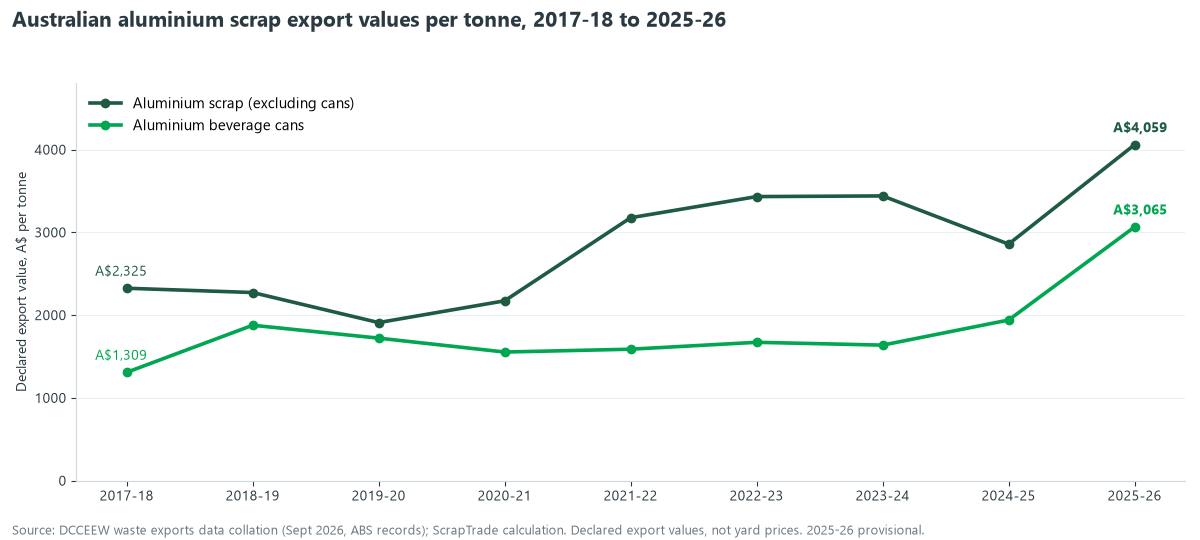
Australian export data show aluminium scrap excluding cans rising from A$2,325 a tonne in 2017-18 to A$4,059 in 2025-26, an increase of about 75%, and beverage cans rising from A$1,309 to A$3,065 [1]. The series is uneven: the cans line stayed between about A$1,300 and A$1,950 until 2024-25 and then jumped. Aluminium's recorded export weight also fell from 0.57 million tonnes in 2024-25 to 0.38 million tonnes in 2025-26 while its value held near A$1.4 billion, so part of the apparent price jump may reflect product mix or later revisions to the provisional year [1].
Quantities and arithmetic
The arithmetic below uses ScrapTrade's index prices and assumed lot sizes.
| Lot | Calculation | Value |
|---|---|---|
| 1 tonne of clean extrusion | 1,000 x A$2.63 | A$2,633 |
| 5 tonnes of baled cans | 5,000 x A$2.21 | A$11,029 |
| A 20 tonne lot of extrusion (assumed size) | 20,000 x A$2.63 | A$52,654 |
| 1 tonne of sheet instead of extrusion | 1,000 x A$2.13 | A$2,135 |
Compared with copper, aluminium is a weight business: a lot has to be large before the value is large, and freight is a bigger share of the cost. That is part of why aluminium scrap is often aggregated by yards and processors before it reaches a smelter or exporter. Check what minimum quantity your buyer expects before you list.
Where the demand comes from
Australia exported 377,501 tonnes of aluminium scrap in 2025-26. By value, India took 29.2%, China 21.2%, South Korea 19.2%, Thailand 8.8%, Belgium 7.1% and Indonesia 3.4% [1].
The structural reason for the demand is energy. The International Aluminium Institute puts the average energy to make primary aluminium at 186 gigajoules a tonne in 2019, against about 8.3 gigajoules for recycled metal, a saving of 95.5%. The IAI notes that the recycled figure rests on regional datasets because no global estimate exists [3]. A remelter that skips most of that energy can pay for scrap, which is what keeps demand strong.
Estimates of how much of the world's aluminium comes from recycling vary by source. Trade press citing IAI-related data puts secondary aluminium at roughly 28% to 35% of supply in 2024, and IAI data cited by the Australian Aluminium Council say more than 30 million tonnes of aluminium scrap is recycled worldwide each year [4][2]. The range is wide, so treat any single share with care.
Australia's remelting gap
A 2026 report by L.E.K. Consulting for the Australian Aluminium Council estimates that Australia generates about 440,000 tonnes of aluminium scrap a year and exports almost all of it for remelting abroad. It says scrap prices sit above 90% of the London Metal Exchange benchmark, which leaves little margin for a local remelter, and that collecting beyond about 500 kilometres is uneconomic without support [2]. For sellers this means the buyers for most Australian aluminium scrap are overseas, and local demand is limited to what a few domestic processors can use.
Listing aluminium scrap on ScrapTrade
A good aluminium listing tells the buyer exactly what is in the pile.
- Name the form: extrusion, sheet, cans, castings or mixed.
- State the alloy if you know it, such as 6063 for window and door extrusions.
- Disclose coatings and attachments: paint, powder coat, seals, bolts and glass.
- Give weight and how you measured it.
- Add clear photos, and a GPS-verified listing for larger lots.
- Set the pickup location and access.
Check the live material prices, then list it on the marketplace. To see what buyers are looking for, browse the buyer requests, and read fixed price, auction or Wanted Board to choose how to sell.
Mistakes that cost money
- Leaving steel on aluminium. Bolts, hinges and screws add weight that buyers will deduct or reject.
- Selling mixed alloys as one grade. A buyer who finds castings in an extrusion lot will re-grade the lot.
- Ignoring freight. Because aluminium is a weight business, a long haul can erase a small margin.
- Reading export values as a yard price. The A$4,059 a tonne export figure is not what a collector receives.
Frequently asked questions
How much is aluminium scrap worth per kilogram?
On ScrapTrade's index on 26 October 2026, between about A$2.13 (sheet) and A$2.63 (clean extrusion) a kilogram. These are indicative estimates.
Why is aluminium scrap in such demand?
Because remelting uses about 5% of the energy of making primary aluminium, according to the International Aluminium Institute [3].
Who buys Australian aluminium scrap?
Mostly overseas buyers. By value in 2025-26 the largest were India, China and South Korea [1].
Are aluminium cans worth collecting?
Baled cans are indicated at A$2.21 a kilogram on ScrapTrade's index, so 5 tonnes is worth about A$11,029 on that price. It takes a lot of cans to make a tonne, so volume and baling matter.
Does Australia recycle aluminium scrap at home?
Very little. The 2026 Australian Aluminium Council report says almost all of the roughly 440,000 tonnes generated each year is exported for remelting [2].
Sources
- DCCEEW, Waste exports data collation, September 2026 (ABS records), ScrapTrade calculations. See Australia's Scrap Metal Exports: 2025-26 Data.
- Australian Aluminium Council and L.E.K. Consulting, Enabling Development of Aluminium Recycling Capability in Australia, March 2026.
- International Aluminium Institute, Aluminium recycling saves 95% of the energy needed for primary aluminium production.
- AL Circle, Recycled aluminium outlook: demand surge, capacity race and the policy forces shaping it, trade-press estimates that differ by source.
- ScrapTrade Price Index, scrap.trade/market-prices, retrieved 26 October 2026. AI-generated indicative estimates, not a quote.
Prices and figures are indicative, as at 26 October 2026, and change daily. ScrapTrade operates the marketplace described here and has a commercial interest in the scrap trade. This article is general information, not financial or trading advice.