

Copper is the metal most scrap traders learn first, because a small weight carries real money. A kilogram of clean bare bright wire is worth roughly 29 times a kilogram of heavy melting steel on ScrapTrade's price index, and Australian exporters declared copper-alloy scrap at about A$12,243 a tonne in 2025-26, up from A$4,833 in 2017-18. This guide sets out the grades that matter, what they are worth, how much buyers expect per lot, and what is driving demand, using named sources and clearly labelled arithmetic.
Two cautions apply to every number below. The ScrapTrade Price Index is an AI-generated indicative estimate that the platform refreshes daily, and its own page says actual prices vary by location, grade, condition and quantity. The export values are declared at the border for mixed shipments and are not what a collector or small yard is paid. Treat both as reference points, and confirm a price with the buyer before you commit.
Copper scrap at a glance
| Measure | Figure | Source |
|---|---|---|
| Bare bright wire, indicative | A$11.67 per kg | ScrapTrade Price Index, 26 October 2026 |
| Copper 1, indicative | A$10.82 per kg | ScrapTrade Price Index |
| Copper 2, indicative | A$9.68 per kg | ScrapTrade Price Index |
| Insulated cable, indicative | A$6.40 per kg | ScrapTrade Price Index |
| Australian copper and copper-alloy scrap exports, 2025-26 | 113,411 tonnes worth A$1.23 billion | DCCEEW export data collation [1] |
| Average declared export value, copper alloys | A$12,243 per tonne in 2025-26, from A$4,833 in 2017-18 | DCCEEW [1] |
| China's copper scrap imports, 2024 | 2,249,952 tonnes, up 13.26% | SMM, from Chinese customs data [2] |
| Secondary copper share of world refined output, 2023 | About 16.9% | ICSG, via Recycling Today [3] |
The grades and what separates them
Copper scrap is priced by grade, and grade is mostly about cleanliness and form. The grade definitions below follow the descriptions on ScrapTrade's price index.
| Grade | Description | Indicative price (A$ per kg) | Per tonne |
|---|---|---|---|
| Bare bright wire | Clean, uncoated, unalloyed wire with no insulation | 11.67 | 11,669 |
| Copper 1 | Clean tubing, bus bar and wire at least 1/16 inch thick | 10.82 | 10,815 |
| Copper 2 | Copper with some solder, paint or light oxidation | 9.68 | 9,677 |
| Brass | Clean yellow brass with no iron attachments | 8.25 | 8,254 |
| Insulated cable | Mixed cable with insulation, 60 to 70% copper recovery | 6.40 | 6,404 |
The gaps between grades are where money is made or lost. Copper 2 sits 17% below bare bright, which on a tonne is a difference of about A$1,992. Moving a load from Copper 2 to Copper 1 by removing solder and paint is worth about A$1,139 a tonne on the same index (A$10,815 less A$9,677). That is why sorting and stripping are not busywork. See our guide to how to grade scrap metal for the practical tests.
Insulated cable: a worked example
Cable looks cheap per kilogram, but it carries copper. The index page says insulated cable yields 60 to 70% copper. Taking 500 kg of cable at A$6.40 a kilogram gives A$3,202. At 65% recovery the load holds 325 kg of copper, which at the bare bright price would be worth A$3,792. At the page's range of 60% to 70%, the cable price equals between 78% and 92% of the copper's bare bright value. The gap pays for stripping, processing and the buyer's margin. If you can strip cable yourself cleanly, the arithmetic shows why people do.
Prices over time
The chart below uses Australian export data, which is a different measure from yard prices but shows the direction clearly.
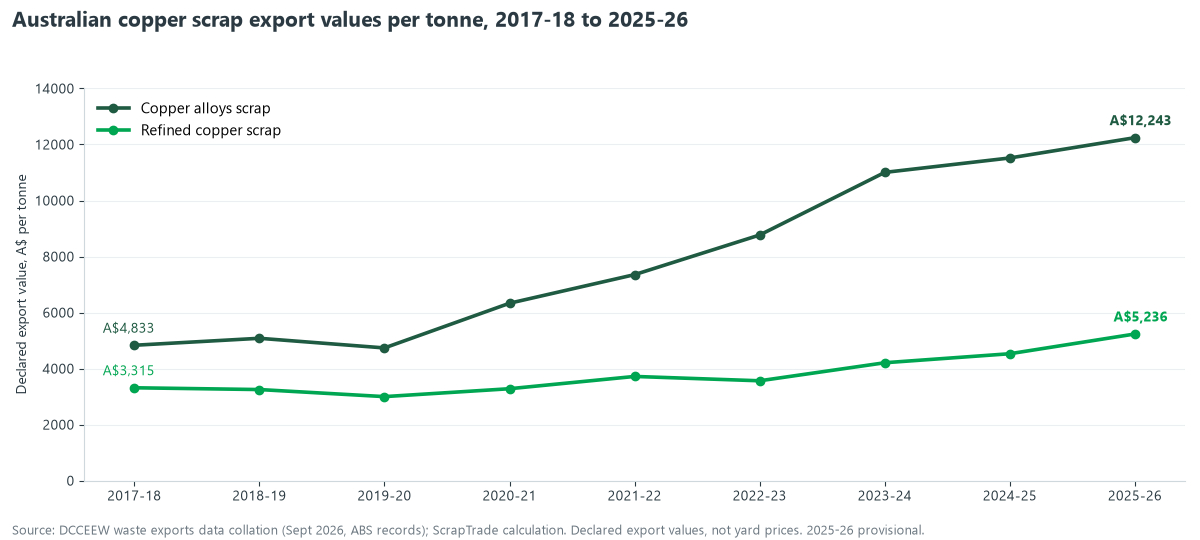
Copper-alloy scrap rose from about A$4,833 a tonne in 2017-18 to A$12,243 in 2025-26, an increase of about 153%. Refined copper scrap rose from A$3,315 to A$5,236, about 58% [1]. Most of the rise came after 2020-21. The export values for a given year average across many grades and shipments, so they should not be used to price a single load.
Quantities: what buyers expect
The index prices are per kilogram, and the money only gets large at scale. The arithmetic below uses the index prices and assumed lot sizes, and is meant to show what different lots are worth, not to promise a sale.
| Lot | Calculation | Value |
|---|---|---|
| 500 kg of bare bright wire | 500 x A$11.67 | A$5,835 |
| 1 tonne of Copper 1 | 1,000 x A$10.82 | A$10,815 |
| 500 kg of insulated cable | 500 x A$6.40 | A$3,202 |
| A 20 tonne lot of Copper 2 (assumed size) | 20,000 x A$9.68 | A$193,538 |
The last row shows why a small trader seldom buys a full container of copper outright. A lot of that size ties up close to A$200,000 before freight, which is why many people start by handling smaller lots or by working for a seller on commission. Buyers differ: a local yard may take kilograms, while a smelter or exporter wants tonnes.
Where demand comes from
Australia sells most of its copper scrap overseas. In 2025-26 China took 56.0% of Australia's copper scrap by value but 34.4% by weight, which suggests it receives the higher-value material. Thailand took 17.1% by value (25.5% by weight), India 11.3% (15.2% by weight) and South Korea 10.4% (7.0% by weight) [1].
China is also the world's largest buyer. Chinese customs data reported by SMM show 2,249,952 tonnes of copper scrap imported in 2024, up 13.26% from 1,986,559 tonnes in 2023, with some of the increase attributed to classification issues earlier in the year [2]. S&P Global reported that China has allowed free imports of secondary copper raw materials that meet specified standards since November 2020, and that the United States was the largest source, with 361,099 tonnes in the first ten months of 2024, about 19.5% of the total [4]. Scrap is a significant but minority input: the International Copper Study Group's data, reported by Recycling Today, put secondary copper at about 16.9% of world refined output in 2023, around 4.55 million tonnes [3].
What this means for a seller: demand is concentrated in a few smelting countries, so rules or tariffs in those countries can move prices. Our guide to trading scrap internationally covers cross-border basics.
Listing copper scrap on ScrapTrade
If you have copper to sell, a listing that answers a buyer's questions up front sells faster. Include:
- The grade, named plainly. Bare bright, Copper 1, Copper 2, brass or insulated cable, using the descriptions above.
- Weight and how it was measured. State whether it is estimated or weighed.
- Clear photos. Show the material loose and in the container.
- Contamination, honestly. Solder, paint, attached steel and insulation lower the grade.
- Location and pickup details.
- A GPS-verified listing for higher-value lots, which ties the material to a recorded location.
Check today's number on the live material prices before you set a price, then list it on the marketplace as a fixed price, an auction or a response to a buyer's request. Buyers can also post what they need on the buyer requests page. To see how the deal is protected, read how ScrapTrade works.
Mistakes that cost money
- Mixing grades. A little insulated cable or solder in a Copper 1 load drops the whole lot to a lower grade.
- Quoting from a stale price. The index is refreshed daily and can move between visits, so check it on the day you agree a deal.
- Treating export values as yard prices. The A$12,243 a tonne export figure is not what a collector is paid.
- Ignoring the rules. Buying copper from the public is regulated in many places because of theft, and traceable payment and record-keeping are expected. Check your local regulator.
Frequently asked questions
What is the most valuable grade of copper scrap?
Bare bright wire, which is clean, uncoated and unalloyed. It is priced at the top of the copper range on ScrapTrade's index.
How much is a tonne of copper scrap worth?
On ScrapTrade's index on 26 October 2026, between about A$6,404 (insulated cable) and A$11,669 (bare bright) a tonne, depending on grade. Australian exporters declared copper-alloy scrap at an average of about A$12,243 a tonne in 2025-26 [1]. Both are indicative.
Who buys copper scrap?
Local yards, processors, smelters and exporters. In Australia's export trade the main destinations by value are China, Thailand, India and South Korea [1].
Why is insulated cable cheaper per kilogram?
Because only part of its weight is copper. ScrapTrade's index lists 60 to 70% copper recovery for mixed cable.
Is copper scrap demand growing?
China's imports rose 13.26% in 2024 [2], and Australia's declared export value per tonne for copper-alloy scrap has more than doubled since 2017-18 [1]. Demand and prices change with the market, so past figures are not a forecast.
Sources
- Department of Climate Change, Energy, the Environment and Water (DCCEEW), Waste exports data collation, September 2026 (Australian Bureau of Statistics records). ScrapTrade calculations. See also Australia's Scrap Metal Exports: 2025-26 Data.
- SMM, 2024 Brief Review of Imported Copper Scrap, from Chinese customs data.
- Recycling Today, Copper recycling secondary output 2023 rising, citing the International Copper Study Group.
- S&P Global, Chinese importers hit pause on copper scrap from US as talks of new tariffs weigh (November 2024).
- ScrapTrade Price Index, scrap.trade/market-prices, retrieved 26 October 2026. AI-generated indicative estimates, not a quote.
Prices and figures are indicative, as at 26 October 2026, and change daily. ScrapTrade operates the marketplace described here and has a commercial interest in the scrap trade. This article is general information, not financial or trading advice.