

E-waste is the odd one out in the scrap trade. The volumes are enormous and growing, the metals inside are valuable, and yet most of it is not recycled through formal channels. The UN's Global E-waste Monitor 2024 counted 62 million tonnes of e-waste generated worldwide in 2022 and found only 22.3% of it formally collected and recycled. For a seller, that gap is the opportunity and the risk: material is plentiful, but the price depends heavily on how it is sorted, what it contains and whether the buyer can process it legally.
This guide sets out the verified numbers, what mixed e-waste is worth on ScrapTrade's index, how value is created by sorting, and what to include when you list it. As elsewhere in this series, the index is an AI-generated indicative estimate, not a quote.
E-waste at a glance
| Measure | Figure | Source |
|---|---|---|
| E-waste generated worldwide, 2022 | 62 million tonnes, up 82% from 2010 | UN Global E-waste Monitor 2024 [1] |
| Formally collected and recycled, 2022 | 22.3%, about 13.8 million tonnes | UN Global E-waste Monitor 2024 [1] |
| Projected generation, 2030 | 82 million tonnes | UN Global E-waste Monitor 2024 [1] |
| Metals in the 2022 e-waste | About 31 million tonnes | UN Global E-waste Monitor 2024 [1] |
| Mixed e-waste, pre-sort, indicative | A$0.57 per kg (A$569 a tonne) | ScrapTrade Price Index, 26 October 2026 |
| Australian precious-metal scrap exports, 2025-26 | About 1,785 tonnes worth A$269 million, plus platinum-group scrap of about 453 tonnes worth A$102 million | DCCEEW export data collation [2] |
The size of the pile
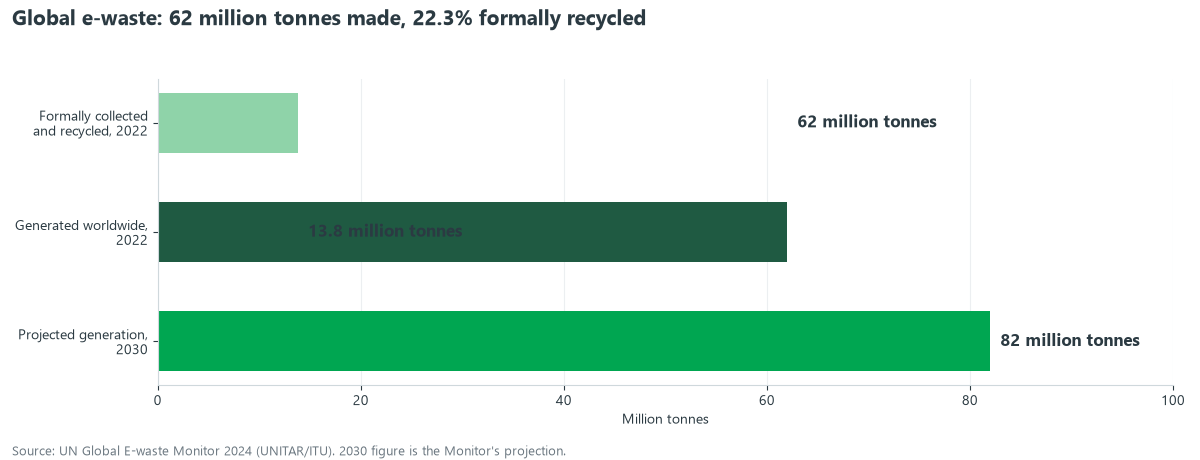
The Monitor reports that the 62 million tonnes of e-waste in 2022 contained about 31 million tonnes of metals, 17 million tonnes of plastics and 14 million tonnes of other materials, and it projects generation rising to 82 million tonnes by 2030. It expects the formal recycling rate to slip to about 20% by 2030 because collection is not keeping pace with generation [1]. The UN estimates the value of recoverable resources in e-waste that was not formally recycled at about US$62 billion, though it measures that differently from the market value of the metals alone, and other reports quote other totals [1].
What this means for a trader: supply is not the constraint. The constraint is getting material collected, sorted and into the hands of a processor that can recover it safely and legally.
What mixed e-waste is worth, and why it varies
ScrapTrade's index lists "E-waste (mixed)" described as mixed electronics, circuit boards and cables, pre-sort, at A$0.57 a kilogram on 26 October 2026, about A$569 a tonne. That sits above steel scrap and well below clean aluminium or copper, which fits: a mixed pile is mostly plastic, glass and steel with small amounts of valuable metals inside.
| Lot | Calculation | Value |
|---|---|---|
| 100 kg of mixed e-waste | 100 x A$0.57 | A$57 |
| 1 tonne of mixed e-waste | 1,000 x A$0.57 | A$569 |
| 1 tonne of insulated copper cable (for comparison) | 1,000 x A$6.40 | A$6,404 |
| 1 tonne of HMS 1 steel (for comparison) | 1,000 x A$0.40 | A$399 |
The comparison rows explain the trade. A tonne of cable pulled out of an e-waste pile is worth about eleven times the same weight of the mixed pile, so value is created by separating components, not by collecting everything together. Circuit boards, which are rich in precious metals, are valued separately by processors and are not shown on the platform's index, so the A$0.57 figure should not be applied to board-level material.
The export data show how valuable the recovered end of the chain is. Australian exporters declared precious-metal scrap at about A$150,737 a tonne and platinum-group scrap at about A$224,444 a tonne in 2025-26, from about 1,785 and 453 tonnes respectively [2]. Those categories include more than e-waste, so they are not a price for electronics, but they show why processors with the right equipment pay for the right feedstock.
Where the demand comes from
Demand for e-waste comes from specialist recyclers and processors who can dismantle, shred and refine it, and from smelters and refiners further along the chain that recover copper, precious metals and other metals. Legitimate buyers are also constrained by regulation. E-waste contains hazardous components such as batteries and other materials that many countries regulate for handling, transport and export. That narrows the buyer pool compared with steel or aluminium and is a reason to deal only with processors who can show they are authorised.
Selling e-waste: practical points
- Sort before you sell. Separate cables, boards, metal casings, plastics and anything with batteries. Each stream has its own buyer and price.
- Remove batteries. Loose lithium batteries are a fire risk and are usually handled separately.
- Ask about data. Storage devices may hold personal data, so ask the buyer about data destruction before you hand over drives or phones.
- Check authorisation. Confirm that the buyer can lawfully take electronic waste, and keep records of what you sold and to whom.
- Weigh and photograph. Written weights and photos protect both sides if there is a dispute.
Listing e-waste on ScrapTrade
A strong e-waste listing says what the material is, not just that it is e-waste. Include:
- The type: mixed pre-sort, circuit boards, cables, power supplies, casings or a named appliance type.
- Estimated weight and how it was measured.
- A description of contents and any batteries.
- Clear photos, and a GPS-verified listing for larger lots.
- Location and pickup details.
Check the live material prices, then list it on the marketplace. To see what buyers have asked for, browse the buyer requests. The trust and safety page explains how verification and escrow work on a deal.
Mistakes that cost money
- Selling the whole pile as one grade. Cable and boards separated out are worth far more than the mixed average.
- Leaving batteries in. It can make material unsellable and is a safety risk.
- Ignoring data and compliance. Handing devices to an unauthorised buyer exposes you to risk.
- Applying the mixed price to boards. The index figure is for mixed, pre-sort material.
Frequently asked questions
How much e-waste is there in the world?
The UN's Global E-waste Monitor 2024 counted 62 million tonnes generated in 2022 and projected 82 million tonnes by 2030 [1].
How much e-waste is recycled?
About 22.3% was formally collected and recycled in 2022, around 13.8 million tonnes [1].
What is mixed e-waste worth?
ScrapTrade's index showed A$0.57 a kilogram, about A$569 a tonne, on 26 October 2026 for mixed pre-sort material. That is indicative, and sorted components are worth more.
Is e-waste more valuable than steel or aluminium scrap?
Mixed e-waste is indicated above steel and below clean aluminium and copper. Value comes from the metals inside, which is why sorting matters.
Can anyone buy e-waste?
Buyers need to be able to handle it lawfully, because it contains hazardous components. Ask any buyer to show that they are authorised and keep records.
Sources
- UNITAR, International Telecommunication Union and partners, Global E-waste Monitor 2024.
- DCCEEW, Waste exports data collation, September 2026 (ABS records), ScrapTrade calculations. See Australia's Scrap Metal Exports: 2025-26 Data.
- ScrapTrade Price Index, scrap.trade/market-prices, retrieved 26 October 2026. AI-generated indicative estimates, not a quote.
Prices and figures are indicative, as at 26 October 2026, and change daily. ScrapTrade operates the marketplace described here and has a commercial interest in the scrap trade. This article is general information, not financial, legal or trading advice.