

For decades Europe has treated its old steel as a commodity to be sold to whoever pays most. In 2024 that meant shipping about 16.7 million tonnes of ferrous scrap outside the bloc. A draft list published by the European Commission on 18 September 2026 would change who is allowed to receive part of it. If adopted as drafted, metal scrap could no longer go from the EU to 16 named non-OECD countries, including India, Egypt and Pakistan, from May 2027.
This article sets out what has actually been proposed, which figures are solid and which are not, who has most to gain and lose, and what buyers and sellers of scrap anywhere in the world should watch. It is an analysis, not a forecast. Where a claim rests on trade-press reporting instead of an official document, we say so.
The argument in one line: Europe is not banning scrap exports. It is changing the list of countries that can receive them, and that quietly makes one OECD buyer, Turkey, even more important to every European scrap collector.
At a glance
| Question | Answer |
|---|---|
| What changes? | From 21 May 2027, non-hazardous waste, including metal scrap, can go from the EU to a non-OECD country only if that country and that waste stream are on an EU list |
| Where is the process now? | A draft list was published on 18 September 2026. Consultation closed on 16 October 2026. The first list is due by 21 November 2026. Nothing is adopted yet |
| Who is proposed for metal scrap? | Moldova, Montenegro, North Macedonia, Serbia and Ukraine only, according to trade-press reporting on the draft |
| Who is proposed to be left out? | 16 applicants, including India, Egypt, Pakistan, Bangladesh, Malaysia, Vietnam, Morocco and Indonesia |
| How much scrap is exposed? | About 3.4 million tonnes went from the EU to Egypt, India and Pakistan in 2024, roughly a fifth of EU ferrous scrap exports. S&P Global estimates 4.0 to 4.1 million tonnes a year, about a quarter |
| Who is not affected by this list? | OECD destinations, including Turkey, which took about 63% of EU ferrous scrap exports in 2024 |
What Europe has actually proposed
The law behind it
The proposal grows out of the revised EU Waste Shipment Regulation, Regulation (EU) 2024/1157. It tightens how waste leaves the bloc. The key dates are short and worth keeping in one place.
| Date | Milestone |
|---|---|
| 21 May 2026 | The revised regulation starts to apply, with most export rules for third countries following a year later |
| 18 September 2026 | The Commission publishes a draft delegated act listing the non-OECD countries that may be authorised to receive specified non-hazardous waste from the EU |
| 16 October 2026 | Consultation on the draft closes |
| 21 November 2026 | The first list must be adopted. Non-hazardous plastic waste exports to non-OECD countries are also prohibited from this date, for 2.5 years |
| 21 May 2027 | The new third-country export rules apply. Covered waste can go to a non-OECD country only if both the country and the waste stream are on the final list |
Two design choices matter. First, authorisation is specific to each waste stream, so a country listed for one category of waste does not automatically qualify for metal. Second, the list will be reviewed at least every two years and countries can be removed if they stop meeting the requirements. The Commission also expects exporters to make sure receiving facilities are independently audited.
The draft list for metal scrap
The Commission received 32 requests from non-OECD countries that want to keep importing EU waste. According to trade-press reporting on the draft, it treats ferrous and non-ferrous metal waste with "particular scrutiny", citing the risk of heavy metals and the environmental risks of shredding, smelting and refining.
| Proposed for metal waste | Not proposed for metal waste |
|---|---|
| Moldova Montenegro North Macedonia Serbia Ukraine | Bangladesh, Bosnia and Herzegovina, Egypt, Georgia, India (listed for other streams), Indonesia, Malaysia, Morocco, Oman, Pakistan, Saudi Arabia, Sri Lanka, Taiwan, Thailand, Tunisia, Vietnam |
What the draft does not touch
The list covers non-OECD destinations only. Turkey is an OECD member, so it is outside this mechanism. Plastic waste and e-waste were excluded from this authorisation exercise. The draft also does not prohibit trade within the EU or with OECD countries, which follow different rules.
What is still unconfirmed
The country split above comes from SteelOrbis and is consistent with the BIR member update, but we could not retrieve the draft delegated act itself (reference Ares(2026)8856013), so treat the country-by-country detail as reported, not verified. The draft has not been adopted or endorsed by the Commission and could change after consultation.
A note on sources
Statistics in this article come from named sources: Eurostat data as reported by GMK Center, the Bureau of International Recycling (BIR), worldsteel figures as reported by GMK Center and EUWID, and S&P Global estimates as reported by the Middle East Observer. Where figures from two datasets are compared, the result is approximate and labelled.
Who buys Europe's scrap today
The reach of the proposal depends on where the scrap actually goes. Eurostat data reported by GMK Center show the shape of EU ferrous scrap exports to third countries in 2024.
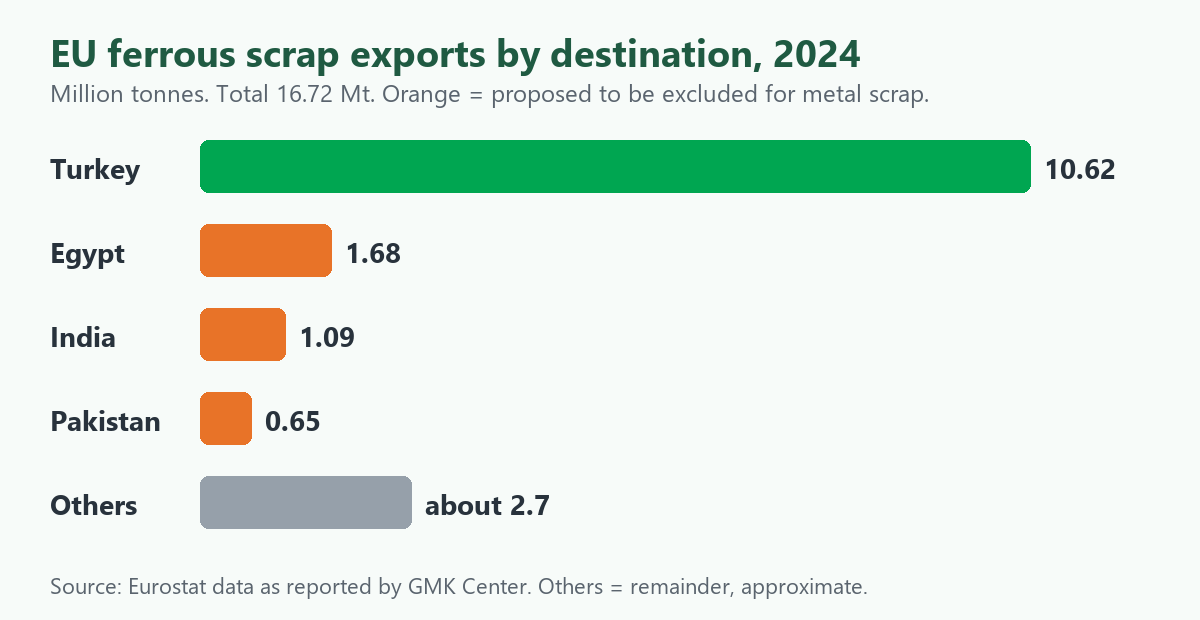
| Destination | 2024 volume | Share (calculated) | Change on 2023 | Under the draft? |
|---|---|---|---|---|
| Turkey | 10.62 Mt | about 63% | +1.7% | OECD, not covered |
| Egypt | 1.68 Mt | about 10% | +1.2% | Not proposed for metal |
| India | 1.09 Mt | about 6.5% | -51.3% | Not proposed for metal |
| Pakistan | 0.65 Mt | about 3.9% | -17.5% | Not proposed for metal |
| All others | about 2.7 Mt | about 16% | not given | Mixed |
| Total | 16.72 Mt | 100% | about -10.8% |
Three observations follow from the table.
- Four buyers take 84% of the total. Europe's scrap export trade is concentrated, which makes a rule that targets specific countries more consequential than a general tightening would be.
- The exposed volume is sizeable but not the majority. Egypt, India and Pakistan together took about 3.4 million tonnes, roughly 20% of the total. S&P Global's higher estimate of 4.0 to 4.1 million tonnes a year, about 25% to 26% of shipments, presumably includes other excluded destinations. The gap between the two numbers is a reminder that these are estimates.
- The trend was already moving. Shipments to India halved in 2024 and those to Pakistan fell by nearly a fifth, before any rule existed.
Turkey is the centre of gravity
Turkey's steel sector runs largely on the electric arc furnace route, with around three-quarters of production based on it, and it is heavily reliant on European material. The Bureau of International Recycling reports that Turkey imported about 20.1 million tonnes of recycled steel in 2024, up 6.7%, with the United States (about 4.5 million tonnes), the Netherlands (about 2.8 million tonnes) and the United Kingdom (about 2.2 million tonnes) as its largest suppliers. Comparing the two datasets loosely, EU origin material is roughly half of what Turkey imports.
That is why the list matters for strategy and not only for compliance. If a fifth to a quarter of EU scrap exports lose their route, the obvious destination for the displaced tonnes is Turkey, which is already the buyer that sets the benchmark price in the region.
Why Brussels is doing this
There are three overlapping motives, and they do not all point the same way.
1. Environmental protection abroad
The stated justification in the Waste Shipment Regulation is that waste exports should not cause environmental or health damage in third countries. For metals, the Commission's assessment, as reported, flags heavy metals and the risks of shredding, smelting and refining. This is the argument that applies most directly to the list.
2. Keeping a strategic raw material at home
European steelmakers argue that scrap is a strategic secondary raw material. In late 2024, EUROFER and the IndustriAll union asked the Commission to recognise steel scrap as one under the Critical Raw Materials Act and to enforce the revised waste shipment rules. The industry's case is that scrap exports to countries without comparable environmental and social standards should be restricted. Turkey's steel producers' association pushed back at the time, warning that such measures could lead to a reduction in scrap procurement.
The Commission's Steel and Metals Action Plan, published in March 2025, signalled that it would monitor scrap exports and consider a trade measure, and law-firm summaries of the plan note that export fees or duties are not off the table. A Circular Economy Act, expected from the Commission in late 2026, is a further vehicle. The draft list is the first concrete step that actually restricts destinations.
3. Feeding a cleaner steel industry
Scrap-based electric arc furnaces emit far less than the blast furnace route and are central to decarbonising steel. The table shows why Europe, with a much higher share of electric steelmaking than the world average, wants a dependable scrap supply.
| Region | Share of crude steel made in electric arc furnaces | Year |
|---|---|---|
| World | 29.1% | 2024 |
| World | 30.3% | 2025 (reported by EUWID citing worldsteel) |
| European Union | 44.4% | 2024 |
| United States | 71.8% | 2024 |
| China | 10.2% | 2024 |
The pattern behind the table is simple. Where electric steelmaking is growing, scrap is a competitive input, and governments start to treat it as one. China's low share means its scrap demand is modest by comparison with its output, while India, Turkey and Egypt are building or running large scrap-based capacity and are exposed when a supplier region closes its doors.
Why OECD status changes the rules
The draft list only governs exports to non-OECD countries. Waste shipments between OECD members have generally moved under a separate, lighter system of controls, and Turkey has been an OECD member since the organisation's early years. That is the legal reason the largest buyer of European scrap sits outside this list. It is not a reason to assume it will stay outside European policy.
Turkey is not beyond reach
The Commission published the draft list alongside an assessment of plastic waste exports to Turkey. Reporting on it says Turkey accounts for about 70% of EU plastic waste exports to OECD countries, and that the Commission will engage with the Turkish authorities on its findings and keep monitoring these exports. That concerns plastic, not metal, and it does not mean metal scrap will be restricted. It does show that the Commission is already looking at where OECD-bound waste ends up. A scrap exporter who plans around Turkey as a permanent safe harbour is making an assumption, not a certainty.
The audit requirement is the practical test
Under the revised regulation, companies exporting waste outside the EU must make sure the receiving facilities are subject to an independent audit. For a large exporter that is a cost of doing business. For a small yard it is a barrier, because it means paperwork, access to the destination site and a buyer willing to be audited. The likely effect is to favour larger, better-documented exporters and buyers, which is a point for any trader to consider when choosing counterparties. Verified identities and clear records, the kind a marketplace such as ScrapTrade builds in, make that evidence easier to produce, though they do not replace the audit itself.
Who gains, who loses, and who is uncertain
The honest summary is that the effects are uneven and depend on how markets respond. The assessments below are our analysis, built from the figures above.
European steelmakers: likely gainers
If more scrap stays inside the bloc, mills have a larger local supply and less competition from non-OECD buyers. The effect on prices is a reasonable expectation, but it depends on what happens to the displaced volume in practice, so it should be treated as a hypothesis, not a result.
European collectors and recyclers: mixed
Collectors sell into export markets because those markets pay for volume and grade. Removing a fifth to a quarter of export outlets reduces the number of competing buyers. That tends to push the price paid for the displaced grades down and to concentrate bargaining power with fewer buyers. The risk is that lower prices reduce the incentive to collect and sort the lower-grade material in the first place, which is the opposite of the circular-economy aim. Our guide to grading scrap explains why grade drives price, and it is also why clean, well-sorted material is the safest to sell in a changing market.
India, Egypt and Pakistan: losing a supplier region
The exposure differs by country. Using the two datasets loosely, EU material was about 13% of India's 2024 imports (1.09 million tonnes of about 8.5 million), and about 30% of Pakistan's (0.65 million tonnes of about 2.2 million). Those are approximate because the figures come from different sources, but they show that Pakistan relies more heavily on EU origin material than India does. India has other suppliers, notably the United States and the United Kingdom, and its imports from the EU had already halved.
For these buyers the question is substitution. They can replace EU scrap with material from elsewhere, but not necessarily at the same price or quality, and the replacement suppliers are the same ones that Turkey also buys from. Our corridor guides cover the routes into these markets: US to India, Canada to India and India to the UAE.
Exporters outside the EU: opportunity with competition
Scrap producers in the United States, the United Kingdom, Canada, Australia and elsewhere may find more demand from buyers who can no longer source in Europe. The opportunity is real but not guaranteed, because those buyers will also push on price, and because other restrictions are appearing. The United Arab Emirates introduced a temporary export ban on certain scrap in June 2026, with a four-month term to 8 October and automatic renewal unless cancelled. We could not confirm its status afterwards. When several exporting regions tighten at once, importing countries compete harder for what remains.
Summary
| Group | Likely direction | Why |
|---|---|---|
| EU steel mills | Better off | More local scrap, fewer competing buyers |
| EU collectors and yards | Mixed to worse | Fewer export outlets, lower prices for displaced grades |
| Turkish mills | Better off, with a caveat | OECD status keeps access, though European policy may later extend to them |
| Indian, Egyptian, Pakistani mills | Worse off | Lose a source and must pay to replace it |
| US, UK, Canadian and other exporters | Opportunity | Displaced demand looks for new origins |
| Serbia, Ukraine, Moldova and other listed countries | Advantage | Retain legal access to EU metal scrap |
Three ways this could play out
Scenario one: adopted largely as drafted
Metal scrap flows to the five listed countries and OECD destinations only. Expect trade to concentrate on Turkey, a search for new origins in India, Egypt and Pakistan, and pressure on European collection prices. The first list is due by 21 November 2026, and the rules apply from 21 May 2027.
Scenario two: softened after consultation
Consultation responses lead to some excluded countries being added for metal, perhaps with audit conditions. The list is reviewed at least every two years, so countries could also be added later as they improve their capacity.
Scenario three: delayed or litigated
Timelines slip, and the practical effect is deferred while the market anticipates the change. Even then, the direction of travel in European policy, toward keeping scrap at home, is unlikely to reverse.
Signals to watch
- Whether the final list adds countries for metal compared with the draft.
- Whether a Circular Economy Act or a trade measure adds export fees or duties on scrap.
- Monthly EU export data to Egypt, India and Pakistan, and to Turkey.
- Turkish mills' purchasing behaviour, given their stated concern about scrap procurement.
- European scrap prices relative to Turkish import benchmarks.
What this means if you buy or sell scrap
If you sell scrap outside the EU
Check who your buyers are exposed to. A buyer in India, Egypt or Pakistan who loses European supply may pay more attention to your material, and a verified, well-documented lot is easier for them to say yes to. Compare offers instead of defaulting to a single quote: our guides on why competing offers beat a single quote and choosing between a fixed price, an auction and the Wanted Board explain how.
If you buy scrap in an affected country
Plan to diversify origins early. Verify counterparties and permits before you commit to freight. The checklist in the real cost of sourcing scrap abroad sets out how to vet a seller remotely, and trust and safety on ScrapTrade explains what verification and escrow do. Use the buyer requests to see what other buyers are asking for.
If you are a European collector or yard
Expect pressure on prices for lower grades and invest in sorting, because clean grades keep more options open. Watch the final list closely, and talk to buyers in OECD markets about volume commitments.
Read next
- The world's biggest scrap metal importers for the wider 2024 trade picture.
- Istanbul, Mumbai, Dubai and Rotterdam for the trading hubs involved.
- Trading scrap internationally and the global scrap marketplace.
- Live material prices.
What we do not know
- The final list. The draft may change after consultation, and our country detail relies on trade-press reporting, not the delegated act itself.
- Price effects. We have not modelled prices. The statements about prices are reasoned expectations.
- Substitution. We cannot say how quickly India, Egypt and Pakistan can replace EU supply, or at what cost.
- Trade measures. We found no confirmation that a separate export fee or duty on scrap has been adopted.
- Dataset differences. Comparisons between EU export data and importing-country data are approximate.
Frequently asked questions
Is the EU banning scrap exports?
No. It is proposing that non-hazardous waste, including metal scrap, can go to non-OECD countries only if the country and the waste stream are on an approved list from 21 May 2027. Exports to OECD countries are governed separately.
Is Turkey affected?
Not by this list, because Turkey is an OECD member. It took about 63% of EU ferrous scrap exports in 2024.
Which countries are proposed for metal scrap?
According to reporting on the draft: Moldova, Montenegro, North Macedonia, Serbia and Ukraine. Sixteen other applicants, including India, Egypt and Pakistan, are not proposed for metal.
Has the list been adopted?
No. Consultation closed on 16 October 2026 and the first list is due by 21 November 2026.
How much scrap could be affected?
About 3.4 million tonnes went to Egypt, India and Pakistan in 2024, roughly 20% of EU ferrous exports. S&P Global estimates 4.0 to 4.1 million tonnes a year, about a quarter.
Sources
- Regulation (EU) 2024/1157 on shipments of waste, via the IEA policy database and law-firm summaries.
- SteelOrbis, EU draft list of countries authorised to import EU waste (September 2026); Bureau of International Recycling member updates on the draft list.
- Brussels Times, report on the 32 applications and the 2027 shift.
- GMK Center, EU scrap exports in 2024 (Eurostat data) and the share of EAF in global steel production in 2024; EUWID, scrap use in global steel production in 2025.
- Bureau of International Recycling, World Steel Recycling in Figures, 2024 update.
- Middle East Observer (October 2026), citing S&P Global estimates of displaced EU scrap exports.
- Mayer Brown, summary of the European Steel and Metals Action Plan (March 2025).
This article is analysis based on published sources as of 21 October 2026. Policy is changing quickly, so check the Commission's official documents before making trading decisions. ScrapTrade operates a marketplace for scrap and has a commercial interest in the scrap trade.