

Before you sell scrap, you want to know roughly what it is worth. Before you buy it, you want to know whether an offer is fair. A scrap price calculator exists to answer that question in thirty seconds: pick a material and grade, enter a weight, choose a currency, and read an estimate. This guide explains exactly how ScrapTrade's calculator does that, what each setting changes, how the numbers are converted, three worked examples, how to read an estimate against a benchmark price, and, just as important, where the tool's limits are. It is a guide to using an estimate well, not a promise that the estimate is a price anyone will pay.
The key fact comes first. According to ScrapTrade's own published description, the calculator uses AI to generate indicative global scrap prices, refreshed at least once a day, with a fixed reference price used only as a fallback if the AI service is temporarily unavailable [1]. The platform states that the figures are estimates, not locked-in trading prices, and that users should confirm with a buyer or seller before they deal.
The calculator at a glance
| Feature | Detail | Source |
|---|---|---|
| What it estimates | The value of ferrous metals, non-ferrous metals, plastics, paper and cardboard, and e-waste | ScrapTrade [1] |
| Materials | 24 material and grade entries in the price index, each with a short description | ScrapTrade price index |
| Weight units | Kilograms, tonnes and pounds, switchable without re-entering | ScrapTrade [1] |
| Currencies | 20: AUD, USD, GBP, INR, CNY, AED, SGD, CAD, ZAR, MYR, EUR, JPY, KRW, IDR, THB, MXN, BRL, ARS, NZD and HKD | ScrapTrade [1] |
| Countries | 10: Australia, the United States, the United Kingdom, India, China, the UAE, Singapore, Canada, South Africa and Malaysia | ScrapTrade [1] |
| Price source | AI-generated indicative prices, refreshed at least once a day, with a fixed fallback if the AI service is unavailable | ScrapTrade [1] |
| Cost | Free, with no sign-up | ScrapTrade [1] |
| Status of the numbers | Indicative estimates. ScrapTrade says it does not guarantee their accuracy | ScrapTrade [1] |
How it works, step by step
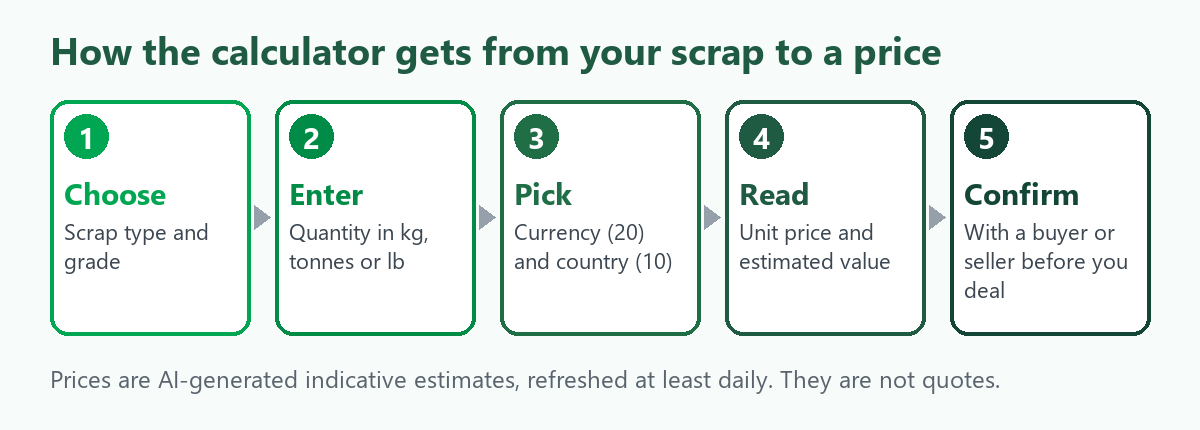
Step 1: choose the scrap type and grade
The calculator first asks for a scrap type: ferrous metals, non-ferrous metals, plastics, paper and cardboard, or e-waste. It then asks for a grade within that type. The grade matters more than anything else, because the price of "steel" or "copper" is meaningless without it. The index describes each grade in plain terms. For example:
| Grade | Description on the index |
|---|---|
| HMS 1, heavy melting steel | Clean heavy steel a quarter inch and over, with no tin, galvanised or coated material |
| Copper bare bright wire | Clean, uncoated, unalloyed copper wire with no insulation |
| Copper 2 | Copper with some solder, paint or light oxidation |
| Aluminium extrusion (6063) | Clean, uncoated window and door extrusions |
| Stainless steel 304 | 18/8 grade stainless, mixed form |
| E-waste (mixed) | Mixed electronics, circuit boards and cables, pre-sort |
Pick the description that honestly matches your material. If part of a lot is coated, painted or contaminated, the estimate for the clean grade will overstate what a buyer pays. See how to grade scrap metal.
Step 2: enter the quantity and the unit
Enter how much you have, in kilograms, tonnes or pounds. The calculator recalculates when you switch units, so you can think in whatever unit your buyer uses. One tonne is 1,000 kilograms, or about 2,204.6 pounds.
Step 3: choose a currency and a country
Choose the currency you want to see the value in, and the country you are trading from. The calculator defaults to Australian dollars and Australia. ScrapTrade says that choosing a currency and a location converts prices so you are comparing like for like wherever you trade from [1]. We could not independently confirm what the country setting changes beyond what ScrapTrade says, so treat the currency conversion as the part you can check yourself.
Step 4: the calculation
Behind the screen the logic is simple arithmetic. The index lists a price per kilogram for each grade. The calculator multiplies that by your weight, converted to kilograms, and converts the result into your currency using exchange rates. ScrapTrade's website serves those rates from its own feed, quoted against the US dollar. On 26 October 2026 the feed listed rates for 166 currencies, including all 20 that the calculator offers, with AUD at about 1.423 to the US dollar.
Step 5: read the result
The calculator shows a unit price in your currency and unit, and an estimated value for your quantity. That is the end of the calculation and the start of the real work: check it against your material, then against what buyers will actually offer.
Three worked examples
These use the ScrapTrade Price Index on 26 October 2026 and the platform's exchange rates the same day. Both change daily, so they show how the arithmetic works and are not quotes.
| Lot | Index price | Estimated value in AUD | USD | GBP | EUR |
|---|---|---|---|---|---|
| 2.5 tonnes of HMS 1 steel | A$0.3985 a kg | A$996.25 | US$700 | £523 | €625 |
| 150 kg of Copper bare bright wire | A$11.6692 a kg | A$1,750.38 | US$1,230 | £920 | €1,098 |
| 1,200 lb of aluminium extrusion | A$2.6327 a kg | A$1,433.01 | US$1,007 | £753 | €899 |
The third example shows the unit conversion: 1,200 lb is about 544.3 kg, and 544.3 x A$2.6327 is about A$1,433. A trader in the United States quoting in pounds and a buyer in Australia quoting in kilograms get to the same number without anyone converting by hand.
What goes into the estimate
ScrapTrade's public description says the prices are generated by AI, that they "reflect current estimated market conditions" instead of a single static list, and that this is why they can shift from day to day [1]. It also says a fixed reference price is used only if the AI service is temporarily unavailable. The public description does not list the specific data inputs. We therefore describe what the tool says about itself and not more.
Some context helps you judge any scrap estimate. Scrap is rarely priced at the benchmark. Buyers pay a discount to the benchmark that depends on the grade, form, quantity, location and market conditions. The Australian Aluminium Council's 2026 report notes that aluminium scrap prices typically sit above 90% of the London Metal Exchange benchmark [2]. For copper, weekly scrap reviews from Shanghai Metals Market in July 2026 described discount rates holding at high levels when supply was tight [3]. The size of the discount varies from market to market and week to week, which is why no calculator can replace a quote.
Reading an estimate against the benchmark
A good habit is to compare an estimate with the benchmark for the metal. An example with copper makes the point. On 26 October 2026, COMEX copper closed at about US$14.31 a kilogram, and the index price for bare bright wire of A$11.67 a kilogram converts to about US$8.20, roughly 57% of the benchmark. Copper 1 (A$10.82) and Copper 2 (A$9.68) convert to roughly 53% and 47%. Scrap buyers do pay less than the benchmark, so a gap is expected, but this one is large, and it means that for copper the calculator should be read as a conservative reference, not as an expected price. Firm offers can be materially higher or lower, so ask for them. For why copper is moving, see Copper Prices: Analysis, Risks and Outlook.
How to use the calculator before you deal
| Step | Action | Why |
|---|---|---|
| 1 | Pick the grade that honestly matches your material | Grade drives the price |
| 2 | Enter the weight and your currency | Get a reference value in your terms |
| 3 | Treat the result as a range, not a price | The tool is an estimate |
| 4 | Compare it with a benchmark where one exists | Metals like copper and aluminium have public benchmarks |
| 5 | Get at least two offers | Competition tells you more than any reference. See why competing offers beat a single quote |
| 6 | Confirm the price and terms in writing | The calculator is not a contract |
On ScrapTrade you can list the material on the marketplace and let several buyers respond, or post a request on the buyer requests page. Deals run through escrow, with identity checks and GPS-verified listings available. See how ScrapTrade works and trust and safety.
Strengths and limits
| Strengths | Limits |
|---|---|
| Free, instant and no sign-up | The prices are estimates, not quotes |
| Handles kilograms, tonnes and pounds | It cannot see the condition of your material |
| 20 currencies and 10 country settings | It cannot know your buyer, your location or your freight |
| Named grades with descriptions | AI-generated values can move from day to day |
| A reference before you list or bid | A fixed fallback price applies if the AI service is unavailable, so prices may not move that day |
| Clear disclaimer on the page | Specific data inputs are not published |
Frequently asked questions
How does the ScrapTrade scrap calculator work?
You choose a scrap type and grade, enter a quantity in kilograms, tonnes or pounds, and pick a currency and country. It multiplies an indicative per-kilogram price by your weight and converts the result using exchange rates, then shows a unit price and estimated value [1].
Where do the prices come from?
ScrapTrade says they are AI-generated indicative prices, refreshed at least once a day, with a fixed reference price used only as a fallback if the AI service is unavailable [1].
Are they live market prices?
No. ScrapTrade describes the index as continuously refreshed but still an estimate, not a locked-in trading price [1].
How accurate is it?
ScrapTrade says it does not guarantee accuracy. Compare the estimate with firm offers and, for metals with a public benchmark, with that benchmark.
Which currencies and units does it support?
Twenty currencies and three weight units: kilograms, tonnes and pounds [1].
Is it free?
Yes, with no sign-up, according to ScrapTrade [1].
Should I use it to set my asking price?
Use it as a starting reference, then check your grade, the benchmark and what buyers are offering before you set a price.
Sources
- ScrapTrade, Scrap Price Calculator and ScrapTrade Price Index, including its FAQ, retrieved 26 October 2026. Prices on the page are AI-generated indicative estimates.
- Australian Aluminium Council and L.E.K. Consulting, Enabling Development of Aluminium Recycling Capability in Australia (March 2026).
- SMM, Ex-China copper scrap weekly review (July 2026).
- Yahoo Finance, COMEX copper futures (HG=F), close on 26 October 2026, used for the benchmark comparison.
- ScrapTrade exchange-rates feed, scrap.trade/api/exchange-rates, retrieved 26 October 2026.
Prices and exchange rates are as shown on 26 October 2026 and change daily. The calculator gives indicative estimates, not quotes, and ScrapTrade does not guarantee their accuracy. This article is general information, not financial or trading advice. ScrapTrade operates the marketplace described here and has a commercial interest in the scrap trade.