

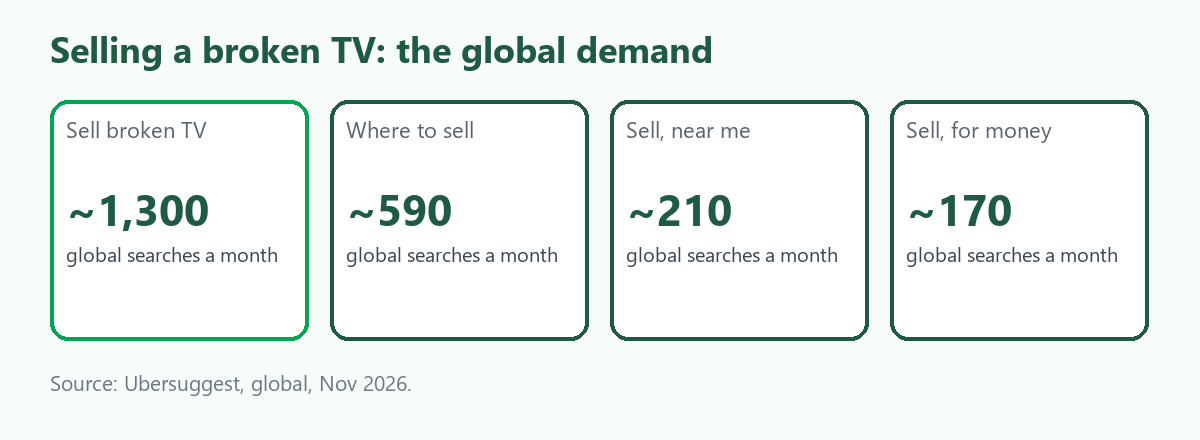
"Sell broken TV" is searched about 1,300 times a month worldwide, according to Ubersuggest, with "where to sell broken tv" about 590, "sell broken tv near me" about 210, "sell broken tv for money" about 170 and "can I sell broken tv" about 110. Keyword competition is low, and the cost per click is only about 1 dollar. The searchers have a set with a cracked screen, no picture or no power, and they want to know whether it is worth anything. The answer depends on the fault and the model, and many sets are worth recycling and not selling. This guide explains who buys a broken TV, what they want from it, when repair makes sense and the one safety warning that matters. It follows our global guide to selling broken TVs and electronics in bulk, and our Australian companion is Can You Sell a Broken TV in Australia. We give no prices. ScrapTrade benefits from scrap trading, and that is a conflict you should weigh.
Who buys a broken TV
The consumer guides we found, several of them thin or promotional, name the same buyers:
- Local repair shops. They buy sets for parts or to fix and resell.
- Electronics recyclers. They take sets that are beyond repair.
- Pawn shops. One source says some buy broken TVs for parts or resale.
- Parts harvesters. They want specific boards.
- Online listings. A marketplace "for parts" category, and general classifieds.
What buyers want from the set
Buyers mostly want the internal boards. One guide lists the power-supply board, the timing-control (T-Con) board and the main board as the parts buyers look for, and another adds speakers and remotes. Selling parts separately can return more than listing the whole set as "for parts or repair", according to the same guides, but it takes more time, tools and care. We give no part prices, since the figures in those guides are undated and from sellers.
Is repair worth it?
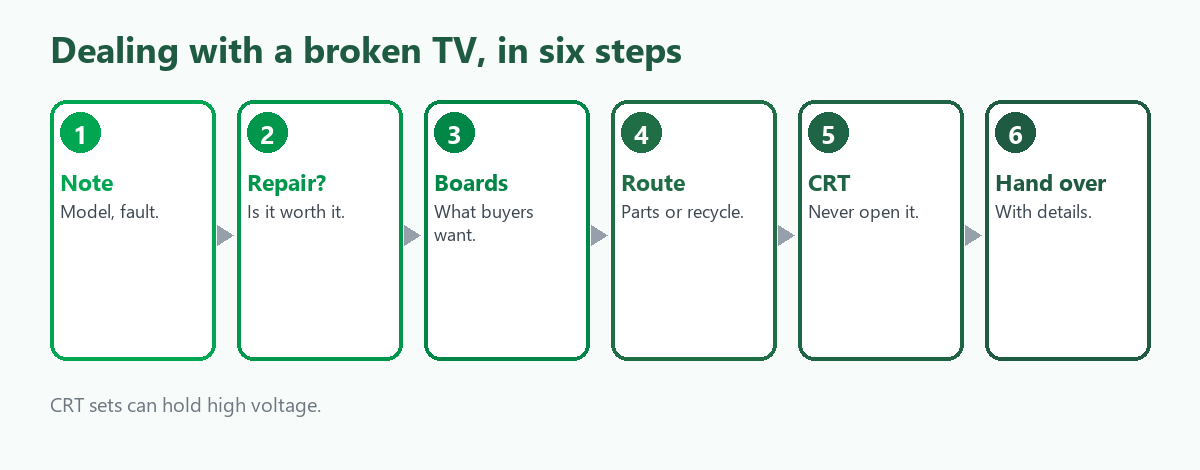
One source's example is a power-supply repair on a three-year-old large TV that cost several hundred dollars new and is worth doing, but not on an older, smaller set. Treat it as a rule of thumb and not data. Compare the quoted repair with what a working set of that model sells for, and with the cost of a replacement. If the screen panel itself is cracked, repair is rarely worth it, in our reading, since the panel is usually the costly part, though we found no source that states this.
The CRT warning
Old cathode-ray tube sets are different from flat screens. One source warns that a CRT television stores up to 27,000 volts in its capacitors even when unplugged, so do not take one apart yourself, and take it to a certified e-waste recycler. We did not find a source on how the lead glass in these tubes or the backlights in some flat screens are regulated, and the Australian guide we wrote covers its local rules, so check your local e-waste authority.
Recycling and free drop-off
Several guides say a TV can be recycled for free or for a small fee at a large electronics retailer or a local e-waste center, and one flags that fees change, so check the current policy before you go. Manufacturer take-back programs exist too. Our guide to selling old electronics and the worldwide guide above explain the used-versus-waste test that applies when sets cross borders.
Preparing the sale
- Note the model and the fault. Buyers search by model.
- Photograph the set. Front, back, the model label and the damage.
- Do not open a CRT. And handle flat screens carefully, since a cracked panel can cut.
- Remove accounts. Smart TVs hold logins, so sign out and reset where you can, as our broken phone guide explains for phones.
- Compare offers. Repair shop, parts buyer and recycler.
- Agree collection. Sets are bulky and awkward.
Where ScrapTrade fits
One broken TV belongs with a repair shop, a recycler or a classified listing, and ScrapTrade is not the right route for it. The marketplace suits volume: a repairer with a yard of dead sets, a hotel replacing screens or a recycler with boards, as our bulk TV guide describes. E-waste is one of its twelve categories, and verified traders in more than 50 countries bid. Listing is free with no commission, you negotiate in real time and the buyer's 5 percent deposit is held in escrow after a bid is accepted. Businesses and individuals can sell once verified. We could not confirm how TV lots are tested and shipped, so write to cs@scraptrade.com.au first.
What we could not verify
- What any broken TV or board sells for. We give no prices.
- How lead glass and backlights are regulated in each place.
- The repair-economics example. It is one guide's opinion.
- How ScrapTrade handles TV lots.
Frequently asked questions
Can I sell a broken TV?
Often yes, to repair shops or parts buyers, but many sets are worth recycling. It depends on the fault and the model.
Which parts of a broken TV are worth selling?
Guides name the power-supply, T-Con and main boards, plus speakers and remotes. We give no prices.
Is a CRT TV dangerous?
One source warns that it can hold up to 27,000 volts even when unplugged, so do not open it. Take it to a certified recycler.
Can I list TVs on ScrapTrade?
E-waste is a category and verified sellers can list. We could not confirm how TV lots are handled, so ask support.
Sources
- Ubersuggest keyword data, global, queried November 2026.
- Consumer and recycler guides on selling and recycling broken TVs, as summarised in search results.
- ScrapTrade website, accessed November 2026.
General information only, not safety advice. Do not open a TV yourself.