

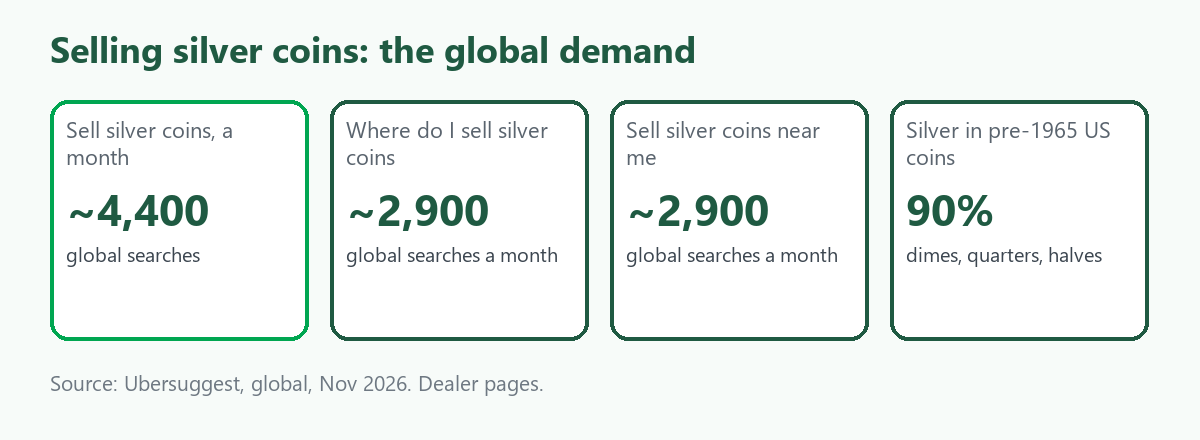
"Sell silver coins" is searched about 4,400 times a month worldwide, according to Ubersuggest, with "where do i sell silver coins" and "sell silver coins near me" about 2,900 each and "where sell silver coins" about 2,400. Almost every searcher holds a mixed handful: some coins that are worth their metal, some worth more to a collector, and some worth face value. Sorting them correctly is the whole job. This guide explains which coins carry silver, how melt value and collector value differ, what tax and reporting points come up and where to sell. It is part of our guide to selling gold, silver and scrap jewelry worldwide, and our Australian companion is Sell Old Coins in Australia. We quote no prices, because silver moves daily and we found no reliable dated figure. ScrapTrade runs a scrap marketplace and has a commercial interest in the scrap trade.
Which coins hold silver
Junk silver is the trade name for circulated coins that are bought for their silver and not as collectibles. For United States coins, dimes, quarters and half dollars dated 1964 or earlier are 90 percent silver, Kennedy half dollars from 1965 to 1970 are 40 percent, and the 1964 Kennedy is 90 percent, according to the dealer pages we found. Coins from 1971 onward are copper-nickel clad and hold no silver. The Coinage Act of 1965 removed silver from dimes and quarters because the metal had become worth more than the coins' face value. Morgan and Peace dollars are 90 percent silver too, but they often carry a collector premium that lifts them above junk status.
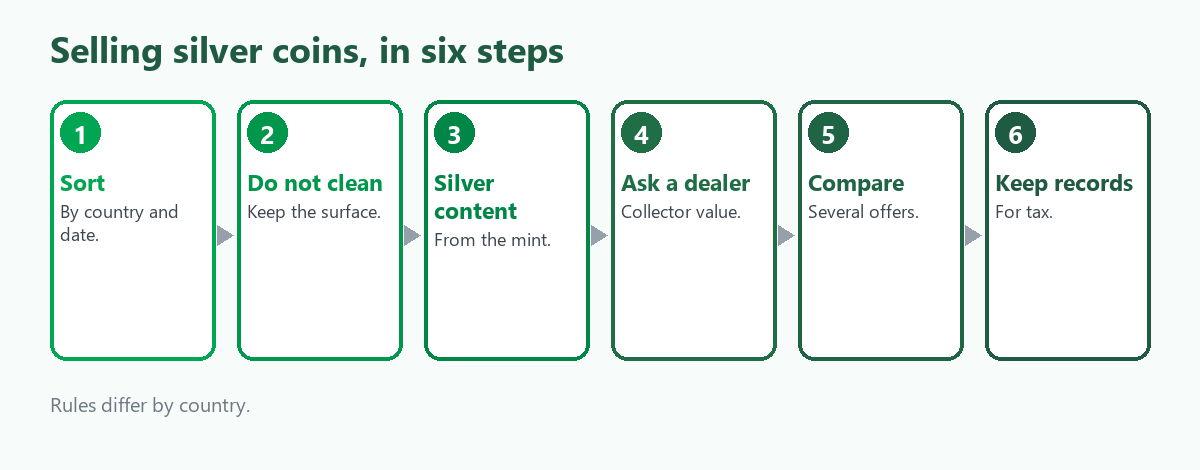
Dealers commonly price a dollar of face value of 90 percent coins at about 0.715 troy ounces of pure silver, which allows for wear, while the figure as minted is about 0.7234, one source says. A 1965 to 1970 Kennedy half holds about 0.148 troy ounces. Other countries struck silver coins to different standards and dates, and we found no single reliable source, so look up the composition of each coin from the issuing mint before you sell it by weight. For Australia, see our guide.
Melt value and collector value
Every silver coin has a melt value: its silver content times the silver price. Some also have a collector value from rarity, date and condition. For circulated common dates the melt value is the floor and the collector value adds nothing. For a scarce date or a coin in excellent condition, the collector value can be many times the melt. A buyer who prices by weight will not pay a collector premium, so sell the wrong coin to the wrong buyer and you lose it. Do not clean or polish coins. Cleaning can damage the surface and cut a collector's interest.
Tax and reporting points
Rules differ widely by country and we did not review them all. Two points came up in our research and are worth knowing. In the United Kingdom, dealer guides say silver coins are standard-rated for VAT at 20 percent when bought new from a VAT-registered dealer, that a private individual selling to a dealer makes no taxable supply and that silver coins issued by the Royal Mint are exempt from capital gains tax on sale, but these are dealer sources, and HMRC's own notice should be checked. In the United States, dealers file reports on certain bullion sales, but the sources we found disagree on whether bags of 90 percent coins still trigger a form, with some listing a threshold of 1,000 dollars face value and a 2026 article saying recent guidance removed it. None was an IRS source. Check the current rules with the tax authority or an adviser.
Where to sell
- A coin dealer. The best route when some coins may carry a premium. Ask which dates they would pay more for, and compare more than one quote.
- A bullion dealer. For common junk silver and bullion coins, priced on weight and silver content.
- An auction house. For a valuable single coin or a collection.
- A pawn shop or general gold buyer. Fast, and sources we found say it generally pays a lower share of metal value.
- Online marketplaces. Possible, with more effort and more risk. Some sellers use them for sets of collectible coins.
- A trade marketplace. For quantity, as below.
Where ScrapTrade fits
A handful of coins belongs with a coin dealer who can test and pay in front of you. ScrapTrade is a trade marketplace with precious metals among its twelve categories, and the coin sellers it suits are the ones with weight: a dealer with surplus junk silver, a club or bank clearing a quantity, or an estate with kilograms of mixed coin. Verified traders in more than 50 countries can bid, listing costs nothing and carries no commission, and you negotiate in real time and agree collection or shipping terms yourself. A bid you accept puts the buyer's 5 percent deposit into escrow. Businesses and individuals can both sell once verified. Describe each coin type and weight, say which are junk and which might carry a premium, and photograph them without cleaning. We could not confirm how ScrapTrade buyers value collector premiums, so ask cs@scraptrade.com.au before listing a valuable collection.
What we could not verify
- The current silver price and coin melt values. The calculators we found used different prices.
- Silver compositions for coins outside the United States and Australia.
- US reporting thresholds for 90 percent coins. The sources conflict and none is the IRS.
- UK tax points. We relied on dealer pages, not HMRC.
- Whether ScrapTrade buyers pay collector premiums.
Frequently asked questions
Which US coins are 90 percent silver?
Dimes, quarters and half dollars dated 1964 or earlier, plus Morgan and Peace dollars.
Are 1965 to 1970 half dollars silver?
Kennedy halves from 1965 to 1970 are 40 percent silver, and 1971 and later are clad.
Should I clean old coins before selling?
No. Cleaning can reduce collector value.
Can I sell silver coins on ScrapTrade?
Precious metals are a category. Businesses and individuals can sell after verification. A single handful is better sold to a local coin dealer.
Sources
- Ubersuggest keyword data, global, queried November 2026.
- Dealer and reference pages on junk silver compositions and Coinage Act of 1965, as summarised in search results.
- UK dealer guides on VAT and capital gains tax for silver coins; US dealer and trade-press pages on 1099-B reporting, as summarised in search results.
- ScrapTrade website, accessed November 2026.
General information only, not financial or tax advice. Rules vary by country. ScrapTrade benefits from scrap trading.