

A pallet of used laptops, a container of retired monitors and a drum of dead phone boards are all "electronics to sell", but the moment they cross a border they are either used goods or waste, and that single label decides which rules apply, who may buy them and what paperwork must travel with them. This guide is for sellers who hold lots, not single devices: repairers, retailers, offices, recyclers and collectors. It explains how the used-or-waste distinction works, what testing and records buyers and regulators expect, what the main rules say, and how selling on ScrapTrade works. It is the international companion to our Australian guide to selling broken, faulty or old electronics. No prices appear here: we found no reliable source for what these lots fetch, and we flag where our evidence runs out. ScrapTrade runs a scrap marketplace, so read this with that interest in mind.
What people search for
Ubersuggest data for the world, pulled in November 2026, shows that e-waste searches are mostly about finding any buyer.
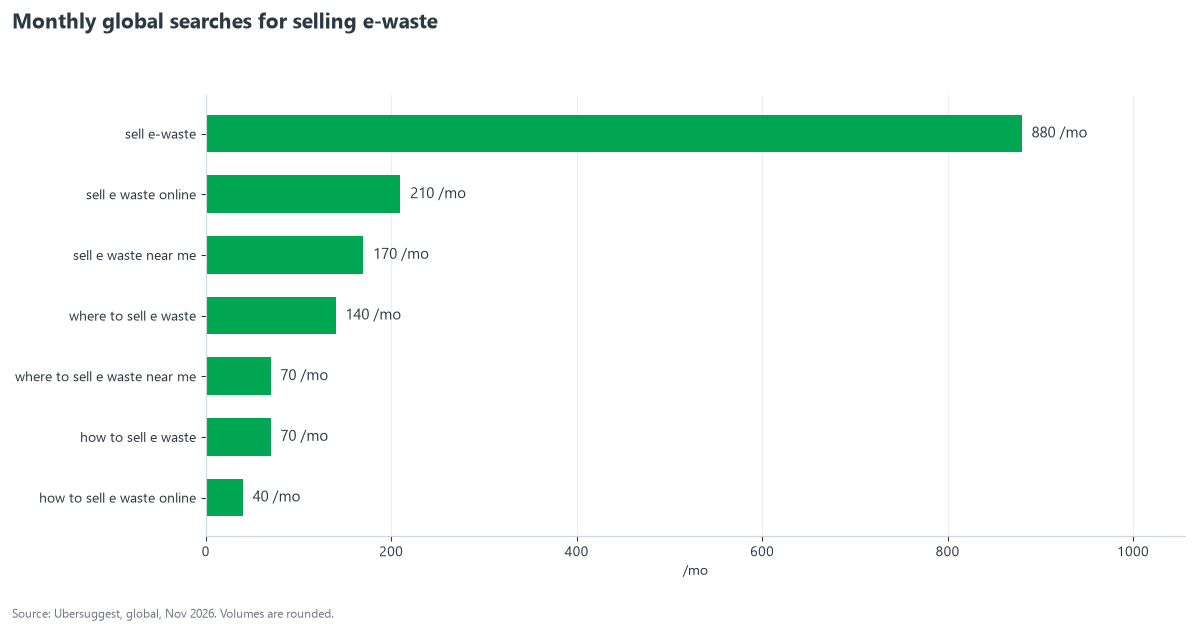
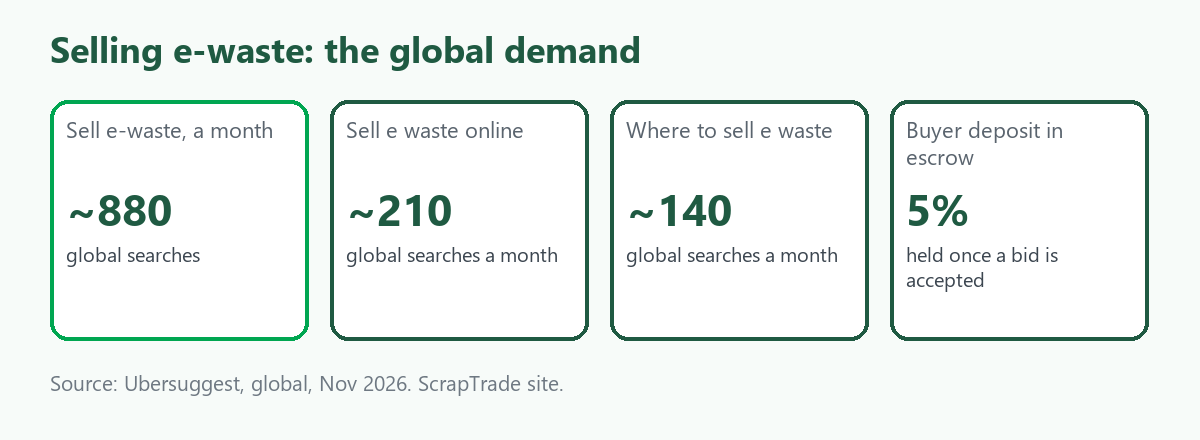
"Sell e-waste" is searched about 880 times a month worldwide, "sell e waste online" about 210, "sell e waste near me" about 170 and "where to sell e waste" about 140. The long tail is Indian city phrases such as Mumbai, Delhi and Hyderabad, of 10 to 30 searches each, and the advertising cost is low, under about a dollar a click. Searches for bulk phrasing such as "sell used electronics in bulk" show no measurable volume, even though bulk is how trade works. The searchers are mostly people with a quantity who want a local buyer, and the cross-border question usually comes later, when a local buyer pays little or none.
The test that decides everything: used or waste
The Basel Convention, the international treaty on hazardous waste movements, turns on whether electronic equipment is waste. Its technical guidelines on e-waste, as summarised in the sources we found, centre on functionality. Used equipment is normally treated as waste if it has a defect that materially affects its function and fails the relevant tests, or has physical damage that impairs its function or safety. Testing is expected, and the guidelines suggest that evidence of testing, such as a certificate or record, should accompany exported used equipment. Inspection without testing function is described as unlikely to be enough.
Parties and campaigners disagree on the edges. The Basel Action Network takes the stricter line that equipment of unknown functionality should be treated as waste. Whether equipment sent for repair, refurbishment or failure analysis counts as waste differs among Parties. We could not confirm which version of the guidelines is the currently adopted text, so check the Basel Convention secretariat's site before you rely on specific wording. For a seller, the working rule is simple: if you cannot show that it works, treat it as waste.
What the main rules say
- Basel. Waste electronics that are hazardous, or listed, need prior consent from the importing country, and commentary says recent amendments to the e-waste entries narrow the gap that let hazardous or mixed e-waste move as if it were a harmless commodity.
- European Union. Regulation (EU) 2024/1157 on shipments of waste keeps hazardous waste exports to non-OECD countries prohibited, and non-hazardous waste exports for recovery to non-OECD countries face approval and a list of approved destination facilities, with the first list expected by 21 November 2026, according to law-firm summaries. Plastic waste exports to non-OECD countries are banned from the same date. One source says e-waste exports to non-OECD countries are banned and another reads the annexes more narrowly, so the answer depends on how each item is classified. Check the EUR-Lex text.
- Australia. The Department of Climate Change, Energy, the Environment and Water controls e-waste exports through its own rules, summarised in our guide to selling broken TVs and electronics in bulk.
- Everywhere else. Importing countries add their own rules, including bans and licences for used electronics. We did not review them individually.
We are not lawyers, and most of our sources are legal summaries and commentary, so treat this as a map and not as advice.
Step 1: Classify the lot
Split a lot into three groups before you offer it. Working items pass a functional test, can be shown to work and are sold as used goods. Repairable items have a known fault and are sold to repairers or refurbishers, with the destination's rules in mind. Waste items are broken beyond reuse, and are sold to recyclers or processors, with waste rules applying. Mixed lots are the problem: a pallet with a few working units hidden among dead ones will be treated as waste and may be refused.
Step 2: Test, record and wipe
Test every unit that is sold as working and keep the record: the model, serial number, test date, what was tested and the result. Wipe or remove data storage, because devices carry personal and business data. The records protect you in a dispute and at a border, and they help the buyer price the lot. Label the packaging with the contents and condition, and photograph pallets as they are loaded.
Step 3: Agree the contract and the paperwork
For a cross-border sale, agree the shipping terms, such as EXW or FOB, the currency, the test and inspection rights of the buyer and who obtains any permits or consents. Ask the buyer to confirm that its facility can lawfully receive the material, and get that in writing. Insurance and packaging are your problem until the risk passes under the agreed terms. Expect a good buyer to ask for your records, and be suspicious of any buyer that does not.
Why sell on ScrapTrade
ScrapTrade is a marketplace for scrap and recyclable material, with e-waste among its twelve categories. It was built for trade, which is where this guide's seller fits:
- Who bids. Recyclers, refurbishers and parts dealers in more than 50 countries are the verified traders ScrapTrade says it connects sellers with, which suits lots that a local collector prices badly.
- What it costs. Nothing to list and no commission. The AI helper drafts the description from your photos and details, and you edit it.
- Terms stay yours. Negotiation happens in chat in real time, and you set EXW or FOB terms in Australian or US dollars, which is where testing records and pallet counts earn their keep.
- Money is held. Once a bid is taken, the buyer's 5 percent deposit sits in escrow until the sale is done, with Stripe handling payment.
- Identity is checked. Sellers pass identity and business verification, whether a company or an individual.
How it works, step by step
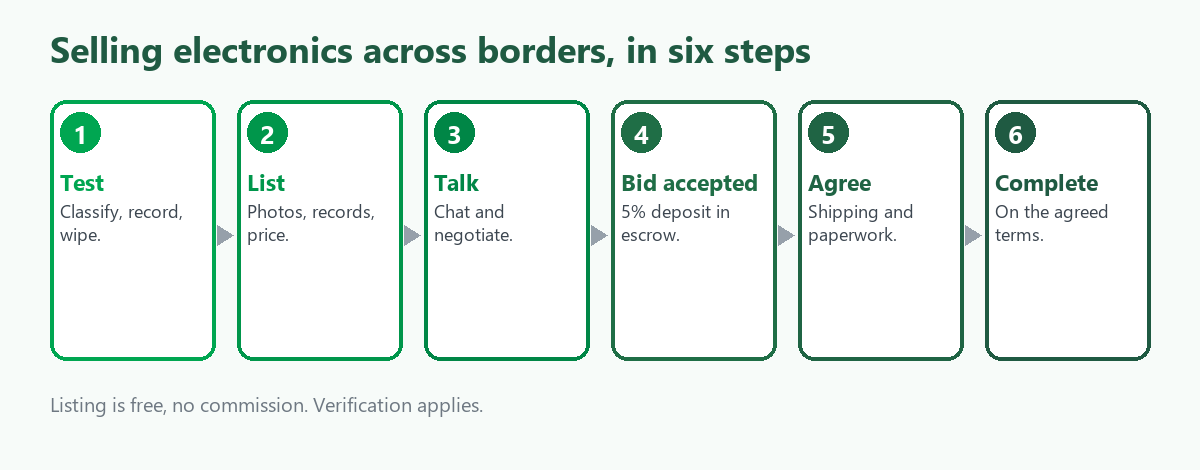
- Test and document. Classify the lot, test the units, wipe the data and photograph the pallets.
- List. Open an account, pass verification, then publish a listing with quantities, test records and an asking price. Check any AI-drafted text.
- Talk. Inquiries arrive in chat, and you negotiate live.
- Bid accepted. Accepting a bid puts the buyer's 5 percent deposit into escrow.
- Agree shipping and paperwork. Settle terms, permits and who handles them.
- Complete. The sale closes on the agreed terms.
Where it does not fit
ScrapTrade does not own the material, broker the deal or arrange consents, so legal responsibility for a shipment stays with seller and buyer. A single phone is better recycled through a local scheme. We could not confirm how ScrapTrade checks that a lot is classified correctly, or how it treats consent paperwork, so ask before planning a cross-border lot. For anything else, including verification steps, contact cs@scraptrade.com.au.
What we could not verify
- What used and broken electronics sell for. We found no reliable source.
- The current adopted Basel technical guidelines. We relied on draft and secondary versions.
- How the EU rules classify each e-waste item. The sources conflict.
- Importing countries' rules. We did not review them.
- How ScrapTrade checks classification and permits.
- ScrapTrade's verification process. It is not published.
Frequently asked questions
How do I sell e-waste to a buyer overseas?
Classify the lot as working, repairable or waste, test and record the working units, agree terms and paperwork with the buyer and check both countries' rules.
Is a broken laptop waste?
Under the Basel guidelines, used equipment with a defect that materially affects function, and that fails testing, is normally treated as waste.
Do I need a certificate of testing?
The guidelines suggest records or a certificate of testing should accompany exported used equipment, and buyers and customs may ask for them.
Can I sell electronics on ScrapTrade?
E-waste is a category. Businesses and individuals can sell after verification, listing is free with no commission, and the buyer's 5 percent deposit is held in escrow after a bid is accepted.
Sources
- Ubersuggest keyword data, global, queried November 2026.
- Basel Convention technical guidelines on e-waste and commentary, as summarised in search results; Basel Action Network guideline on used electronics.
- Regulation (EU) 2024/1157 on shipments of waste, as summarised in law-firm guides.
- ScrapTrade website, accessed November 2026.
General information only, not legal advice. Cross-border rules vary and change, so confirm with the authorities concerned. ScrapTrade is a scrap marketplace.