

Used machinery is traded across borders every day, and the buyers who pay best for an old press, a food processing line or a restaurant fit-out are often in a country where new equipment costs more than the buyer can afford. The same rules also stop shipments: import age limits, inspection requirements and safety duties can all attach to the seller's paperwork. This guide is for businesses, liquidators, dealers and workshops that hold used equipment and surplus stock. It explains the demand, how to grade equipment, what to check before selling to a foreign buyer and how selling on ScrapTrade works. It is the international companion to our Australian guide to selling used commercial and industrial equipment. There are no prices below, as no trustworthy source emerged, and we say where our evidence stops. Bear in mind that ScrapTrade operates a scrap marketplace and profits from the trade.
What people search for
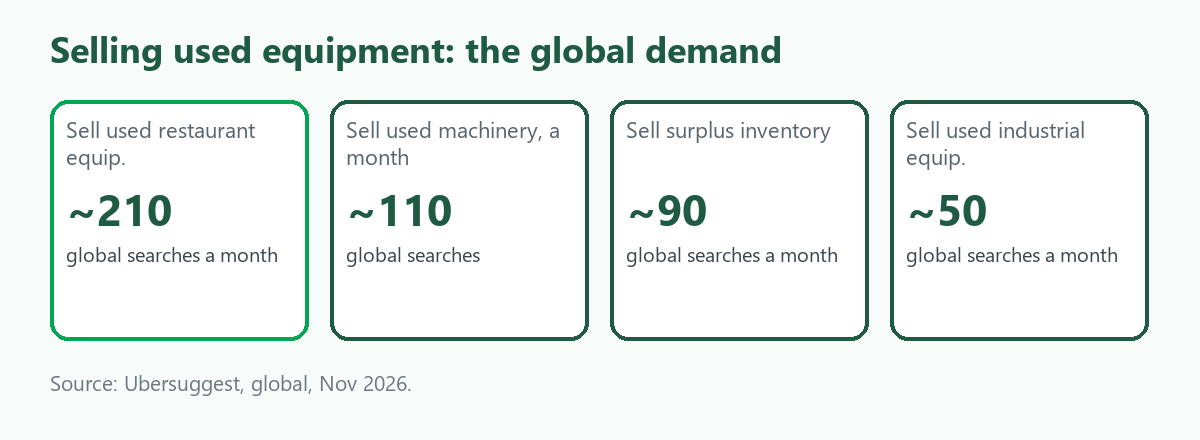
Ubersuggest data for the world, pulled in November 2026, shows a small seller-side family with a high advertising price.
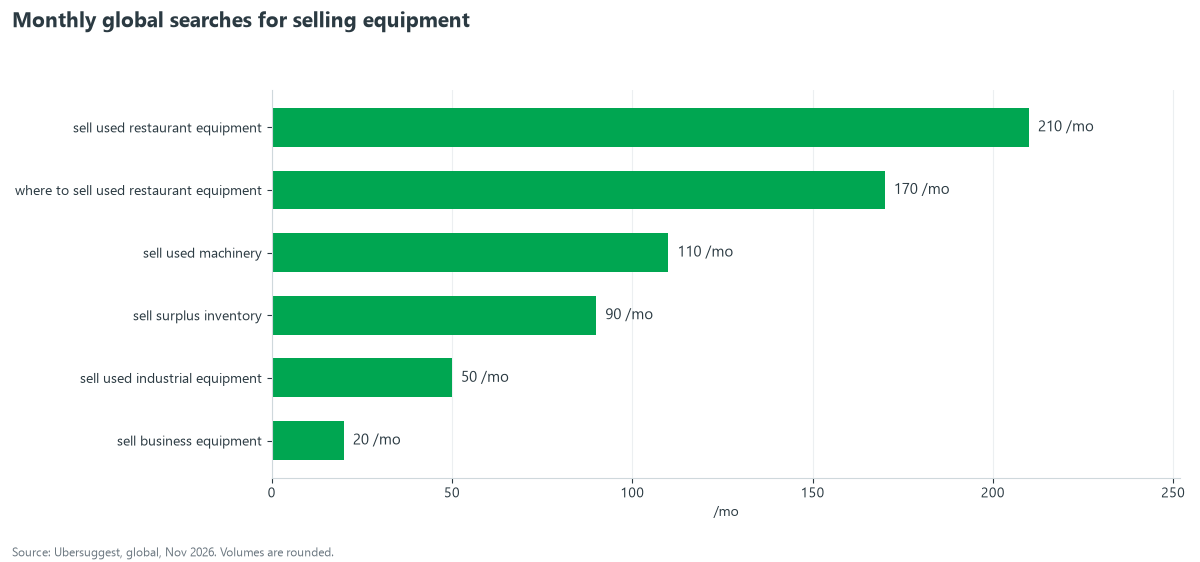
"Sell used restaurant equipment" is searched about 210 times a month worldwide, "where to sell used restaurant equipment" about 170, "sell used machinery" about 110, "sell surplus inventory" about 90, "sell used industrial equipment" about 50 and "sell business equipment" about 20. The volumes are small but the advertising cost is not: about 8 dollars a click for machinery, near 20 for industrial equipment and 5 to 7 for restaurant equipment, which suggests buyers pay well to reach sellers. Indian phrasing such as "sell used machinery online india" is about 70. As with every equipment family, most sales never start with a search, so the value of a page is in explaining the checks.
Step 1: Grade the equipment
- Serviceable. Working, safe and complete, with records. Sold as equipment to a user.
- Repairable. A known fault. Sold to repairers and dealers with workshops.
- Spares. Not worth repairing, but motors, controllers, drives and tooling are useful.
- Scrap. Beyond use, sold by weight and metal type.
Record the make, model, serial number, age, hours and condition, and keep manuals and service history. For restaurant equipment, add fuel type and certification plates, because gas appliances are regulated in some countries. For example, selling a non-certified gas appliance, including a second-hand one, is an offence in Australia, as we explain in Sell Second-Hand Commercial Kitchen Equipment.
Step 2: Check the destination's import rules
Many countries restrict imports of used machinery, and the sources we found conflict, so do not rely on a single guide. India's rules are described differently by different sources: one 2026 guide gives a 10-year age limit for used capital goods without special authorisation, another says most second-hand capital goods can be imported freely, and both mention that a chartered engineer's certificate of residual life is commonly required. Indonesia is described as setting age caps by tariff line under a 2025 trade regulation, with only some importers allowed, though sources disagree and one vendor's claim of a 10-year ban could not be confirmed. China is described by one source as having no age limit but safety and usability requirements, and by another as imposing strict age limits, and most sources agree that pre-shipment inspection by an approved body is common. These are vendor and logistics blogs, not regulators. The working rule is that the buyer owns import compliance, and the seller supplies the documents: age, condition, serial numbers, inspection reports and certificates. Ask the buyer which they need before you agree a price.
Step 3: Know your own safety and legal duties
Some countries put duties on the seller of used plant. Safe Work Australia's guidance, for example, says suppliers of second-hand plant must take reasonable steps to make it safe, disclose faults and condition and tell the buyer in writing when plant is sold as scrap or spares and should not be used as plant, as set out in Sell Used Machinery and Industrial Equipment. Other countries have their own rules, and we did not review them. In any country, check that the equipment is yours to sell: law-firm guides advise searching registers of security interests by serial number and against the seller, and leased or financed equipment is not free to sell until the lender releases it.
Step 4: Inspect, document and ship
Offer the buyer or an independent inspector the chance to inspect and test the equipment before loading, and keep photographs and a loading list. Agree shipping terms such as EXW or FOB, the currency, who loads and secures heavy items and who handles export and import documents. Insurance and packaging are yours until the risk passes under the terms.
Why sell on ScrapTrade
ScrapTrade is a marketplace for scrap and recyclable material. That describes where it fits. The case for it is practical:
- Who bids. Metal recyclers and spares dealers, among verified traders in more than 50 countries, are the likely audience for retired equipment sold by weight.
- What it costs. Listing is free and no commission applies. The AI helper can draft the text from your details, and you correct it.
- Terms stay yours. Chat and negotiation are live, and collection or shipping is agreed directly using EXW or FOB terms in Australian or US dollars, which matters for heavy items.
- Money is held. After a bid is accepted, the buyer's 5 percent deposit stays in escrow, and payments run through Stripe.
- Identity is checked. Verification applies to every seller, company or individual.
How it works, step by step
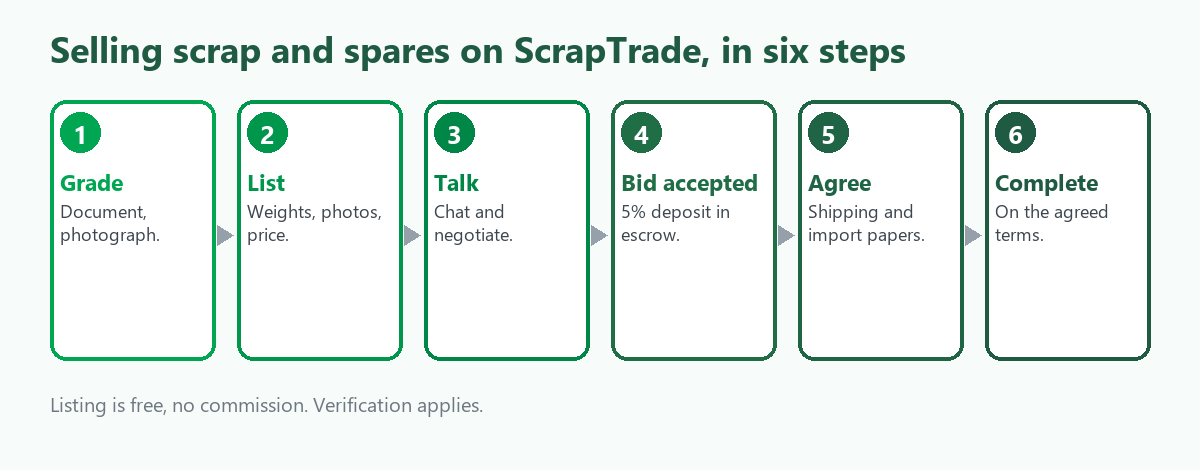
- Grade and document. Grade the equipment, record the details and photograph each item.
- List. Sign up, pass verification and publish quantities, weights, photos and price. Edit any AI-drafted text.
- Talk. Buyers contact you, and you negotiate in real time.
- Bid accepted. The buyer's 5 percent deposit goes into escrow.
- Agree shipping and import documents. Settle who loads, who ships and who supplies which paperwork.
- Complete. The sale closes on the agreed terms.
Where it does not fit
ScrapTrade neither owns the material nor brokers deals, and it does not arrange inspections or permits. A working machine for a particular factory often sells better through a dealer, an industrial auction or a direct sale, where the buyer wants it to run. We could not confirm whether working equipment can be listed as equipment, as opposed to scrap or spares, so ask cs@scraptrade.com.au first. The sweet spot is scrap and spares: retired machinery sold by weight, motors and cable, stainless fit-outs and lots with no local buyer.
What we could not verify
- What used equipment sells for. We found no reliable price source.
- Importing countries' current rules. The sources conflict, and we relied on vendor and logistics pages.
- Other countries' seller safety duties. We reviewed only Australian guidance.
- Whether ScrapTrade lists working equipment as equipment.
- ScrapTrade's verification process. It is not published.
Frequently asked questions
Can I export used machinery?
Usually yes, but many countries restrict imports by age, inspection or licence, so ask the buyer what the destination requires.
Do I need an inspection certificate?
Often, according to the sources we found, including a chartered engineer's certificate for some destinations or a pre-shipment inspection for others. Confirm with your buyer.
Can I sell equipment for scrap or spares?
Yes. Some countries require sellers to say in writing that plant is sold as scrap or spares and not for use.
Can I sell equipment on ScrapTrade?
It is a scrap and recyclable material marketplace. Businesses and individuals can sell after verification, and listing is free with no commission. Ask support whether working equipment suits it.
Sources
- Ubersuggest keyword data, global, queried November 2026.
- Logistics and vendor guides to used-machinery import rules in India, Indonesia and China, as summarised in search results.
- Safe Work Australia guidance on supplying second-hand plant, as summarised in search results.
- Law-firm guides to security-interest registers for equipment, as summarised in search results.
- ScrapTrade website, accessed November 2026.
General information only, not legal or trade advice. Import and export rules change by country, so confirm them. ScrapTrade benefits from scrap trading.