

Search for how to start a scrap business in Dubai and you will find dozens of company-setup websites, each with its own list of costs and timelines, and they often disagree. We said so in Scrap Business Rules and Documents by Country, where Dubai was one of two places we could only describe from consultancy blogs. This article fixes that for Dubai. It is built from the regulator's own document: Dubai Municipality's "Technical Guidelines on Scrap & Metal Waste Trading Activity" (document DM-WSPD-P04-015, version 1.0, dated 22 August 2024), published as open data by its Waste Strategy and Projects Department [1].
We read the guideline directly. We also say what it does not cover, because that is where company-setup websites tend to fill the gap with confident figures. It is general information, not legal advice, and the guideline is for Dubai only. Other emirates have their own authorities.
Who the guideline applies to
The guideline covers scrap and metal waste trading inside the Emirate of Dubai by companies that hold, or plan to hold, either:
- a business licence from the Department of Economy and Tourism (DET) for activity code 4669102, Scrap & Metal Waste Trading, or
- a licence from one of Dubai's free zone authorities for the same activity [1].
"Trading" is defined broadly. It includes purchasing, wholesaling and retailing of waste, and it includes brokering: arranging transactions between waste producers and treatment facilities for a fee or commission. A trader, in the guideline's words, acquires waste on its own responsibility and resells it without changing its nature. A broker does not take ownership but brings the parties together by contract [1].
The steps, as the guideline sets them out
1. Get approval from DET before you operate
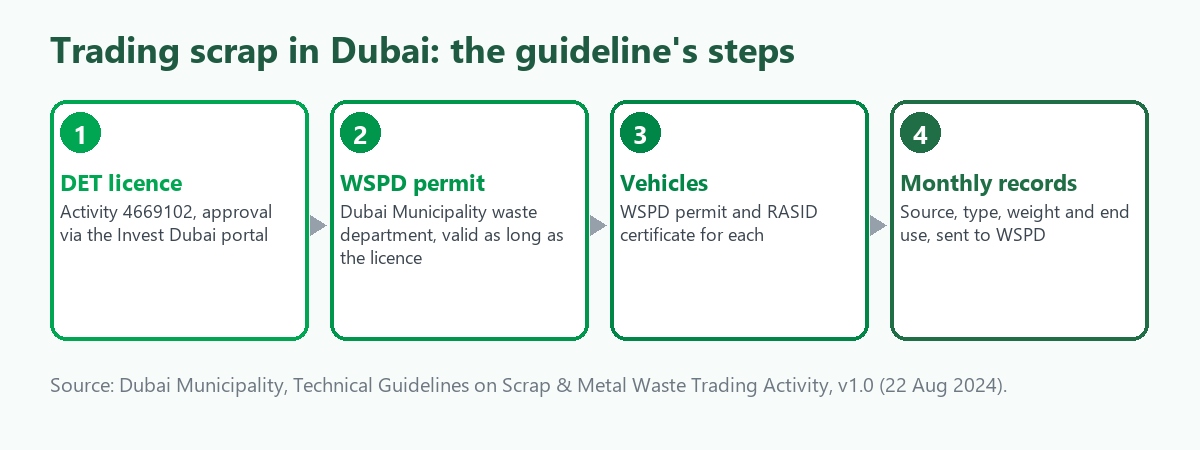
All waste trading companies applying for permits must secure DET approval before operating, through the Invest Dubai portal [1].
2. Get a permit from Dubai Municipality's waste department
All companies engaged in, or planning, waste trading must also apply for a prior permit from the Waste Strategy and Projects Department (WSPD). The permit is valid for the same duration as the business licence [1]. This is a separate step from the DET licence, which is the point many summaries blur.
3. Meet the basic company requirements
A trading company must have a Dubai office, a working mobile and landline number and an email address [1].
4. Permit every vehicle
Every vehicle used to transport waste needs a WSPD permit and must meet the guideline's transport rules. For transport within Dubai, the guideline also requires a valid RASID certificate for the vehicles. RASID is Dubai Municipality's waste monitoring system for registered waste management companies, tracking collection, transport and disposal [1]. Suitable vehicles listed in the guideline are pick-up trucks with side barricades, skip loaders or tippers, and closed vans for small amounts.
You may use a third-party transporter if you have a formal contract. Any accident or activity caused by the transporter is the hiring company's responsibility unless the contract says otherwise [1].
5. Keep records and report every month
This is the heart of the compliance burden. Trading companies must submit details of their activity to WSPD monthly: the source of the material, its type, its weight and the end-use facility, including exports. The minimum records are the type of material traded, the total quantity per day, details of the source and the destination [1]. The guideline includes a template with these columns: date, waste type and description, amount in kilograms, container type, source name and address, transporter name and vehicle plate, and end-use facility name and address.
6. Know what you may not do
- You may not collect waste from communal bins provided by Dubai Municipality or from the bins of private companies.
- You may not install cages or bins for collection unless you get a no-objection certificate (NOC) from the relevant authorities, including WSPD, and from the owner of the plot where the waste is collected [1].
Specific activities in the guideline's table
| Activity | What you need, according to the guideline |
|---|---|
| Brokering within Dubai | A valid waste trading licence from WSPD for the specific waste type, and valid contracts with the waste generator and the treatment or recycling facility |
| Transport within Dubai | A valid waste trading licence from WSPD for the specific waste type, and RASID certificates for the vehicles |
| Import or export between emirates | A valid waste trading licence from DET for the specific waste type. Export of hazardous waste to other emirates for reasons other than disposal needs prior written approval from the Waste Treatment Section. Import of non-hazardous waste, such as metal waste and recyclables, needs the approvals of the local authority where the waste originated |
Companies may also import, collect and transport recyclable materials from other emirates or other countries, provided the local authority where the waste originated approves [1].
The load standards
The guideline also sets technical standards for what you trade. In summary [1]:
- No hazardous contamination. Scrap must not be contaminated with hazardous materials or other impurities that would stop recycling being done safely.
- Inspect before collecting. The trader must inspect the waste to check it meets the quality requirements.
- No visible oil. Oil, oily emulsions, lubricants or grease should not be visible, apart from negligible amounts that will not drip. The guideline says to look especially at the bottom of the load.
- No closed or pressurised containers. Scrap must not contain pressurised, closed or insufficiently open containers that could cause explosions in a furnace.
- Grade to a specification. Scrap should be graded to the receiving facility's specification, or to a standard or industry specification. The guideline's examples are the European Steel Scrap Specification and the ISRI specifications.
- No hazardous input. No hazardous waste should have been used as input to obtain the scrap, unless there is proof that it was treated in a process approved by Dubai Municipality to remove its hazardous properties.
- Train your staff on the hazardous properties that can be associated with iron and steel scrap and how to recognise them, with the procedure documented.
- Keep digital records of quantities and qualities received and traded, and show them during inspections. For metals this means type (such as ferrous or non-ferrous), alloy composition, weight and contamination level.
These are close to what any careful buyer does anyway. For the practical side, see How to Verify Scrap Before You Buy or Sell.
What the guideline does not say
This matters as much as what it does. The document does not give:
- Fees and timelines. It lists the legal framework, including a resolution on waste fees and fines, but gives no amounts for licences or permits and no processing times. Figures you see on company-setup sites come from those companies, not this document.
- Penalties. It does not set out fines for breaking the guideline.
- Customs and export rules. It deals with inter-emirate movement and refers to exports in the monthly report, but does not cover UAE customs procedures or the destination country's import rules.
- Yard or processing sites. Its scope is trading. It does not describe the approvals for operating a yard, shredder or processing plant. Some consultancy sites describe a yard inspection by Dubai Municipality, but we have not verified that against an official source.
- Seller identity and payment rules. Unlike Australian states or UK councils, it does not set out seller ID checks or rules on cash payment.
- Other emirates. It applies in Dubai only.
If a website tells you the exact cost or the exact number of weeks, ask where the figure comes from.
Scenario: a first-time trader
Layla wants to trade steel and aluminium scrap from Dubai's industrial areas, selling to a smelter in another emirate. She does not plan a yard. (An invented example.)
- She chooses a trading licence with activity 4669102 and applies for DET approval on the Invest Dubai portal.
- She applies to Dubai Municipality's waste department for her trading permit.
- She sets up an office, phone numbers and email.
- She uses a third-party transporter under a written contract. The transporter holds a permit and RASID certificates for its vehicles.
- She confirms her DET licence covers the specific waste type for movement between emirates, and asks the smelter what approvals the receiving emirate needs, since the guideline only covers Dubai's side.
- Every month she sends a record of what she bought, from whom, how much, and where it went.
- She inspects each load for oil, sealed containers and mixed metals before collecting, and keeps her grade notes in a digital log.
Nothing in that list involves a yard, but all of it involves paperwork. The most common failure for new traders is not the application. It is keeping monthly records up to date.
What it means for you
- Start from the regulator. Read the guideline yourself, and ask Dubai Municipality and DET to confirm current fees, timelines and any updates, because this is version 1.0.
- Budget for compliance, not just the licence. Vehicle permits, RASID certificates and monthly reporting are ongoing.
- Brokers are included. If you plan to work through other people's supply, the guideline covers you. See Become a Scrap Broker or Agent: How to Start, and note that ScrapTrade's pages do not say registration is free.
- Ask your buyer for specification. The guideline expects you to grade to the receiving facility's specification. See How to Negotiate a Scrap Deal.
- Exporting needs more. Customs, destination rules and inspection are outside this document. See Trading Scrap Internationally.
To compare buyers and list material, see the ScrapTrade marketplace or register.
Frequently asked questions
Do I need a licence to trade scrap metal in Dubai?
Yes. The guideline covers companies with a DET or free zone licence for activity 4669102, and requires DET approval before operating plus a permit from Dubai Municipality's waste department [1].
Are scrap brokers regulated in Dubai?
Brokering is within the guideline's definition of waste trading, and brokering within Dubai needs a WSPD waste trading licence for the specific waste type and contracts with the generator and the treatment facility [1].
What records must a scrap trader keep?
Type and quantity of material traded per day, source details and destination, and monthly reporting to WSPD. Metals records should include type, alloy composition, weight and contamination level [1].
Can I collect scrap from communal bins?
No. The guideline prohibits collecting from communal bins provided by Dubai Municipality or from private companies' bins [1].
How much does it cost and how long does it take?
The guideline does not say. Ask DET and Dubai Municipality, and treat figures from company-setup sites as estimates.
Sources
- Dubai Municipality, Waste Strategy and Projects Department, Technical Guidelines on Scrap & Metal Waste Trading Activity, document DM-WSPD-P04-015, version 1.0, 22 August 2024.
This article summarises one regulator document and is general information, not legal advice. Rules, fees and approvals change, so confirm with Dubai Municipality and the Department of Economy and Tourism. The scenario is invented. ScrapTrade operates a scrap marketplace and has a commercial interest in the scrap trade.