

Most new traders think negotiating a scrap deal means arguing about the price per tonne. That is only one line. Two deals at the same headline price can leave you with very different money, depending on whose scale is used, who pays for the truck, how much is deducted for dirt and when you get paid. This guide explains what to negotiate, how to work out your limits before you start and how to say no. It uses made-up scenarios with simple arithmetic so you can follow the logic and swap in your own numbers. It is general information, not financial advice, and it follows How to Verify Scrap Before You Buy or Sell.
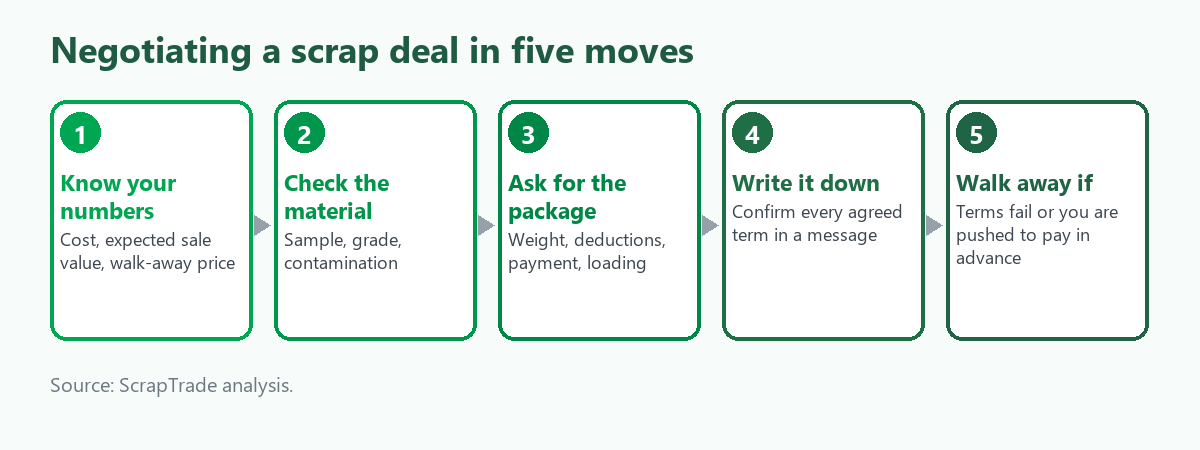
Step one: know your numbers before you open your mouth
You cannot negotiate well if you do not know what a deal is worth to you. For every lot, work out three numbers.
- Your cost, all in: what you pay the seller, plus loading, transport, weighing and any fees.
- Your expected sale value, after the buyer's likely deductions for grade and contamination, not before.
- Your walk-away price: the most you can pay, or the least you can accept, and still make a margin you can live with.
Scenario: the walk-away number
Maya is offered 6 tonnes of aluminium extrusion offcuts at A$2,300 a tonne, a total of A$13,800. She calls a yard and asks what it would pay for clean extrusion of that kind, and learns it pays around A$2,900 a tonne but takes a deduction of about 3% for paint and attachments. Her sums look like this.
| Item | Amount |
|---|---|
| Sale value: 6 t at A$2,900 | A$17,400 |
| Less 3% deduction | minus A$522 |
| Less transport and loading | minus A$450 |
| Left to cover the purchase and pay for her time | A$16,428 |
| Purchase at A$2,300 a tonne | A$13,800 |
| Margin | A$2,628, about 19% of what she pays |
Maya decides her walk-away is A$2,500 a tonne. At that price her margin drops to about A$1,428, which is the least she will accept for a day of work. She now knows what she can offer, what she can concede and when to say no. (Numbers invented for the example.)
Step two: find out what the other side is really asking
Before you push on price, find out what matters to them.
- A seller of scrap may want a quick pick-up, cash soon, no cleaning up or a regular buyer.
- A buyer may want consistent grade, enough volume to fill a truck or a supplier they can rely on.
If you can give them what they value cheaply, you can ask for something in return. A seller who wants the pile gone fast may accept a lower price. A buyer who needs a full truckload may pay more for certainty.
Step three: negotiate the package, not just the price
Here is what is on the table, beyond the headline number.
| Term | What to ask | Why it matters |
|---|---|---|
| Price basis | A fixed price per tonne, or a published benchmark less an agreed discount, and on which date | Metal prices move, so "the price" needs a date |
| Weight | Whose scale, loaded or at delivery, and tolerance | Weight is money |
| Grade | A written description and what counts as a defect | Stops arguments after loading |
| Deductions | How contamination is measured and charged | The silent margin killer |
| Loading and transport | Who does it, who pays and by when | Costs hide here |
| Payment | When, how and what happens if there is a dispute | Cash flow and risk |
| What if it goes wrong | Re-grading, rejection and return freight | Decides who bears a bad surprise |
For metals such as copper and aluminium, deals are commonly quoted off a published benchmark price, such as the London Metal Exchange, less a discount for grade, quantity and location. Steel is more often priced on regional market levels. Whichever it is, make sure both sides name the same price source and the same date, because a swing of a few per cent over a week can erase a margin.
Scenario: the same price, two different deals
Two buyers offer Tom A$1,000 a tonne for 10 tonnes of mixed steel.
- Buyer A weighs at his yard after delivery, deducts 4% for dirt, and pays in 30 days. Tom pays the freight.
- Buyer B weighs on a public weighbridge before loading, deducts 1%, collects the load himself and pays within three days.
The price is the same. Buyer B's deal is worth far more: no freight to pay, a neutral scale, a smaller deduction and cash 27 days sooner. A tonne price is not a deal. A tonne price plus terms is a deal.
Step four: how to actually do it
Let them speak first when you can
If the seller names a price, you learn their expectations. If you name a price first, make it reasonable and be ready to explain it. "I can pay A$2,200 a tonne because the paint and steel attachments mean the buyer will deduct, and I have transport to cover" is stronger than "that is too much."
Use facts, not feelings
"My yard checked a sample and graded it as X. Prices for that are around Y after deductions" works better than "you are asking too much." Facts give the other side a way to move without losing face.
Trade, do not just concede
Every time you give something, ask for something. If you agree to a higher price, ask for weight to be taken at your scale. If the seller wants cash quickly, ask for a lower price in return. Concessions that cost you little and are worth a lot to the other side are your best tools.
Having another option helps more than clever words
The best negotiating position is a real alternative. If Maya has another seller or Tom has another buyer, they can say no without panic. Before negotiating, line up a second option, even a weaker one. This is a big reason to list your material where several buyers can see it. On ScrapTrade, sellers can choose a fixed price, a live auction or a response to a buyer's request on the Wanted Board, and they can accept, decline or negotiate offers in the listing's built-in chat [1]. An auction, where buyers compete, can bring a price up without you having to argue for it. See fixed price, auction or Wanted Board.
Put it in writing
When you agree something, write it down and send it back: "Just confirming: 10 tonnes of clean extrusion at A$X a tonne, weighed at the public weighbridge before loading, 1% tolerance, pickup Friday, payment within three days." A text or email is enough. Many scrap disputes are not about dishonesty but about two people remembering a phone call differently.
Step five: know when to walk away
Walk away when:
- the price puts you below your walk-away number;
- the other side will not agree a written grade or weighing method;
- you are pressed to decide right now, or to pay in advance for something you have not seen. The Bureau of International Recycling has warned of fake offers of discounted scrap backed by false documents, and prepayment is a standard warning sign [2];
- the numbers only work if everything goes perfectly.
Walking away is not losing. It is the cheapest way to avoid a bad deal. And it often brings the other side back with a better offer.
Scenario: the pressure call
A caller offers Lena 20 tonnes of "mixed copper" at a price far below the market, but only if she transfers 30% today. She cannot see the material and the company name is not one she knows. She says: "I can come and look at it on Thursday, and I would pay on delivery through an escrow or after inspection." The caller loses interest. Lena has lost nothing but a call. (Invented example.)
Common mistakes
- Negotiating price only, and ignoring weight, deductions and payment.
- Not writing anything down.
- Accepting the first offer because you do not know your numbers.
- Negotiating while angry or in a hurry.
- Squeezing a regular supplier so hard they stop calling.
That last point matters. A good deal is one both sides want to repeat. A supplier who feels cheated will sell to someone else next time.
How ScrapTrade fits in
ScrapTrade is a marketplace, not a negotiator. Its pages say the buyer pays a 5% deposit when an offer is accepted or an auction closes, held in escrow through Stripe, and the seller is paid after the buyer confirms receipt or after 24 hours pass without a dispute [1]. That gives you a protected payment step to build your terms around. The pages do not state any other fee, how long payment takes after release or how disputes are decided, so read them again before relying on them.
To see this in action read A Scrap Deal on ScrapTrade: Worked Examples, and for how to protect yourself, How to Secure Scrap Deals and Avoid Scams. Check today's live material prices before you price a lot, browse the marketplace, or register to list your material.
Frequently asked questions
How do I know what price to ask for scrap?
Check recent prices for your grade, call a yard for what it would pay for a sample, and subtract deductions and transport. Public index figures are rough guides, so confirm with a real buyer.
Should I negotiate price or terms?
Both. Terms such as weighing, deductions and payment can be worth as much as the price per tonne.
Is it normal for buyers to deduct for contamination?
Yes, it is common. Agree in writing how it is measured and charged.
Should I take a deposit?
It depends on the route. On ScrapTrade the buyer's 5% deposit is held in escrow and the seller is not paid until the buyer confirms receipt or the 24-hour window passes without a dispute [1].
When should I walk away?
When the price is below your walk-away number, the other side will not agree to a written grade or weighing method or you are pushed to pay in advance for material you have not seen.
Sources
- ScrapTrade, How ScrapTrade works, as published in October 2026.
- Recycling Today, BIR issues recyclers warning on fraud, as summarised in search results. We could not open the full article.
This article is general information, not financial or legal advice. All people, prices and deals in the scenarios are invented for illustration. ScrapTrade operates a scrap marketplace and has a commercial interest in the scrap trade.