

Here is a story that plays out in scrap every week. A man we will call Dan sees a pile of "clean copper" at a workshop and offers a fair price for the lot. It looks right: reddish, heavy, tangled wire and tube. He loads it, pays and drives to the yard. The yard's grader pulls out a handful and shows him something he did not see: the wire is copper-plated steel, a third of the tube is brass, and the whole load is damp. The yard pays for what is really there, not for what Dan thought he bought, and his margin is gone.
Nothing dishonest had to happen. Dan simply never checked. This guide is about the checks, in plain words, so you do not repeat his mistake. The story is made up, but the pattern is real, and every check below is something you can do with little or no equipment. It is general information, not safety, legal or financial advice. This is one of a series, which starts with How to Plan a Scrap Business: 90-Day Roadmap.
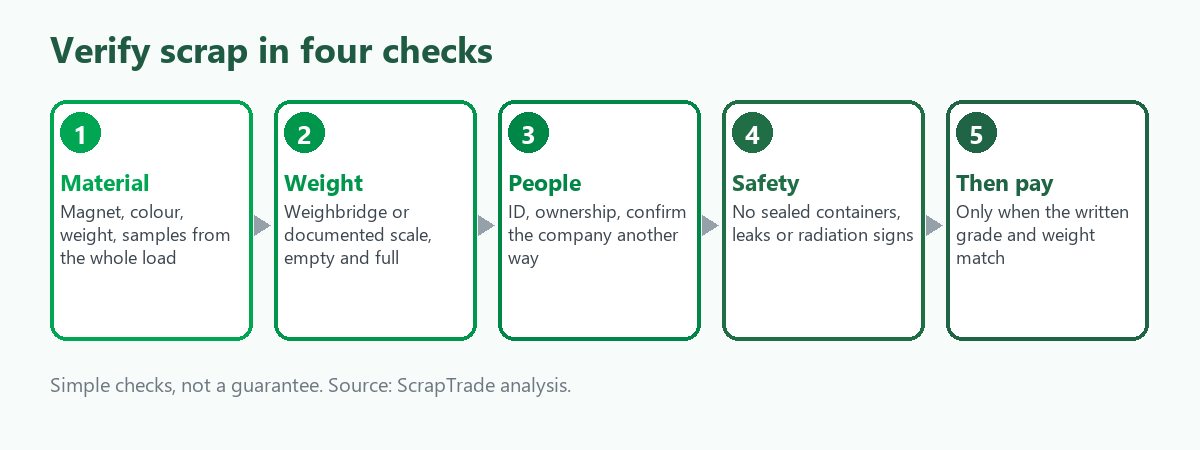
The four checks
Whether you are buying from a workshop or selling to a yard, ask the same four questions before money moves.
- What is it, really? The grade, and how much of it is something else.
- How much is there? The weight, measured in a way both sides accept.
- Who is on the other side? And is the material theirs to sell?
- Is it safe? For you, the truck, the yard and the furnace at the end.
We take them in turn.
1. What is it, really?
Start with your eyes and a magnet
A cheap magnet on a string, or even one from a fridge, does a lot of work.
- It sticks hard: iron or steel. Heavy steel and cast iron are the bulk of most scrap.
- It does not stick: a non-ferrous metal such as copper, brass, aluminium, lead or zinc, or some stainless steels.
- It sticks weakly: often a type of stainless steel. Stainless is the tricky one, because some grades are non-magnetic and others are slightly magnetic, so a magnet alone cannot sort it.
Then use colour, weight and feel. Copper is red-orange where it is clean. Brass is yellow, like a door handle. Aluminium is light for its size and silvery-grey. Lead is surprisingly heavy and soft enough to scratch with a fingernail. Our guide to how to grade scrap metal has more tests.
No home test is certain. Yards that deal in valuable metals often use handheld analysers that read the metal's makeup in seconds, and a good yard will show you the reading if you ask. If a lot is worth thousands, ask a yard or processor to test a sample before you commit. It costs little compared with a wrong grade.
Look for what does not belong
Price lists are for clean material. The usual downgrades are:
- Attachments: steel bolts on aluminium, rubber seals on window frames, plastic on copper pipe.
- Coatings: paint and powder coat on aluminium, solder on copper.
- Mixed metals: brass in a copper load, or cast aluminium in extrusion.
- Moisture and dirt: heavy loads that were left in the rain weigh more than they are worth.
- Plated or "copper-clad" items, which look like copper on the outside and are something else on the inside.
Open the pile, do not just look at the top. A good habit is to take samples from three or four places in a load. If the sample is clean at the top and dirty at the bottom, you have learned something the photo did not show.
Written grade beats a spoken one
The Scrap Specifications Circular published by ReMA, the US recycling industry association, is widely used as a common language for grades. It is a starting point rather than a complete contract, and some grades leave final terms to be agreed between buyer and seller [1]. So whichever name you use, write down what you mean: "clean uncoated aluminium extrusion, no steel, no seals, less than X% paint", for example. If a dispute comes up, the words you wrote are what both sides argue about.
2. How much is there?
Scrap is paid by weight, so weight is where a surprising amount of money disappears.
Scenario: the weight argument
Priya sells 3.2 tonnes of aluminium. The buyer's scale says 2.9 tonnes. She had estimated by eye, and now she is not sure whether she was wrong or the buyer's scale is. With no record of her own, she accepts the lower figure. Next time she knows to weigh first, and to write the number down.
In Australia, a weighbridge used for buying and selling goods is trade equipment. The National Measurement Institute says the owner must have it approved, have a licensed servicing company verify it, keep it clean and working and have it re-verified after each repair or adjustment. It also says weighbridges can weigh goods such as scrap metal over 3 tonnes, and that public weighbridges are open to anyone, usually for a charge [2]. For a seller, that points to a simple habit.
- Use a public weighbridge for bigger lots. Weigh the truck full and empty, so both numbers are on a docket. Neither side owns the scale.
- Agree up front where weight is taken: at your place before loading, or at the buyer's yard after delivery. They can differ, and the difference should not surprise anyone.
- Allow for a tolerance, such as one or two per cent either way, and write it down.
- Keep the dockets. Photograph them. A photo of a weighbridge ticket takes seconds and settles many arguments.
For small lots, use a scale you can document: one with a recent calibration, set to zero before use, on level ground. Rain, wind and a lean can all move the reading. Hanging a load on a crane scale is not the same as standing it on a platform.
3. Who is on the other side?
There are two risks here, and they are different.
Is the material theirs? Scrap metal is a common target for theft, which is why many places require dealers to check seller identification and keep records. If you buy from the public, ask for photo ID, note the vehicle, record what you bought and pay in a traceable way. In New South Wales and Victoria, paying cash for scrap is banned. See Scrap Business Rules and Documents by Country and, for Australia, Scrap Business Rules in Australia by State.
Are they who they say they are? When you trade across distances, fraud is a real risk. The Bureau of International Recycling [3] and large recyclers such as Sims [4] have both published warnings about fake offers and borrowed identities. The patterns and the defences are in How to Secure Scrap Deals and Avoid Scams. The short version: confirm a company through a contact you already trust, and ring the number you know, not the one in the email, before you send money.
ScrapTrade's pages describe identity checks (KYC) for sellers before they list freely, and its trust page says every trader completes one [5][6]. That tells you a real person or business is behind an account. It does not tell you the load is clean, and the trust page says so directly: escrow does not protect the physical condition of the material once it changes hands [6].
4. Is it safe?
This is the one check where being wrong can hurt people, not just your margin.
Sealed containers and gas cylinders
Gas bottles, fuel tanks, drums and any sealed container can explode or burn when they are cut, shredded or baled. Safety bodies are consistent that these are a serious hazard at metal yards, and that most incidents happen when the item is cut, sheared or crushed [7]. A cylinder that looks empty may not be. The safe rule for a small trader is simple: do not buy or accept sealed or unidentified containers, and ask a hazardous-materials professional before anyone touches one.
Scenario: you are clearing a workshop and find a small gas bottle in the metal pile. Take it out, leave it for the owner to return to the supplier, and do not load it with the rest. Cost: five minutes. Alternative: a fire in a shredder, and a yard that never buys from you again.
Batteries, oil and fluids
Batteries, fuel and oil in engines and equipment can leak, burn or poison. Drain or remove what you can and keep the rest separate. Do not mix a leaking item into a clean load.
Radioactive sources
It is rare but serious. New Zealand's health regulator notes that sources that have fallen out of regulatory control, called orphan sources, have ended up in scrap, and in steel made from it, and it advises scrap yards to install gate portal monitors [8]. A small trader will not own a monitor, but you can do three useful things. Ask where industrial equipment came from, particularly gauges, old instruments and devices with warning labels. Do not buy or open anything that carries a radiation sign. And ask the yard or mill you sell to how they screen incoming loads.
What ScrapTrade does and does not check
According to ScrapTrade's own pages [5][6]:
- Sellers complete identity verification before listing freely.
- Listings include photos, material type, estimated weight and pickup location, and a seller can add optional GPS video verification, which ties the material to the place it was recorded.
- The buyer pays a 5% deposit through Stripe, held in escrow. The seller is paid after the buyer confirms the material matches the listing, or after 24 hours pass without a dispute.
- A buyer can raise a dispute within that 24 hours, with the order's chat and any GPS evidence attached.
The pages do not describe a third-party inspection, a photo requirement, a rating system or how long disputes take. So the platform can help you know who you are dealing with and give you a protected payment step. It cannot grade your scrap. Do your own checks.
A checklist to use before you pay
| Check | Quick test | If it fails |
|---|---|---|
| Material | Magnet, colour, weight, three samples from different parts of the load | Re-grade the price or walk away |
| Contamination | Look for steel, paint, seals, moisture, mixed metals | Deduct in writing, or ask the seller to clean it |
| Weight | Weighbridge or documented scale, empty and full | Agree whose scale counts and a tolerance |
| Seller | Photo ID, ownership, traceable payment, records kept | Do not buy |
| Counterparty | Company confirmed through a contact you trust | Do not send money |
| Safety | No sealed containers, no leaks, nothing with a radiation sign | Remove it, or refuse the lot |
| Paperwork | Written grade, weight basis, who loads, payment terms | Write it before loading |
Back to Dan
If Dan had used a magnet, he would have found the steel wire in a minute. If he had taken samples from the bottom of the pile, he would have found the dampness. If he had written "bare bright copper, no plated wire, no brass" on the agreement, he would have had a reason to negotiate the price down or leave. Twenty minutes of checking would have saved him a day of loading and an argument at the yard.
Next in this series: How to Negotiate a Scrap Deal and How to Secure Scrap Deals and Avoid Scams. To see how a protected deal runs, read A Scrap Deal on ScrapTrade: Worked Examples. When you are ready, browse the ScrapTrade marketplace, post what you need on the Wanted Board or register.
Frequently asked questions
Can I test scrap metal at home?
You can sort most common metals with a magnet, your eyes and a scale. It is not certain, particularly for stainless and alloys, so for valuable lots ask a yard to test a sample.
How do I check a seller is honest?
Check identification, ask where the material came from, pay in a traceable way and keep records. For a distant buyer or seller, confirm the company through a contact you already trust.
What should I never buy as scrap?
Sealed gas bottles, closed drums and tanks, anything with a radiation warning, and anything you cannot identify. Ask a professional.
Who should weigh the load?
A neutral, verified scale is best, and in Australia public weighbridges are open to anyone. Whatever you use, agree it in writing before loading.
Does ScrapTrade check my material for me?
No. It describes identity verification, optional GPS video verification and a payment step held in escrow, and its trust page says escrow does not protect the physical condition of the material.
Sources
- ReMA, Scrap Specifications Circular update, describing the circular as guidelines and a starting point for buyers and sellers.
- National Measurement Institute, Weighbridges used for trade (Department of Industry, Science and Resources).
- Recycling Today, BIR issues recyclers warning on fraud, as summarised in search results. We could not open the full article.
- Sims Limited, warning about misuse of its name, as summarised in search results.
- ScrapTrade, How ScrapTrade works, as published in October 2026.
- ScrapTrade, Trust and safety, as published in October 2026.
- Washington State Department of Labor and Industries, Hazard alert on exploding tanks during metal recycling, and related US and UK recycling safety guidance on gas cylinders.
- New Zealand Ministry of Health, Radioactive material in scrap metal recycling.
This article is general information, not safety, legal or financial advice. The stories are invented to show common situations and do not describe real people. ScrapTrade operates a scrap marketplace and has a commercial interest in the scrap trade.