

Refrigerant is the reason an old air conditioner cannot just be hauled to a yard. In the United States, the European Union and Australia, the law says who must recover the gas first, and a unit that arrives with its charge intact creates a problem for everyone down the line. This guide sets out what we could find for each jurisdiction, what it means if you intend to sell or scrap a unit, and where our sources ended. We relied on a summary of an EPA fact sheet, coverage of the EU F-gas Regulation, licensing fact sheets from Australia's industry body and trade press; we did not read the regulations. Many other countries have their own rules, and all of them change. It is general information and not legal advice. ScrapTrade runs a scrap marketplace and has a commercial interest in the scrap trade.
In the United States
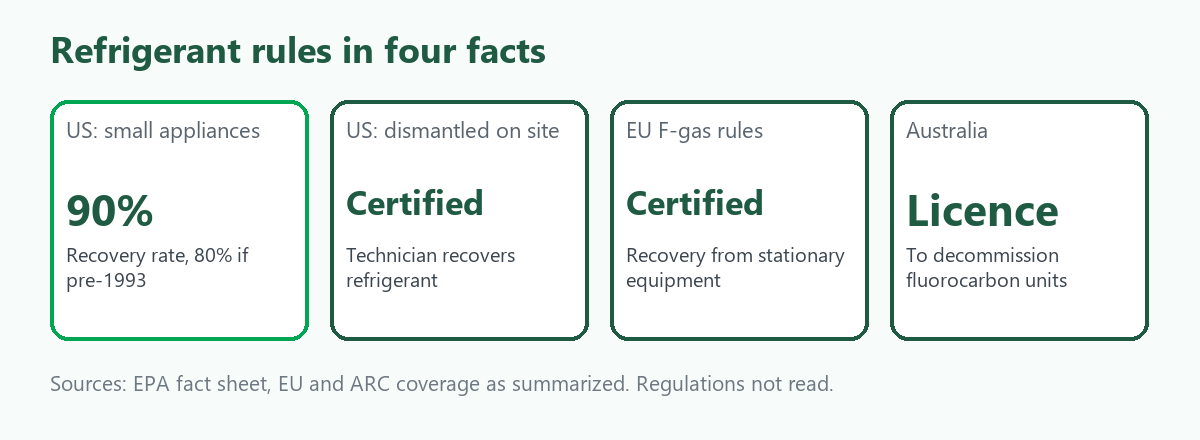
Section 608 of the Clean Air Act is implemented through 40 CFR Part 82, Subpart F, which includes safe-disposal rules for refrigeration and air conditioning equipment. As summarized, equipment usually taken apart on site, such as central residential systems, chillers and retail refrigeration, needs its refrigerant recovered, generally by a certified technician using certified equipment. For small appliances, window air conditioners and refrigerators among them, a fact sheet summary gives a required recovery of 90 percent, or 80 percent if the equipment predates 1993. Knowingly releasing refrigerant during service, repair or disposal is prohibited. A 2021 snapshot says EPA no longer asks final-disposal handlers to certify their recovery equipment to a regional office, so look at EPA's current pages for paperwork. One of our US details came from a study-question site and is secondary.
In the European Union
The F-gas Regulation 2024/573 governs fluorinated gases. Its end-of-life provisions call for recovery, and coverage says HFC refrigerants must be recovered by certified personnel from stationary refrigeration and air conditioning equipment. Vehicle air conditioning is handled separately, and Irish guidance says end-of-life vehicle rules require the fluids to be moved into cylinders before depollution is finished. Industry commentary mentions a 2022 Commission proposal for extra end-of-life requirements, so the rules may have moved. The results did not make clear who performs recovery at the scrap stage in each country, so consult the regulation and your national rules.
In Australia
The Australian Refrigeration Council says that installing, repairing or decommissioning air conditioners and refrigerators that contain fluorocarbon gas requires a licence issued through it. A restricted recovery licence exists for people who want to recover refrigerant from stationary equipment themselves, including home air conditioners, and requires passing an assessment. Most households use a licensed technician. Recovered gas flows into an industry-funded scheme, Refrigerant Reclaim Australia, authorized by the competition regulator for five years. The Australian companion guide, Air Conditioner Disposal and Refrigerant Rules, goes deeper, using fact sheets from 2017 to 2023.
What follows for sellers and scrappers
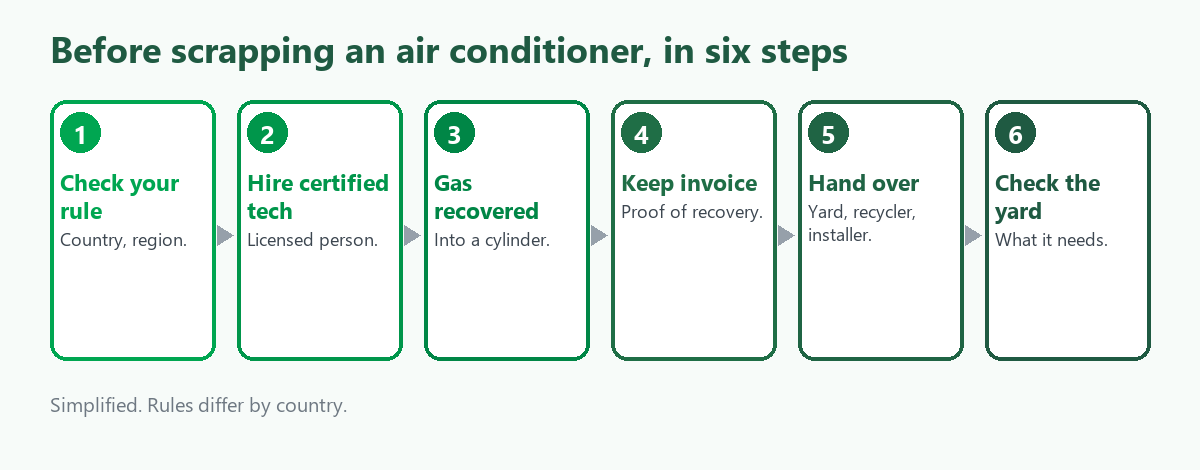
If you are selling a working unit, have a qualified person disconnect it and recover the gas, keep the invoice and say so in the listing; our guide to selling a used air conditioner covers the rest. If you are scrapping it, ask the yard whether it accepts units with or without the charge and what proof it wants; our guide to scrapping an air conditioner explains how yards value the metal. If an installer is replacing the unit, ask whether the quote includes disposal and gas recovery. In any other country, ask the environmental agency or licensing body.
Where ScrapTrade fits
ScrapTrade does not recover refrigerant and is not a disposal service. It is a place to offer scrap to verified buyers in more than 50 countries, which could suit a contractor or demolition crew holding degassed units or separated copper and aluminum. Listing is free of fees and commission, terms are agreed in chat and the buyer's 5 percent deposit sits in escrow after acceptance. Both businesses and individuals can sell after verification. How buyers treat units that still hold gas we could not confirm, so ask cs@scraptrade.com.au.
Open questions
- The regulations' own wording and current paperwork rules.
- Penalties for scrapping a unit that still holds gas.
- Rules in other countries, including the UK, Canada and India.
- Who recovers gas at the scrap stage in each EU country.
- How ScrapTrade buyers treat units that still hold gas.
Quick answers
Is a technician required to scrap an air conditioner?
In the US, EU and Australia, certified or licensed people generally recover the gas, per the summaries. Check your local rule.
Can an owner recover refrigerant personally?
In Australia, only with a restricted licence and an assessment. We found no self-recovery route in the US or EU.
What recovery applies to a US window unit?
90 percent, or 80 percent for pre-1993 equipment, per a fact sheet summary.
Where does recovered gas go?
In Australia, to a stewardship scheme. We did not research elsewhere.
Does ScrapTrade handle the gas?
No. It is a marketplace, and the gas must be recovered by a qualified person before a unit is sold or scrapped.
Sources
- US EPA Section 608 fact sheets and a 2021 EPA snapshot on appliance disposal, as summarized in search results.
- EU F-gas Regulation coverage and Irish EPA guidance on end-of-life vehicles, as summarized in search results.
- Australian Refrigeration Council fact sheets (2017 to 2023) and trade press on Refrigerant Reclaim Australia, as summarized in search results.
- ScrapTrade website, accessed November 2026.
Not legal advice. We did not read the regulations, and rules change by country.