

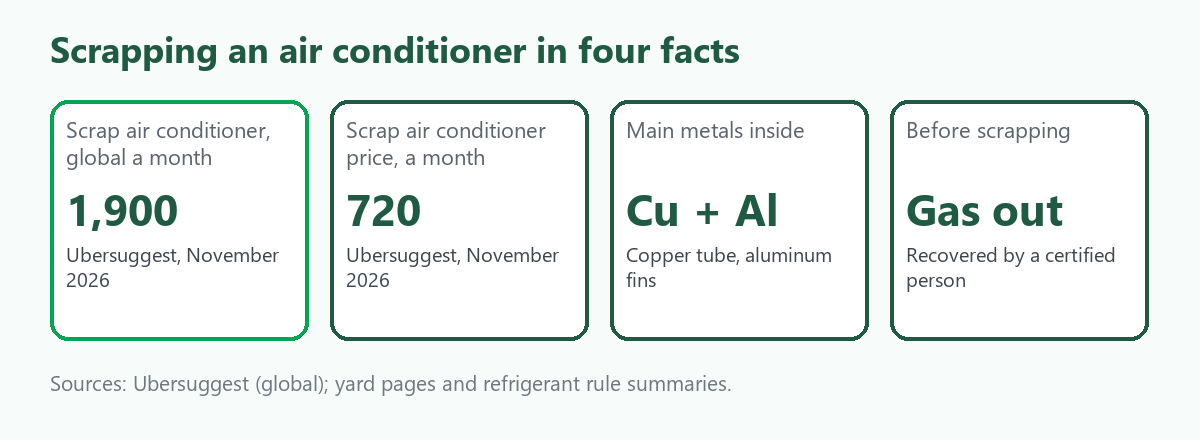
When an air conditioner dies, the owner's first question is usually whether anything is salvageable. Worldwide, "scrap air conditioner" is searched about 1,900 times a month, according to Ubersuggest, "scrap air conditioner price" about 720 and "how to scrap air conditioner" about 140. The short answer is that you are selling metal, at a yard's rate, and that the unit often cannot leave your property until its refrigerant has been dealt with. This guide covers what is in the unit, how yards price it, what to do about the gas and how to get an honest quote. Our sources include a Perth yard, advice written for scrap sellers and trade press. We found no reliable global price for a whole unit, so none is given. ScrapTrade runs a scrap marketplace and has a commercial interest in the scrap trade.
A pile of metals
From a yard's point of view an air conditioner is a heap of metal grades. A Perth yard lists copper, brass, electric motors and aluminum-copper radiators from air conditioning units as material it can use, and says it accepts compressors and fan motors. In a split system the two coils carry most of the value, copper tube threaded through aluminum fins, sold as aluminum-copper radiators; our guide to scrap radiators shows how those are graded. Everything else, a steel casing, plastics, wiring, the compressor and a fan motor, is lower value or sold by metal.
Pricing logic
Payment is by weight, and cleaner metal pays better. A guide aimed at sellers says separated loads, stripped copper and clean aluminum tend to beat mixed or contaminated scrap, and that yards often want plastic and rubber removed so the load unloads quickly. A whole outdoor unit may be bought at a blended rate below the sum of its parts. Whether dismantling is worth your time depends on the yard's rates, which we could not verify. For prices, the web gave us little to trust: a New Zealand list quoted a per-kilogram rate for aluminum-copper radiators that does not carry over to other countries, an Indian blog used rupees, and several pages looked like test sites. We set all of them aside.
The gas is the gating item
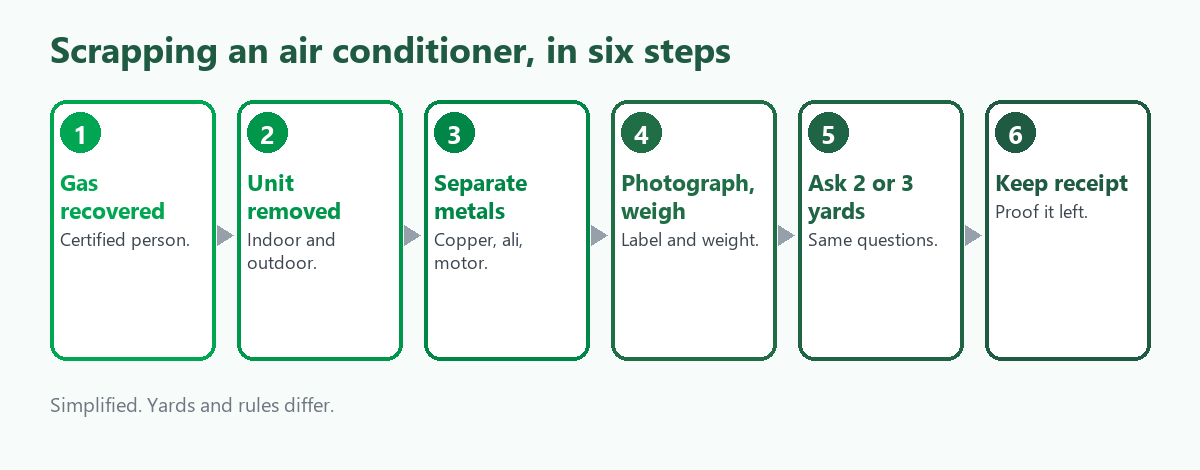
An air conditioner holds refrigerant, and many countries require it to be recovered before the unit goes for scrap. Under Section 608 of the US Clean Air Act, recovery is required before small appliances and certain other equipment are disposed of, and knowingly releasing refrigerant is prohibited. EU F-gas rules call for recovery by certified personnel from stationary air conditioning equipment. In Australia, work decommissioning a unit that holds fluorocarbon gas needs a licensed person. Details differ, and our guide to refrigerant rules before scrapping lays out what we found. In practice, a unit with gas still inside is trouble for the yard and for you, so settle who recovers it first.
Getting a quote you can rely on
Take a photo of the unit and its data label; make, model, type and size tell the yard what it is buying. Give a weight, or weigh the dismantled pieces. If you strip coils yourself, remember that must wait until the gas is out. Put the same questions to two or three yards: the rate for a whole unit, for coils and for the compressor, whether they charge or refuse units, and whether they accept only degassed ones and what proof they want. Keep the receipt, which shows the unit left your hands.
When selling the unit works better
A working unit can be worth more resold than scrapped, and our guide to selling a used air conditioner covers that. A dead unit is scrap. A replaced unit may be hauled away by the installer, in which case ask what the installation price includes.
Where ScrapTrade fits
A lone indoor unit does not justify a marketplace listing. The platform is aimed at volume: an HVAC contractor, a building manager or a demolition crew clearing several units, or anyone holding separated copper and aluminum. Metals are the core of what it trades; verified buyers in more than 50 countries bid, nothing is charged to list, and the buyer's 5 percent deposit sits in escrow once a bid is accepted. Sellers, business or individual, are verified. Whether a whole unit with a refrigerant circuit may be listed we could not confirm, so ask cs@scraptrade.com.au. The Australian version of this guide is Scrap Air Conditioner: What It Is Worth.
Open questions
- A reliable price for any unit.
- Whether stripped coils pay more at your yard.
- How each yard handles gas.
- Whether ScrapTrade lists whole units.
Quick answers
Does a dead air conditioner have scrap value?
Yes, for its metals, mostly copper and aluminum, plus the compressor and motors. We found no dependable price, so get quotes.
Can I drop one at a yard myself?
Many yards take them, but refrigerant has to be recovered first in many countries. Ask the yard what it needs.
Is stripping out the copper worthwhile?
Advice for sellers says it can pay, but the gas has to be recovered first.
How do I get the best offer?
Send a photo and weight, and ask two or three yards the same questions.
Will ScrapTrade take my unit?
It trades scrap metal, so separated copper or aluminum fits best. Ask support about a whole unit.
Sources
- Ubersuggest keyword data, global, queried November 2026.
- Australian scrap yard pages, advice for sellers and trade press on air conditioner scrap, as summarized in search results.
- US EPA Section 608 material and EU F-gas coverage, as summarized in search results.
- ScrapTrade website, accessed November 2026.
Information only, not legal or financial advice. Yards and rules differ by country.