

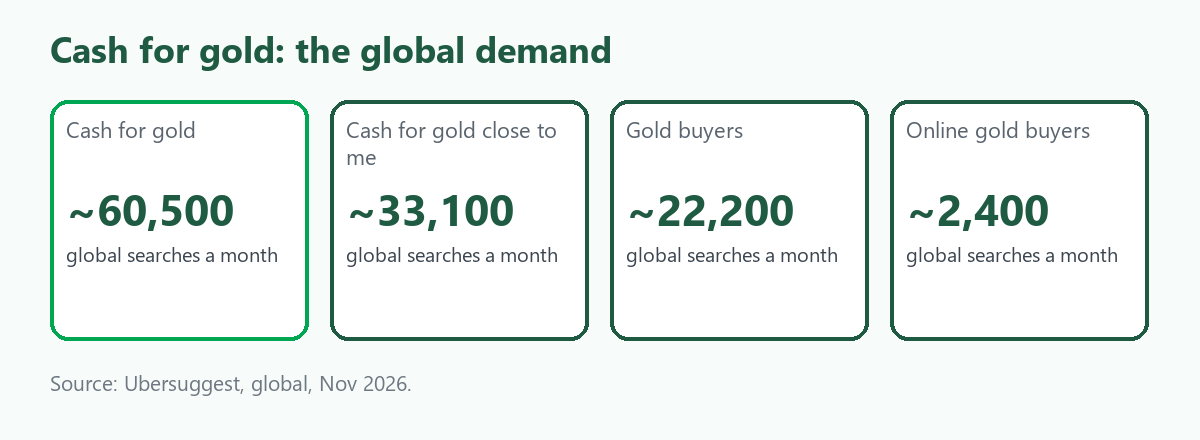
"Cash for gold" is searched about 60,500 times a month worldwide, according to Ubersuggest, with "cash for gold close to me" about 33,100, "gold buyers" about 22,200 and "online gold buyers" about 2,400. The phrase costs 12 to 13 dollars a click, which is among the highest in the scrap family and shows how much money flows through these buyers. This guide is not an offer to buy your gold. It explains how a cash-for-gold buyer should behave, what rules some places impose, and the checks that let you tell a fair one from a poor one. It sits under our guide to selling gold, silver and scrap jewelry worldwide, alongside where to sell gold jewelry. A disclosure: ScrapTrade is a scrap marketplace and profits from scrap trading.
What the rules tend to require
Rules differ by country and often by city, so here are examples, from sources we read as summaries and which are dated:
- New Jersey. A 2012 consumer-affairs release said jewelers must post their gold prices, carry out all weighing and testing in plain sight of the seller, give detailed receipts, and show their name and address at the point of sale.
- New York City. A 2011 consumer-affairs release described rules requiring buyers to disclose the basis for each item's price, including the troy weight, and to give a written receipt with item descriptions and the buyer's licence number. Its tips included selling only to a licensed second-hand dealer.
- United Kingdom. A council warning said some buyers ignore legal requirements about the equipment used to value items, and advised sellers to check the markings on scales.
We did not confirm that any of these are unchanged today, and we did not review other countries, so check what applies where you are. They show the shape of good practice: published prices, testing in front of you, a written basis for the price and a receipt.
What to check
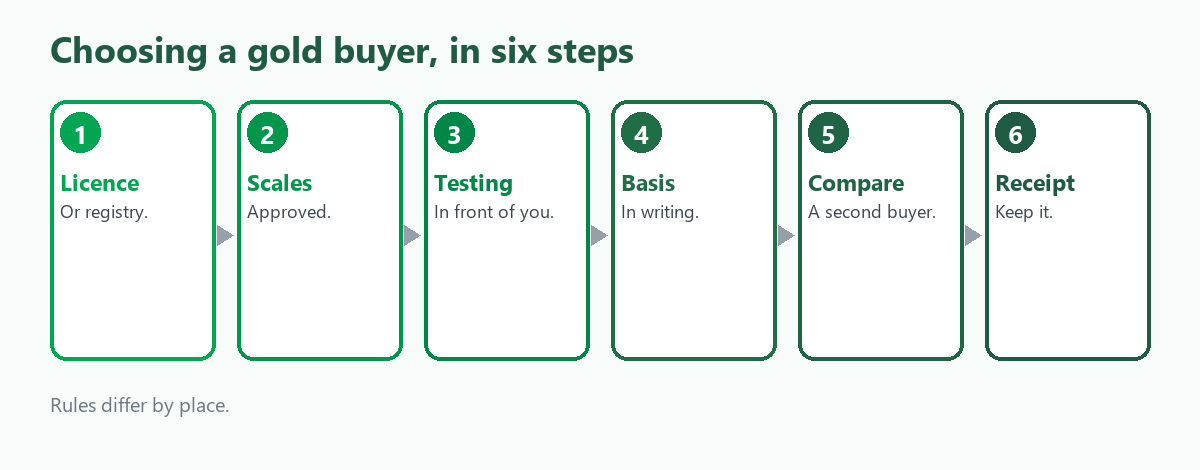
- Is the buyer licensed or registered? Where a licensing or second-hand dealer scheme exists, ask for the number.
- Are the scales approved for trade use? The UK warning is a reason to look for the markings, and we did not research the standards in each country.
- Is the testing done in front of you? Consumer articles warn that a dishonest buyer can swap a piece during evaluation, and the countermeasure is to keep your gold in view.
- What is the price basis? The weight, the purity found, the spot price used and the share paid, as our price guide explains.
- Can you decline? A fair buyer lets you leave with your gold if you do not like the offer, and a mail-in buyer should say whether you get your parcel back.
- Is there a receipt? With the item descriptions and the buyer's details, which you keep.
Warning signs
- "We pay the highest prices." Consumer guidance treats this as a red flag, because prices change too often for it to be checked.
- No written basis. A buyer who will not say what weight and purity it assumed cannot be compared.
- Pieces taken out of sight. If your gold leaves your view for testing, ask why.
- Pressure to decide at once. Get a second quote.
- Cash only, no record. Some jurisdictions restrict cash or require records, and a buyer who avoids both may not be following the rules where they trade.
- A name you cannot check. Check complaint records where they exist. A 2009 article suggested a consumer bureau, and we did not review which services are current.
Cash, identity and records
Many places require buyers to see photo ID and keep records, which is why a legitimate buyer will ask who you are. A buyer who does not ask may not be compliant. Do not sell gold that is not yours, and expect to be asked where it came from. Payment rules and tax on the proceeds vary by country, and we did not review them here.
Where ScrapTrade fits
ScrapTrade does not buy gold and is not a cash-for-gold shop. What it offers is a different route for larger lots: a marketplace on which verified traders from more than 50 countries compete for scrap, with precious metals as one of its categories. A jeweler or estate clearer can list without paying a fee or commission, negotiate in real time and, after accepting a bid, rely on the buyer's 5 percent deposit being held in escrow. Individuals and businesses can both sell once verified. Testing and insurance arrangements for gold are unconfirmed, and ScrapTrade does not replace your own legal obligations as a seller, so ask cs@scraptrade.com.au first.
What we could not verify
- Whether the cited rules are current. They are from 2009 to 2012 releases and articles.
- Rules in other countries, and the scale standards.
- Any individual buyer's honesty. Check each one yourself.
- ScrapTrade's testing and insurance arrangements for gold.
Frequently asked questions
How do I choose a cash for gold buyer?
Check it is licensed where a scheme exists, that testing is done in front of you, that the price basis is in writing, and compare at least two.
Is it safe to sell gold for cash?
It can be, with a licensed buyer, testing in plain sight and a receipt. Some places also restrict cash payments, so ask.
Do gold buyers need ID?
In many places, yes. A legitimate buyer will ask for photo ID and keep records.
Do gold buyers use ScrapTrade?
Verified traders buy scrap there, and precious metals is a category. We could not confirm how gold lots are tested, so ask support.
Sources
- Ubersuggest keyword data, global, queried November 2026.
- New Jersey Division of Consumer Affairs release (2012), New York City consumer-affairs release (2011), a UK council warning on scales and news consumer guidance on gold buyers, as summarised in search results.
- ScrapTrade website, accessed November 2026.
Not legal advice. Rules differ by place and change. ScrapTrade benefits from scrap trading.