

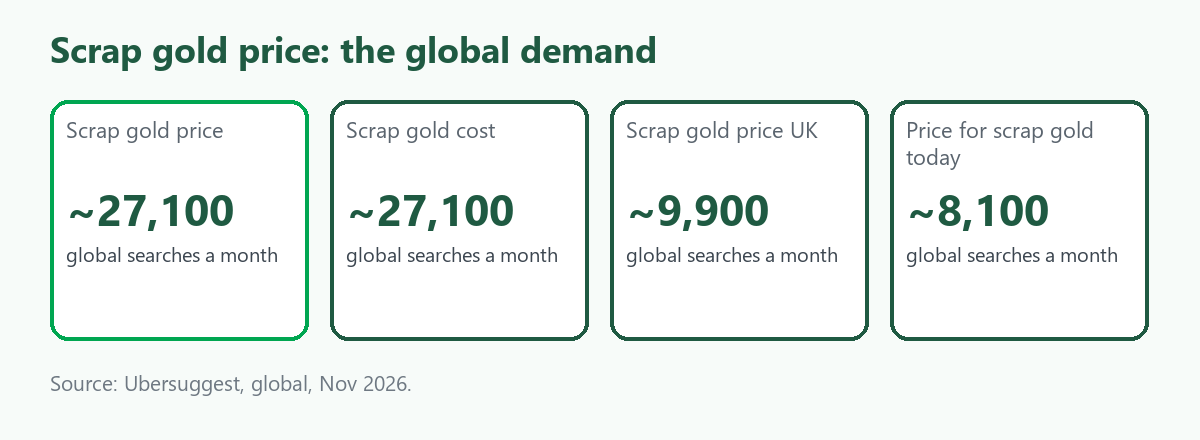
"Scrap gold price" is searched about 27,100 times a month worldwide, according to Ubersuggest, and so is "scrap gold cost". "Scrap gold price UK" is about 9,900, "price for scrap gold today" about 8,100 and "scrap gold price at pawn shop today" about 1,300. This guide gives no price, because a price needs a date and the only lists we found are buyers' own marketing. What it explains is the gap that surprises most sellers, between the gold price in the news and the offer across a counter. It covers what the gap is made of, how buyer types differ and how to turn any offer into a percentage you can compare. For the sum that produces the melt value, see How to Calculate Scrap Gold Value. This belongs to our guide to selling gold, silver and scrap jewelry worldwide. ScrapTrade operates a scrap marketplace and gains from scrap trading, which you should weigh.
Three prices that get confused
- The spot price is the market price of pure gold, quoted per troy ounce. It is the headline number.
- The melt value is what the gold in your piece would be worth at spot, after allowing for its purity and weight. It is always less than the weight of the piece times spot, because jewelry is an alloy.
- The offer is what a buyer pays. Dealer guides say it is a share of the melt value and never the whole of it.
Most "scrap gold price" pages quote a figure per gram for a karat. That is a buyer's offer or a melt value on an undated spot price, and it tells you which one only if the page says.
What the gap is made of
The sources we found, which are dealer and calculator sites with something to sell, agree on the causes. The buyer keeps part of the value to cover refining costs, the cost of running a shop and its own margin. Convenience matters, because a local buyer who pays on the spot can offer a smaller share than a mail-in or refining service that pays closer to market after a short wait. Spot references also differ between buyers, so a buyer using a lower spot has lowered the offer without changing the percentage.
What the sources say shares look like
The ranges below are from dealer pages, and they are marketing, not published rates:
- Specialist bullion and coin dealers are described as paying about 85 to 92 percent of melt value.
- A calculator site cites about 70 to 90 percent at reputable dealers.
- Pawn shops and local jewelers are described as being at the low end.
- Direct refiners are described as paying 90 to 98 percent, but usually requiring minimum weights and an account.
- Designer, antique or resalable pieces may be worth more as pieces than as scrap, and the same sources suggest selling them separately from scrap.
We cannot verify any of these, and a buyer who quotes a number far above this range deserves a closer look, not a celebration.
Turn any offer into a percentage
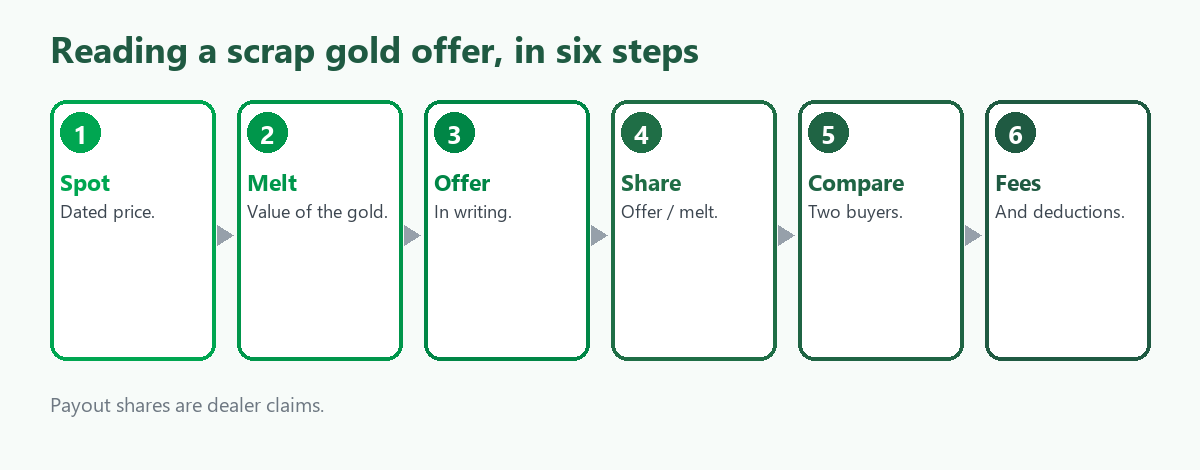
- Find a dated spot price. From a live source that shows the time.
- Work out the melt value. Weight, karat and spot, as in our calculation guide.
- Get the offer in writing. With the weight and karat the buyer assumed.
- Divide the offer by the melt value. That is the share you are being paid. Where the buyer quotes a flat price per gram, divide it by the melt value per gram.
- Compare at least two buyers. Use the same spot price and the same piece.
- Ask about fees and deductions. Testing, shipping, insurance and stone removal.
A quote that cannot be put through this sum is not a quote you can compare.
Why "highest price" claims tell you little
Consumer-protection guidance quoted in news coverage treats "we pay the highest prices" as a red flag, because prices change too often for such a claim to be checked. A better sign is a buyer that shows its working: the weight, the tested purity, a spot reference, the share and any fees. The UK-specific searches, such as the 9ct figures, follow the same logic, because 9ct is simply 37.5 percent gold and the buyer's share is applied to that.
Where ScrapTrade fits
The share a local buyer offers is the one to beat, and ScrapTrade cannot show you a price for one ring. It is built for lots big enough that buyers compete: accumulated scrap from a jewelry business, an estate, a dealer's surplus. Sellers list for free and pay no commission. Buyers from over 50 countries bid, you negotiate live, and accepting a bid moves the buyer's 5 percent deposit into escrow. Private sellers and businesses both qualify once verified, and precious metals is among the categories. Testing and insurance arrangements for gold are not something we could confirm, so ask cs@scraptrade.com.au.
What we could not verify
- The scrap gold price today. We give none.
- The payout shares. The ranges are from dealer marketing.
- What any individual buyer pays.
- Gold-lot testing and insurance on ScrapTrade.
Frequently asked questions
Why is the scrap gold offer lower than the gold price?
The gold price is for pure gold, jewelry is an alloy, and buyers pay a share of the melt value to cover refining, costs and margin.
What percentage of melt value should I expect?
Dealer pages quote about 70 to 98 percent depending on buyer type, but those are marketing. Compare quotes instead.
Is a pawn shop price lower?
Dealer guides describe pawn shops and local jewelers as being at the low end, but check by dividing each offer by melt value.
Is there a way to sell scrap gold to several buyers?
For larger lots, a marketplace such as ScrapTrade lets verified traders bid. We could not confirm gold-lot handling there, so ask first.
Sources
- Ubersuggest keyword data, global, queried November 2026.
- Dealer, refiner and calculator guides on melt value and payout shares, as summarised in search results.
- News and agency consumer guidance on gold buyers' price claims, as summarised in search results.
- ScrapTrade website, accessed November 2026.
Not financial advice. Payout shares are dealer claims. ScrapTrade benefits from scrap trading.