

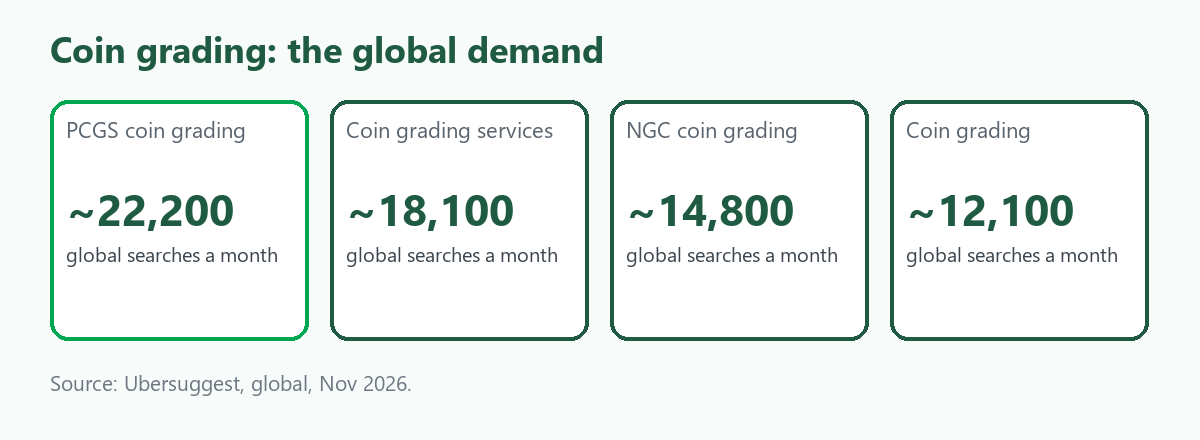
"Coin grading" is searched about 12,100 times a month worldwide, according to Ubersuggest, and the company names dominate the related searches: "PCGS coin grading" about 22,200, "coin grading services" about 18,100, "NGC coin grading" about 14,800, "ANACS coin grading" about 5,400 and "coin grading system" about 3,600. Most of those searches are people trying to reach a grading company or understand a number on a holder, and we are not a grading company, so this guide explains what grading is, how the scale works, what the companies will not grade and when it is worth the cost. We give no fees, because we found no reliable current source. It follows our guide to old coin value. ScrapTrade runs a scrap marketplace and has a stake in this trade, which is not coin dealing.
What grading is
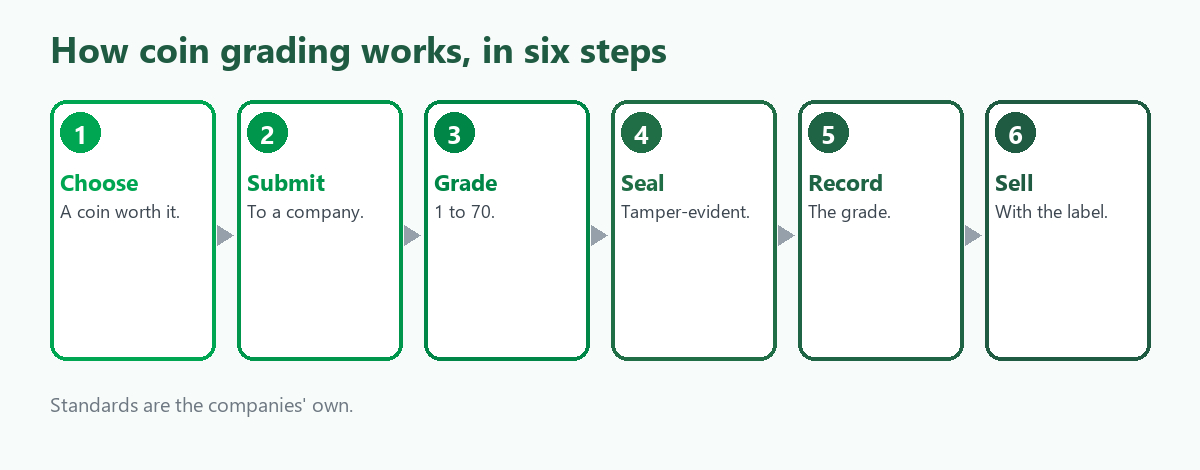
A grading company examines a coin, assigns a grade, seals it in a tamper-evident holder with the grade on a label and records it. The aim is to give buyers a standard description they can trust without inspecting the coin. Collectors use the grade, with the coin's rarity and demand, to price it. Bullion-type coins are bought and sold near melt value, so grading matters less for them, as one dealer guide puts it, though some collectors pay more for top examples. Scarce or historical coins depend far more on grade.
The scale
PCGS and NGC both use the 1-to-70 Sheldon scale, devised by William Sheldon in 1949, according to the guides we read. Higher numbers describe better-preserved coins. We did not review the full descriptions, and the companies' own grading standards are the authority. Their grades are generally treated as interchangeable, and one guide says a PCGS MS-63 and an NGC MS-63 of the same type trade at the same price, which is a dealer's statement and not a guarantee.
How the companies differ
Sources describe small differences. One says NGC uses two graders per coin. We found guides comparing the companies, but they are written by bullion dealers, and we cannot rank them. Other grading companies exist, such as ANACS, ICG and PCI, which appear in the searches above, and the market's acceptance of each varies, which we did not research. If you plan to sell a graded coin, ask the buyer which companies' holders it accepts.
What they will not grade
One guide says PCGS will not grade coins that are damaged, improperly cleaned or altered, though it may still certify them as genuine. That is why dealers warn against cleaning, because cleaning can leave marks that graders see, as our selling guide explains. We did not find equivalent statements for the other companies.
When grading is worth it
Grading costs a fee and takes time, and shipping and insurance add to it, so it suits coins whose value is high enough for a certified grade to matter: scarce, historic or high-condition examples. For common coins, the guides we read suggest the fee usually outweighs the benefit, which is an opinion and not a rule. Before paying, get a dealer's opinion on whether the coin is worth grading. We found no current fee figures we could rely on.
Questions to ask about a graded coin
If you are selling a coin that already sits in a graded holder, a buyer will ask which company graded it, the certification number and whether the holder has been opened or replaced. Have the answers ready, and photograph the holder front and back. If you are selling an ungraded coin that you think is scarce, ask the buyer whether it will grade it at its own cost and risk or buy it as it is, because the grade may change what you are paid and the buyer's offer should reflect that uncertainty. If a buyer offers far less for a graded coin than similar graded coins appear to sell for, ask for the reasoning in writing. These are our suggestions, not rules from the grading companies.
Checking a graded coin
A certified coin has a certification number. "PCGS coin grading verification" is searched about 720 times a month, which suggests an online number check exists, though we did not review it. Check that the holder is intact, the number matches the label and the details match the coin. We found no figures on how common counterfeit holders are.
Where ScrapTrade fits
ScrapTrade is not a grader, dealer or auction house, and a graded collectible coin belongs with those. It is a marketplace for scrap: junk silver, gold coins sold by metal and similar lots, offered to verified traders in more than 50 countries, with precious metals among its twelve categories. Listing carries no fee or commission, price and terms are negotiated live and an accepted bid puts the buyer's 5 percent deposit in escrow. Verified businesses and individuals can sell. We could not confirm that coin lots can be listed, so write to cs@scraptrade.com.au first.
What we could not verify
- Grading fees and turnaround. We found no reliable current source.
- The companies' own standards. We relied on dealer summaries.
- Acceptance of other grading companies' holders.
- Whether ScrapTrade accepts coin lots.
Frequently asked questions
What is the Sheldon scale?
A 1-to-70 grading scale devised by William Sheldon in 1949 and used by PCGS and NGC.
Is a PCGS grade the same as an NGC grade?
They are generally treated as interchangeable, according to one dealer guide, though we cannot guarantee it.
Should I clean a coin before grading?
No. PCGS will not grade improperly cleaned coins, according to one guide.
Does ScrapTrade grade or sell graded coins?
No. It is a scrap marketplace, and we could not confirm that coin lots can be listed, so ask support.
Sources
- Ubersuggest keyword data, global, queried November 2026.
- Bullion-dealer and Coin World guides on PCGS, NGC and the Sheldon scale, as summarised in search results.
- ScrapTrade website, accessed November 2026.
General information only, not financial advice. Consult the grading companies for their standards.