

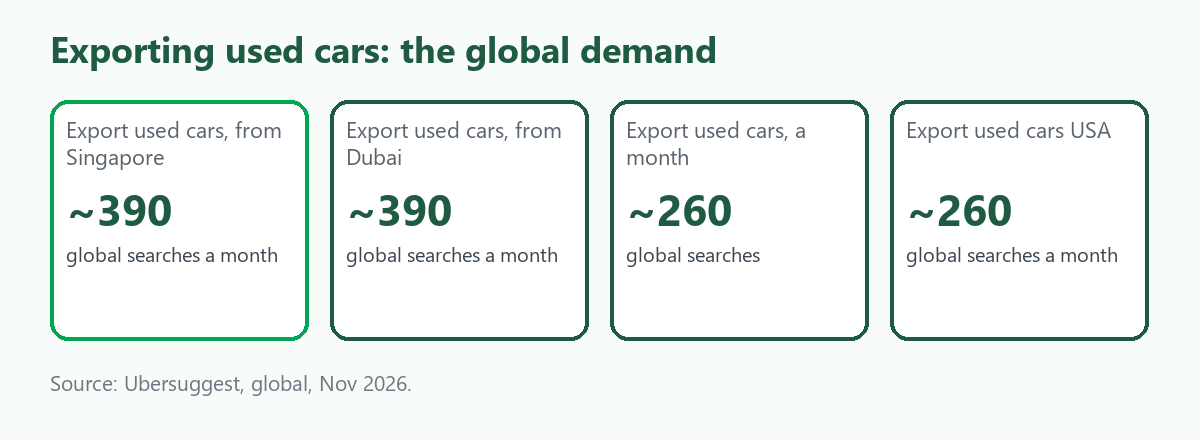
"Export used cars" is searched about 260 times a month worldwide, according to Ubersuggest, and the place-specific versions are larger: "export used cars from singapore" and "from dubai" about 390 each, "export used cars usa" about 260 and "uk export used cars" about 110. These are small numbers for a trade that moves millions of vehicles, and the searchers are dealers and exporters who need practical answers more than volume. The central fact of the trade is that the importing country decides what can be sold there, and the commonest rule is an age limit. This guide explains how age limits work, what the sources say about four well-known markets, how used and end-of-life cars are distinguished and what to check before you ship. It belongs to our guide to selling scrap cars, car parts and used tires online. We quote no prices. ScrapTrade runs a scrap marketplace and has a commercial interest in the scrap trade.
Used or end-of-life: the exporting country's line
Exporting countries separate used cars from end-of-life vehicles, which are waste. Under the proposed European Union End-of-Life Vehicles Regulation, as summarised in the sources we found, used vehicles could be exported only if they are not end-of-life and are roadworthy, and the Council's June 2025 position adds a requirement to document that a vehicle is not end-of-life at each change of ownership, with some exemptions between individuals. A law-firm explainer says export would be limited to roadworthy, non-end-of-life vehicles from 1 September 2031. These are proposals that may change. The Basel Convention's fact sheet says waste vehicles that are hazardous waste are under its control procedure, and that distinguishing used from end-of-life vehicles can be difficult. A car that is roadworthy, registered and complete is a used car, and a stripped wreck is not.
Age limits: what importers do
Many importing countries set a maximum age for used cars, and others charge higher duty on older ones. An academic review cited by one source found that about 25 countries in Africa set maximum ages, four ban used vehicle imports and ten ban vehicles more than five years old. Sources also disagree on how age is measured, from the date of manufacture or from first registration, and a one-year difference can decide a sale. Our sources are importer and exporter blogs and one academic paper, and they conflict, so treat them as leads.
Four markets, and why we are cautious
- Kenya. Most sources say 8 years from first registration, tied to a Kenya Bureau of Standards rule. An older article mentions a rumored cut to 5 years that appears to have been postponed.
- Tanzania. Sources disagree. One gives 10 years from manufacture, and another says there is no hard ban but an escalating over-age excise, with one guide putting the bands at 18 percent above 8 years, 35 percent above 10 and 40 percent above 20 from 1 July 2026.
- Nigeria. A 2021 paper cites a limit of no more than 8 years from manufacture, while more recent guides list 12 years, and one says the 12-year limit applies only to passenger cars, with no age limit for trucks.
- New Zealand. One source gives 20 years and another says 5 years, which is a large discrepancy, and the official customs and transport authorities would settle it.
We did not find an export-side age limit for Japan, and we did not review markets such as the Gulf states or South America in detail. Ask the buyer for the written rule and the official source before you agree a sale, and ask what measure of age applies.
What to check before you ship
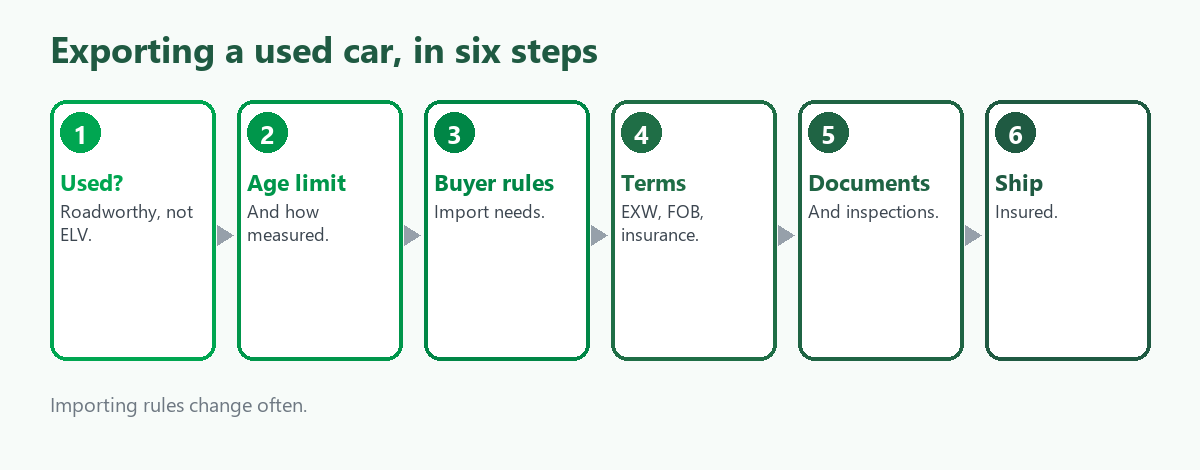
- Is the car roadworthy and complete? If not, it may count as waste.
- What is the buyer's age limit and measure? Manufacture or first registration, and the cutoff date.
- What inspections are required? Pre-shipment inspection by an approved body is common in several markets, according to the vendor guides we found.
- What are the steering and specification rules? Some countries require left-hand or right-hand drive, which we did not research in detail.
- Who handles import clearance? The buyer usually owns compliance, and you supply the documents: registration, export deregistration, invoice, inspection report and bill of lading.
- What are the shipping terms? Agree EXW, FOB or another term, the currency, insurance and who loads.
- Is the paperwork clean? See our guides to selling a junk car without a title and selling a car for parts for ownership.
Where ScrapTrade fits
ScrapTrade is not a used-car retail platform, and we do not suggest it for selling one roadworthy car to an overseas buyer, where a specialist exporter or a dealer network is the better route. It is relevant to sellers who have vehicles that have reached the end of their use: lots of cars sold for parts or metal to traders abroad, where the buyers are verified traders in more than 50 countries. Listing is free with no commission, you negotiate in real time and agree shipping terms, and once you accept a bid the buyer's 5 percent deposit is held in escrow. Businesses and individuals can sell after verification. ScrapTrade does not own the vehicles, broker the deal or arrange export permits, so legal responsibility stays with seller and buyer, and we could not confirm whether whole vehicles can be listed. Ask cs@scraptrade.com.au first.
What we could not verify
- Current age limits in any importing country. The sources conflict and are mostly trade blogs.
- The final EU vehicle rules. We relied on proposals and summaries.
- Exporting-country rules for Japan and others.
- Whether ScrapTrade lists whole vehicles.
Frequently asked questions
Can I export a used car to Africa?
Often yes, but many African countries set maximum ages or ban some imports, so check the destination's current rule and how age is measured.
What is the age limit in Kenya?
Most sources say 8 years from first registration, but confirm with the authority and your buyer.
What is the difference between a used car and an end-of-life vehicle?
A used car is roadworthy and complete. An end-of-life vehicle is waste, and export is restricted under waste rules.
Can I export cars through ScrapTrade?
It is a scrap marketplace. Verified traders buy lots of vehicles and parts, but we could not confirm that whole vehicles can be listed.
Sources
- Ubersuggest keyword data, global, queried November 2026.
- Proposed EU End-of-Life Vehicles Regulation, Council position of June 2025 and law-firm explainers; BIR fact sheet on waste vehicles, as summarised in search results.
- Importer and exporter guides to used-vehicle age limits, and a ScienceDirect review of vehicle regulations in Africa, as summarised in search results.
- ScrapTrade website, accessed November 2026.
General information only, not legal or trade advice. Import rules change often, so confirm with the importing country's authority. ScrapTrade is a scrap marketplace.