

Selling a scrap car or its parts is one of the most searched jobs in the whole scrap family, and almost all of the searching is local. People want a yard that will collect the car, a buyer for a catalytic converter or someone to take a set of tires. The trade is different. Wreckers, tire shops, fleets and recyclers hold lots of vehicles and parts, and the buyers who pay best for lots are often in other countries, where used parts, tires and batteries are in demand. This guide covers the demand, how to sort what you have, what changes when a buyer is abroad and how selling on ScrapTrade works. It is the international companion to our Australian guide to selling an old, broken or unwanted car or parts. We leave out prices because no reliable source turned up, and we mark where our evidence stops. ScrapTrade is a scrap marketplace and benefits from scrap trading.
What people search for
Ubersuggest data for the world, pulled in November 2026, shows searches that are large, local and commercial.
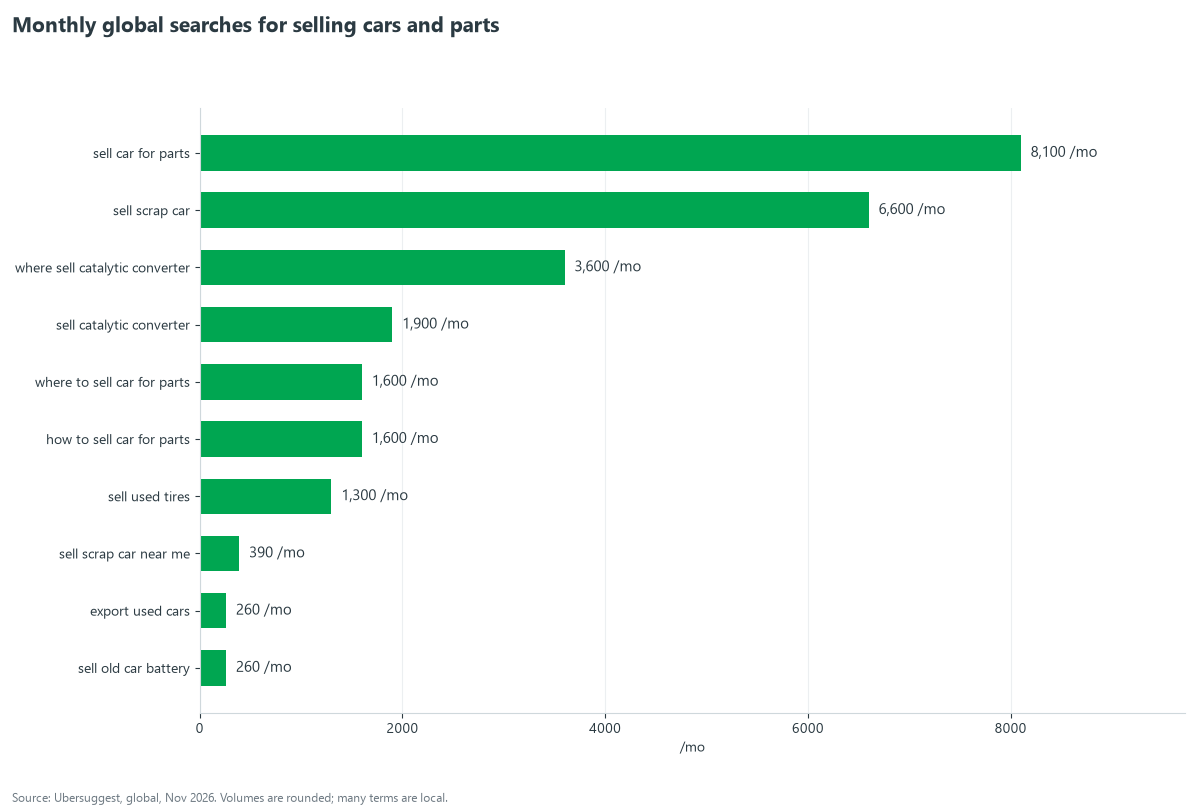
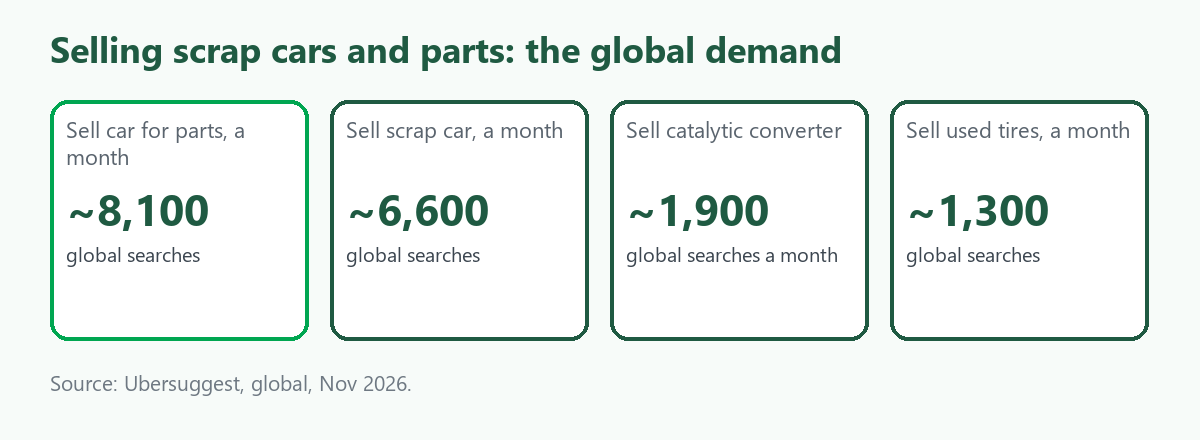
"Sell car for parts" is searched about 8,100 times a month worldwide, "sell scrap car" about 6,600, "where to sell car for parts" and "how to sell car for parts" about 1,600 each, and "sell scrap car near me" about 390. Parts terms are big: "where sell catalytic converter" about 3,600, "sell catalytic converter" about 1,900 and "sell used tires" about 1,300, with "sell old car battery" about 260. The advertising cost is high, around 5 to 7 dollars a click for the car phrases, which means buyers pay to reach these sellers. Phrases such as "sell car for parts no title" suggest that much of the demand is American, where ownership documents are a common obstacle, which is also why this page uses the spelling "tires". The exporting phrases are small: "export used cars" is about 260, with Singapore, Dubai and the United States about 390, 390 and 260.
Step 1: Sort what you have
Four groups cover most stock:
- Roadworthy vehicles. They run and are sold as used cars, domestically or for export.
- Repairable vehicles. Damaged or faulty, sold to rebuilders and traders.
- Parts and components. Engines, gearboxes, panels, wheels and electronics sold by model.
- Scrap. Shells, catalytic converters, batteries, tires and metal sold by weight.
Record the make, model, year and identification numbers, and keep proof of ownership. Buyers and customs ask for it.
Step 2: Know the cross-border line between used and end-of-life
Most countries treat a car that is roadworthy and a car that is scrap very differently when they cross a border.
- European Union. The proposed End-of-Life Vehicles Regulation, as summarised in the sources we found, would allow exports of used vehicles only if they are not end-of-life and are roadworthy, and the Council's June 2025 position adds a requirement to document that a vehicle is not end-of-life at each change of ownership. One law-firm explainer says export limits to roadworthy, non-end-of-life vehicles apply from 1 September 2031. These are proposals and positions that may change, so check the current text.
- Basel Convention. The Convention's fact sheet says movements of waste vehicles that are hazardous waste fall under its control procedure, and that telling used from end-of-life vehicles can be difficult in some cases. We found no Basel standard for classifying cars specifically.
- Importing countries. Many set their own rules, including age limits and bans on used cars. We found no reliable source on any individual country, so ask your buyer to confirm theirs.
Step 3: Batteries, tires and converters
- Lead-acid batteries. Used lead-acid batteries are listed under Basel Annex VIII entry A1160, and exports need prior informed consent from both countries. Mixed battery chemistries fall under entry A1170. Some countries, such as Australia, add a permit requirement. See our guide on where a car battery goes and Do Scrap Yards Buy Batteries?.
- Tires. Basel has technical guidelines on used tires, but we did not find export rules. Condition matters: a tire sold for use must be fit for use under the destination's rules, and a tire sold for recycling is waste. See Rubber and Tyre Scrap Trading.
- Catalytic converters. Converters hold platinum group metals and have been targets for theft. Buyers we found in Australia ask for photo ID and evidence that the unit came from a vehicle you own or owned. We found no international statute, so sell only with documents and only to a buyer that keeps records. See our Australian guide on where an old catalytic converter goes.
Step 4: Agree the terms
For an overseas sale, agree the shipping terms, the currency, the inspection rights and who obtains export and import permits. Ask the buyer to confirm in writing that the material can lawfully enter its country. Keep photographs of every load, and weigh and count at loading. Insurance and packaging are yours until the risk passes under the agreed terms.
Why sell on ScrapTrade
ScrapTrade is a marketplace for scrap and recyclable material, with batteries and precious metals among its twelve categories. It is built for sellers with more than one thing to move:
- Who bids. Wreckers, parts exporters, metal recyclers and battery recyclers, among verified traders in over 50 countries, look for lots that are slow to sell locally.
- What it costs. Listing is free, with no commission. You write the post with the built-in AI helper if you like, and add photos.
- Terms stay yours. You and the buyer negotiate live and settle collection or shipping, with EXW and FOB terms and prices in Australian or US dollars.
- Money is held. When a bid is accepted, a 5 percent buyer deposit stays in escrow, and Stripe processes payments.
- Identity is checked. Sellers, business or individual, go through verification before they can list.
How it works, step by step
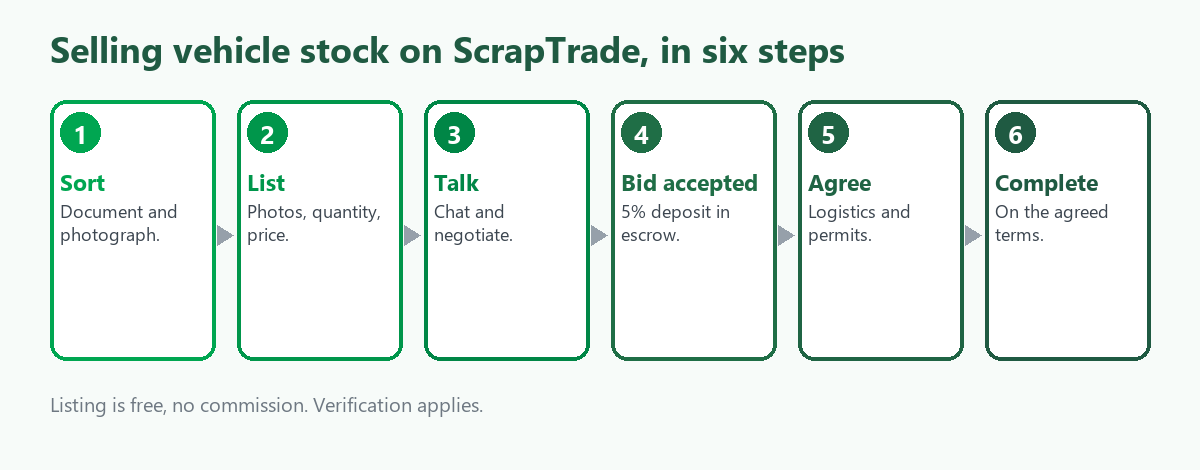
- Sort and document. Group the stock, record the details, and gather paperwork and photos.
- List. Create an account, finish verification and post photos, quantities and a price. The AI helper can draft the text for you to check.
- Talk. Buyers message you, and you negotiate in real time.
- Bid accepted. The buyer's 5 percent deposit goes into escrow.
- Agree logistics and paperwork. Settle collection or shipping and who handles permits.
- Complete. The sale closes on the agreed terms.
Where it does not fit
ScrapTrade is not an owner, broker or permit agent, so legal responsibility for a shipment stays with the parties. A single scrap car with a local yard that collects it is simpler than a listing. We could not confirm whether whole vehicles can be listed, only that batteries and metals are categories, so ask first. The sweet spot is lots: surplus parts from a wrecker, a fleet's retired vehicles, a tire shop's stock or a pallet of batteries. For other questions, including verification, contact cs@scraptrade.com.au.
Car guides: Sell a Car for Parts: Who Buys and How It Works.
Also: Sell a Junk Car for Cash: How It Works.
Also: Sell a Scrap Car: How the Value Is Worked Out.
Also: Sell a Junk Car Without a Title: What Works.
Also: Sell Used Car Parts Online: What Is Allowed.
Also: Export Used Cars: Age Limits and Import Rules.
What we could not verify
- What cars, parts, tires and converters sell for. We found no reliable price source.
- The final EU vehicle rules. We relied on proposals and summaries.
- Importing countries' vehicle rules. We did not review them.
- Whether ScrapTrade accepts whole vehicles.
- ScrapTrade's verification process. It is not published.
Frequently asked questions
How do I sell a car for parts?
Sort and document it, then sell it to a wrecker, dismantler or trade buyer, with proof of ownership. For lots, sell to traders who buy by the unit or the tonne.
Can I export used cars?
Yes, if they are used and roadworthy and the destination allows them, but end-of-life vehicles face waste rules. Check both countries' rules.
Can I export used lead-acid batteries?
They are controlled under the Basel Convention, which requires prior informed consent from both countries.
Can I sell car parts on ScrapTrade?
Batteries and metals are among its categories. Businesses and individuals can both sell after verification, and listing is free with no commission.
Sources
- Ubersuggest keyword data, global, queried November 2026.
- Proposed EU End-of-Life Vehicles Regulation (EUR-Lex 2023/0451), Council position of June 2025 and law-firm explainers, as summarised in search results.
- Basel Convention fact sheet on waste vehicles (BIR) and Annex VIII guidance on lead-acid batteries, as summarised in search results.
- Australian scrap-yard descriptions of catalytic converter buying requirements, as summarised in search results.
- ScrapTrade website, accessed November 2026.
General information only, not legal advice. Check each country's rules, which change. ScrapTrade is a scrap marketplace with an interest in the trade.