

No record names the first person to sell scrap. Reusing a broken tool needs no paperwork, and a sale between two people in the Bronze Age left nothing for an archaeologist to find except the metal itself. What we can do is follow the evidence backwards: a ship that sank with scrap bronze aboard about 3,200 years ago, a scrap yard of broken statues, the street dealers of Victorian London, a meeting of about 40 men in Boston in 1913, and a man collecting metal in Sydney in 1917. This article sets out what each source shows, where historians disagree, and what we could not confirm. It is general history, not a complete one.
Why the first seller cannot be named
Metal is the one common material that does not wear out when it is reused. A bronze axe can be melted and cast into a spearhead, so old metal had a value long before anyone wrote down a price. What survives from that period is objects and hoards, not receipts. An archaeologist can say that metal was broken up, carried or buried. They usually cannot say who paid whom. So any claim to "the first scrap dealer" would be a guess, and we do not make one.
A cargo of broken tools, about 1200 BC
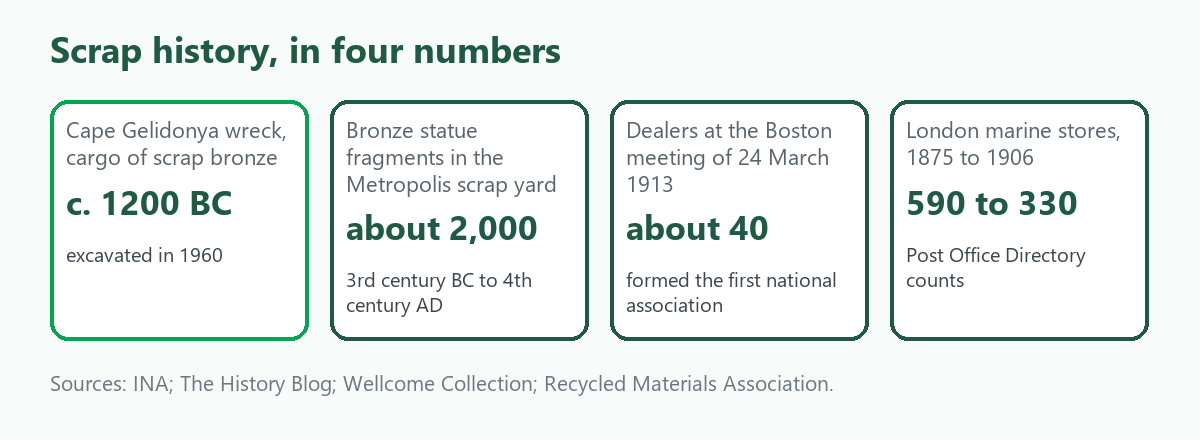
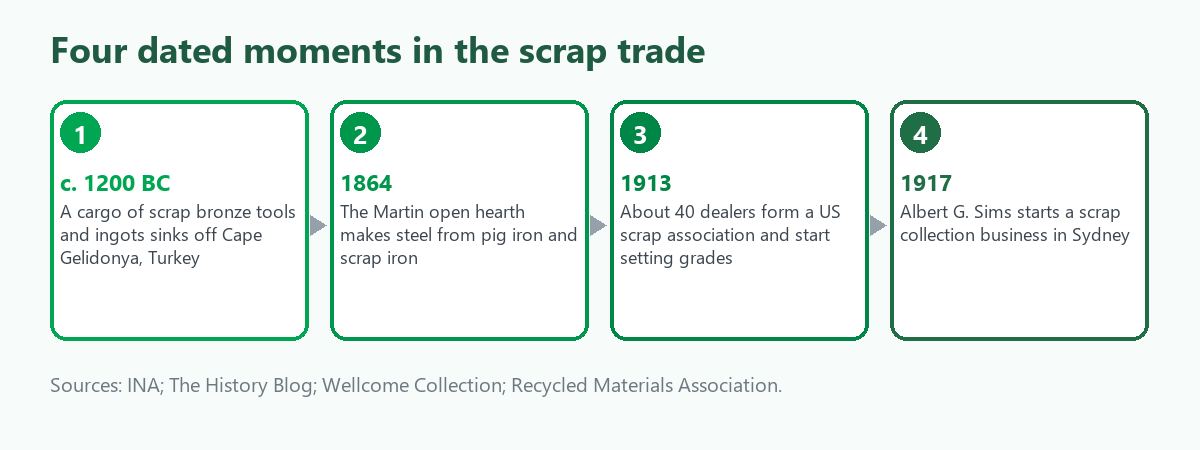
The clearest early evidence of scrap travelling for sale or reuse comes from the sea. In 1954 a Turkish sponge diver, Kemal Aras, found a wreck off Cape Gelidonya on Turkey's southern coast. It was excavated in 1960 under George Bass, then a graduate student, for the University of Pennsylvania [1]. The ship went down about 1200 BC, and the site page also gives the late 13th century BC [1]. Its cargo included scrap bronze tools from Cyprus meant to be recycled, together with copper and tin ingots [1].
The excavators read the stone tools and an anvil-like stone as suggesting that a travelling smith, a tinker, may have been aboard [1]. That is an interpretation, not a fact, and the excavators describe the ship's origin as probably Canaanite or early Phoenician, with a Cypriot origin possible [1]. Later work by the Institute of Nautical Archaeology found that copper ingot fragments make up a much larger share of the cargo than first recognised, at least a third of the copper by their estimate, and says the question now is why the ingots were broken up for circulation [2]. In plain terms, broken metal was moving by ship between smiths more than three thousand years ago.
Scrap hoards: stock or offerings?
On land, Bronze Age Europe left many hoards of broken objects. At Hollingbourne in Kent, a hoard of about 800 BC held 35 copper-alloy pieces: 12 axeheads or fragments, 6 blade lengths, 2 spearheads, 2 sword or dagger handles and 13 cakes, which are lumps of cast metal [3]. The excavators called it a smith's, or founder's, hoard, and it was suggested by the regular breaks and the cakes [3]. They also note it was partly disturbed by ploughing, so its original context is uncertain [3].
Not everyone reads these deposits as stock. Oliver Dietrich argued in 2014 that the large "scrap" hoards of the Carpathian Basin are better seen as votive deposits, with each object a single act of dedication [4]. The honest position is that some hoards may be a smith's stock, some offerings, and some both. The word "scrap" in hoard names is an archaeologist's label, not proof of a market.
A scrap yard of statues
The best example of a yard comes from Metropolis in western Turkey, reported in January 2025. Excavators found approximately 2,000 fragments of bronze statues, dating from the Hellenistic through Roman imperial periods, roughly the 3rd century BC to the 4th century AD [5]. Archaeologists believe the pieces were collected in the late imperial period to be melted down and recycled, perhaps into coins, though that is their reading rather than a proven fact [5]. If so, it is a scrap yard in all but name, with worn and broken statues in place of old cars.
Rags, bones and marine stores
Scrap trading in Britain grew from the street. A 1905 report to the London County Council described a marine store dealer as someone who normally buys old metal, bottles and crockery and sometimes rags, grease, bones and other domestic refuse [6]. The Post Office Directory counted 590 marine stores in London in 1875 and 330 in 1906 [6]. The same report notes that rag, bone and fat dealers got their material from wholesale dealers, retail shops, barrowmen, dust wharves, dustmen and households [6]. The pattern will be familiar: small collectors feed dealers, dealers feed bigger buyers.
Steel makes scrap a raw material
The trade grew when industry needed what it collected. In 1864 the French brothers Pierre and Émile Martin used William Siemens's regenerative furnace to make steel, charging it with pig iron and some wrought-iron scrap [7]. Later open-hearth furnaces were charged with liquid blast-furnace iron and steel scrap together with ore and fluxes [7]. We did not find a source for how much scrap steelmakers used in the 1860s, so we cannot say how large the demand was at the time.
1913: the trade organises
By the early 1900s the American scrap trade, then called the waste trade, was large but disorganised. A history in the Recycled Materials Association's magazine says dealers in woollen rags and scrap rubber were the "aristocrats", non-ferrous metal dealers came next, and scrap iron dealers were at the bottom [8]. Many dealers handled everything and called their goods "junk", and there were no standard grades [8].
On 24 March 1913 about 40 dealers met at Young's Hotel in Boston and voted to form the National Association of Waste Material Dealers, the first national body for the trade [8]. Its first big job was classification: it began with grades for woollen rags and scrap metal, which the trade had long considered impossible, and 44 companies paid dues as charter members in the first year [8]. The same history lists 1913 average prices from the Waste Trade Journal [8]:
| 1913 average | Price |
|---|---|
| Heavy melting steel | US$12.73 a gross ton |
| Cast iron borings | US$8.49 a gross ton |
| Heavy copper | 13.2 cents a pound |
| No. 1 composition | 12.1 cents a pound |
Source: Waste Trade Journal annual averages as reported in [8]. US prices.
The ranking has since flipped. In Australia's 2025-26 exports, non-ferrous metals were about 16% of the tonnes and 67% of the value, as we set out in Australia's Scrap Metal Exports: 2025-26 Data.
Sydney, 1917
Sims Metal's own history says Albert G. Sims started a scrap metal collection business in Sydney in 1917 [9]. The company page gives no details of how he collected, so we do not repeat the often-told stories. It says the company made its first international export of steel scrap, to Japan, in 1956 [9]. The Second World War gives a second Australian thread. In 1943 the Commonwealth Salvage Commission was established in July and the National Salvage Corps in November, both to organise collection of waste and scrap across the country [10]. Local schemes such as Camden's sold scrap iron to Australian Iron & Steel at Port Kembla, and some people raised concerns that scrap might be exported to Japan [10].
Compare that with 2025-26, when Australia shipped 3.05 million tonnes of metal scrap worth A$4.58 billion overseas, according to our earlier analysis of the Department of Climate Change, Energy, the Environment and Water export data.
What the history suggests
This is our reading, not a finding from any source.
- Information has always been the problem. The 1913 dealers formed a body to set grades because every deal was a private haggle. How Scrap Prices Are Set covers today's version.
- Collectors and dealers have always been a chain. From marine stores to modern yards, small suppliers feed larger buyers. How that chain is regulated and taxed is covered in Scrap Business Rules in Australia by State.
- Scrap follows industry. Bronze for smiths, iron for open hearths, aluminium for aircraft in wartime. Demand has always come from what is being made.
What this means for you
- If you are new to the trade, you are working in one of the oldest businesses there is, and the main skills have not changed: knowing what material you hold and who needs it.
- If you run a yard, the 1913 story is a reminder that standard grades and records are what make a trade trustworthy.
- If you export, see How a Scrap Export Deal Works, Step by Step.
You can compare buyers on the ScrapTrade marketplace or register. ScrapTrade operates a scrap marketplace and has a commercial interest in the trade.
What we could not confirm
- The first seller. No source we found names one, or dates the first sale of scrap.
- Whether the Gelidonya cargo was for sale or belonged to a travelling smith. It is a suggestion by the excavators, and the cargo is still being studied [1][2].
- Whether Bronze Age hoards were stock or offerings. Archaeologists disagree [3][4].
- The Metropolis reading. The recycling explanation is what archaeologists believe, not a settled conclusion [5].
- Scale before the 20th century. We found no figure for how much scrap was traded in ancient, medieval or early industrial times.
- How Albert Sims worked in 1917, and the full history of the Australian trade before the war. The company page does not say.
- Other regions. We did not research China, India, Japan or the Islamic world, so this is not a world history.
Frequently asked questions
Who sold the first scrap metal?
No one knows. Reuse of metal is far older than any record of a sale, and the evidence we have is of objects, not transactions.
What is the oldest evidence of a scrap cargo?
The Cape Gelidonya wreck, about 1200 BC, carried scrap bronze tools from Cyprus intended for recycling, with ingots [1]. We cannot say it is the oldest, only that it is well documented.
Were Bronze Age hoards scrap stockpiles?
Some may have been a smith's stock, as at Hollingbourne [3]. Other researchers read the large hoards as offerings [4].
When did the scrap trade first organise?
In the United States, on 24 March 1913, when about 40 dealers met in Boston to form the National Association of Waste Material Dealers [8].
When did the Australian scrap trade begin?
We cannot date the first Australian scrap sale. Sims Metal says Albert G. Sims started a collection business in Sydney in 1917 [9].
Sources
- Institute of Nautical Archaeology, Cape Gelidonya Late Bronze Age shipwreck excavation.
- Institute of Nautical Archaeology, Analyzing ingots from the Cape Gelidonya shipwreck (undated; the image paths suggest 2016).
- Kent Archaeological Society, Hollingbourne Founder's Hoard.
- Oliver Dietrich, Learning from "Scrap" about Late Bronze Age Hoarding Practices, European Journal of Archaeology 17(3), 2014. Abstract read.
- The History Blog, 2,000 bronze statue fragments found in ancient Metropolis scrap yard (21 January 2025).
- London County Council report on marine store dealers (1905), via Wellcome Collection, London's Pulse: Medical Officer of Health reports.
- Britannica, Open-hearth process.
- Kent Kiser, The Birth of an Association, Scrap, March/April 2013, Recycled Materials Association.
- Sims Metal, Our history.
- Ian Willis, Camden's salvage campaign, 1939-45, Australian War Memorial Journal.
This is general history, not a complete account. Prices are 1913 US figures from a trade journal. Dates and interpretations are as reported by the sources cited. ScrapTrade operates a scrap marketplace and has a commercial interest in the scrap trade.