

Ask ten people in the scrap trade "what is the price of scrap today?" and you may get ten answers, all correct. One quotes a number in US dollars for a ship carrying 10,000 tonnes of steel to Turkey. Another quotes a percentage of the London copper price. A third gives you a figure in cents per pound written on a board at a local yard. These are not competing prices. They are different links in the same chain, and once you see the chain, quotes stop being confusing.
This explainer shows how that chain works for steel and for copper and aluminium, with made-up examples so you can follow the arithmetic. ScrapTrade's own How Scrap Metal Pricing Works covers grading, weight and contamination, and we do not repeat it here. This article is about benchmarks. It is general information, not trading advice.
The short version
There is no single "scrap price". There are:
- Benchmarks: published reference prices, such as an exchange price for copper or an agency's assessment of bulk steel scrap.
- Deal prices: what a buyer and seller actually agree for a specific lot, usually benchmark plus or minus an adjustment.
- Yard prices: what a yard pays a collector, which is the deal price less costs and margin.
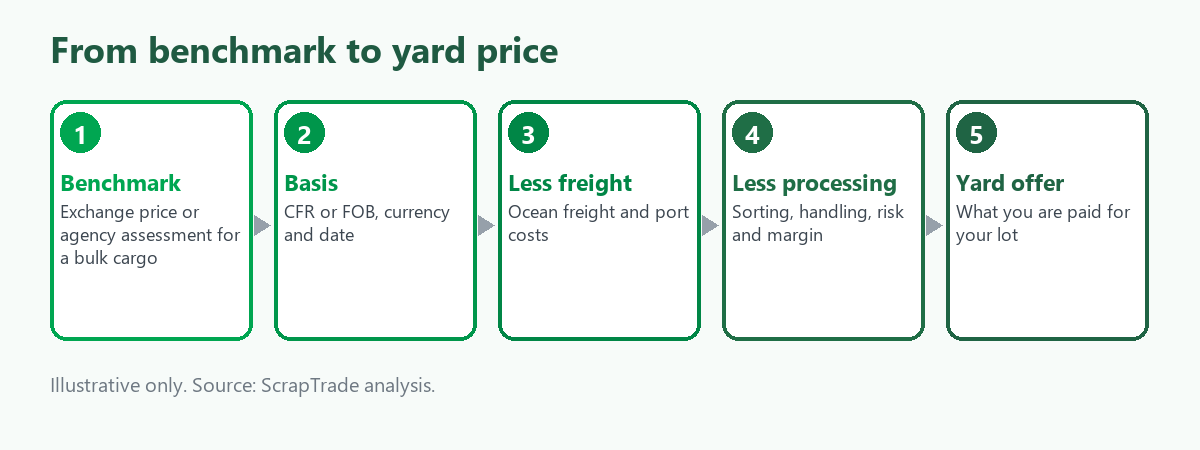
Each step down takes something off, for freight, processing, risk and profit. Knowing which step a quote is from is half the skill.
Steel: benchmarks from bulk cargoes
Ferrous scrap is traded in large cargoes, and benchmarks come from price reporting agencies such as S&P Global Platts, Fastmarkets, Argus, SteelOrbis, BigMint and SMM. They collect bids, offers and completed deals from the market and publish an assessment. Two features of a benchmark matter.
What it describes. Take the best known one, Platts' HMS 1/2 80:20. S&P Global says it reflects the tradeable value of bulk ferrous scrap imports into Turkey from all supply regions, valuing heavy melting scrap grades 1 and 2 blended 80:20, covering ISRI codes 200 to 206, with a minimum lot of 10,000 tonnes and delivery three to eight weeks ahead. Other grades, such as shredded, plate and structural, can be normalised to it [1]. In other words, the benchmark describes one kind of cargo, to one place, for one size of deal. It is not a price for your 5 tonnes in a yard.
Where it is quoted. Different buyers have different reference points. Turkey is the classic one. In October 2026, Platts proposed a new daily assessment for Vietnam from 1 December, based on cargoes of 5,000 tonnes and above, delivered to main Vietnamese ports, with shipment 30 to 60 days ahead [2]. Bangladesh, India and others have their own quotes, usually reported by trade press. Australian exporters often compare offers into several of these at once. For example, SMM reported in June 2026 that Australian offers into Vietnam were around US$380 to 385 a tonne, against about US$370 for Japanese scrap [3]. That is a spot quote, and it moves weekly.
Copper and aluminium: priced off an exchange
Non-ferrous scrap works differently. Refined copper and aluminium trade on exchanges, mainly the London Metal Exchange (LME) and, for copper in the United States, COMEX. Scrap is then priced as a discount to the exchange price, or as a percentage of it, with the size of the gap depending on grade, quantity, location and the buyer.
You can see this in the market. Fastmarkets reported in July 2025 that US copper scrap participants were shifting from COMEX to the LME as the underlying price for discount calculations, after extreme COMEX volatility and a 50% copper import tariff announcement. The gap between COMEX and LME had widened to around US$2,500 to US$2,700 a tonne [4]. That matters because a scrap price calculated as "benchmark minus X" is very different depending on which benchmark you subtract from. Fastmarkets also quoted a source that most US copper scrap is exported, which is why many sellers prefer the international benchmark.
For aluminium, a 2026 report by L.E.K. Consulting for the Australian Aluminium Council says scrap prices sit above 90% of the LME benchmark, which leaves little margin for a local remelter [5]. That tells you how tightly scrap prices track the exchange once you account for grade.
What the discount covers
The gap between the exchange price and what a yard pays is not just profit. It covers:
- sorting and processing, including labour and equipment;
- freight to the smelter or refiner;
- the risk that the price moves between buying and selling;
- losses from contamination and weighing differences;
- the buyer's margin.
The percentage varies a lot, so we do not quote typical figures. Ask for the formula the buyer uses and what it applies to.
The steps from benchmark to yard price
The arithmetic below is invented to show the logic. The numbers are not quotes.
A steel example. Suppose a benchmark for cargoes into an importing port is US$385 a tonne CFR.
| Step | What happens | Amount |
|---|---|---|
| Benchmark | Price delivered to the destination port (CFR) | US$385 |
| Less ocean freight | Cost of shipping to that port | minus US$35 |
| Equals FOB | Price loaded at the Australian port | US$350 |
| Convert to Australian dollars | At an assumed US$0.65 per A$1 | about A$538 |
| Less port, loading, processing and margin | Costs of collecting, sorting and shipping | minus about A$100 |
| Indicative price paid at the yard | Per tonne | about A$438, or A$0.44 a kilogram |
CFR means "cost and freight": the seller pays to ship the goods to the destination port, and the price includes that. FOB means "free on board": the price is for goods loaded onto the ship at the loading port, with the buyer paying the freight. These are standard international trade terms. The point is that the same cargo has a different price at each stage.
A copper example. Suppose the exchange price is US$13,000 a tonne and a buyer pays 88% of it for a particular grade of clean copper wire. The buyer's price is US$11,440 a tonne, or about US$11.44 a kilogram. The 12% difference covers the buyer's processing, freight, risk and margin. A lower grade might be priced at a lower percentage, or at a bigger discount. If the exchange price rises 5%, the price paid rises about 5% too, which is why copper scrap moves with the market daily.
How to read any price you are quoted
Before comparing two prices, check eight things.
| Question | Why it matters |
|---|---|
| Which metal and grade? | HMS and shredded are different |
| What unit? | Tonne, gross ton, short ton, kilogram or pound. See Tonnes, Gross Tons and Short Tons in Scrap |
| Which currency? | US dollars, Australian dollars or others |
| What basis? | Ex-yard, delivered, FOB or CFR |
| What date? | Spot prices move daily or weekly |
| What quantity? | A 10,000 tonne cargo and a 5 tonne lot are different markets |
| What deductions? | Contamination, moisture, weighing tolerance |
| What payment terms? | Same price, different value if payment is 30 days later |
A worked comparison
Two quotes for steel scrap arrive on the same day.
- Quote A: US$380 a tonne CFR, 5,000 tonnes, ship in 30 days.
- Quote B: A$420 a tonne, ex-yard, 20 tonnes, collect this week.
They look unrelated. Using the same invented assumptions as above, A is about US$345 FOB, around A$531 a tonne, before port and processing costs of perhaps A$100, which makes roughly A$430. B is A$420 for a lot you can sell now. The two are in the same range, but A needs a cargo you may not have, a ship and a longer timeline, while B is available today. Which is better depends on your volume and cash. The point is to get them onto the same basis first.
Where ScrapTrade's price index fits
ScrapTrade publishes an indicative price index for common materials, such as heavy melting steel, aluminium extrusion and copper grades, in Australian dollars per kilogram, at live material prices. It is an AI-generated estimate refreshed daily, and the page says actual prices vary by location, grade, condition and quantity. It is a starting point, not a quote or a benchmark of the kind agencies publish, and it can move sharply between visits. Use it to get a sense of scale, then confirm with a real buyer. See How to Negotiate a Scrap Deal for how to turn it into an offer, and Becoming a Pro Scrap Trader for tracking your own margins.
Common mistakes
- Comparing quotes on different bases, such as a CFR cargo price against an ex-yard price.
- Treating an export price as a yard price. The difference is freight, processing and margin.
- Ignoring the date. A week-old quote can be wrong by several per cent.
- Mixing up units. The same number buys different amounts of metal: 400 per gross ton covers about 1.6% more metal than 400 per tonne, and 400 per short ton about 9% less.
- Forgetting the exchange rate. An Australian seller's income moves with the US dollar as well as the market.
Compare buyers on the marketplace or register to list your material.
Frequently asked questions
Is there one official scrap price?
No. There are benchmarks published by agencies and exchanges, deal prices agreed between parties and yard prices paid to collectors.
What is HMS 1&2 80:20?
A grade blend used as a benchmark for ferrous scrap, 80% heavy melting scrap grade 1 and 20% grade 2. Platts' Turkish assessment is built on it [1].
What does CFR mean?
Cost and freight: the price includes shipping to the destination port. FOB means the price is for goods loaded at the origin port.
How is copper scrap priced?
As a discount to, or percentage of, an exchange price such as the LME or COMEX, depending on grade and buyer [4].
Why is my yard price lower than the price in the news?
Because the news price is usually a bulk benchmark for a large cargo, and a yard price subtracts freight, processing, risk and margin.
Sources
- S&P Global, Turkish Scrap: Platts TSI HMS 1/2 80:20.
- S&P Global Platts, Platts proposes to launch daily HS CFR Vietnam ferrous scrap price assessment (12 October 2026).
- SMM, Vietnam import scrap remains soft as buyers stay cautious (June 2026).
- Fastmarkets, US copper scrap markets look to transition to LME vs COMEX (15 July 2025).
- Australian Aluminium Council and L.E.K. Consulting, Enabling Development of Aluminium Recycling Capability in Australia, March 2026.
All worked examples are invented to show the arithmetic and are not quotes. Benchmarks and quotes change daily. This article is general information, not trading advice. ScrapTrade operates a scrap marketplace and has a commercial interest in the scrap trade.