

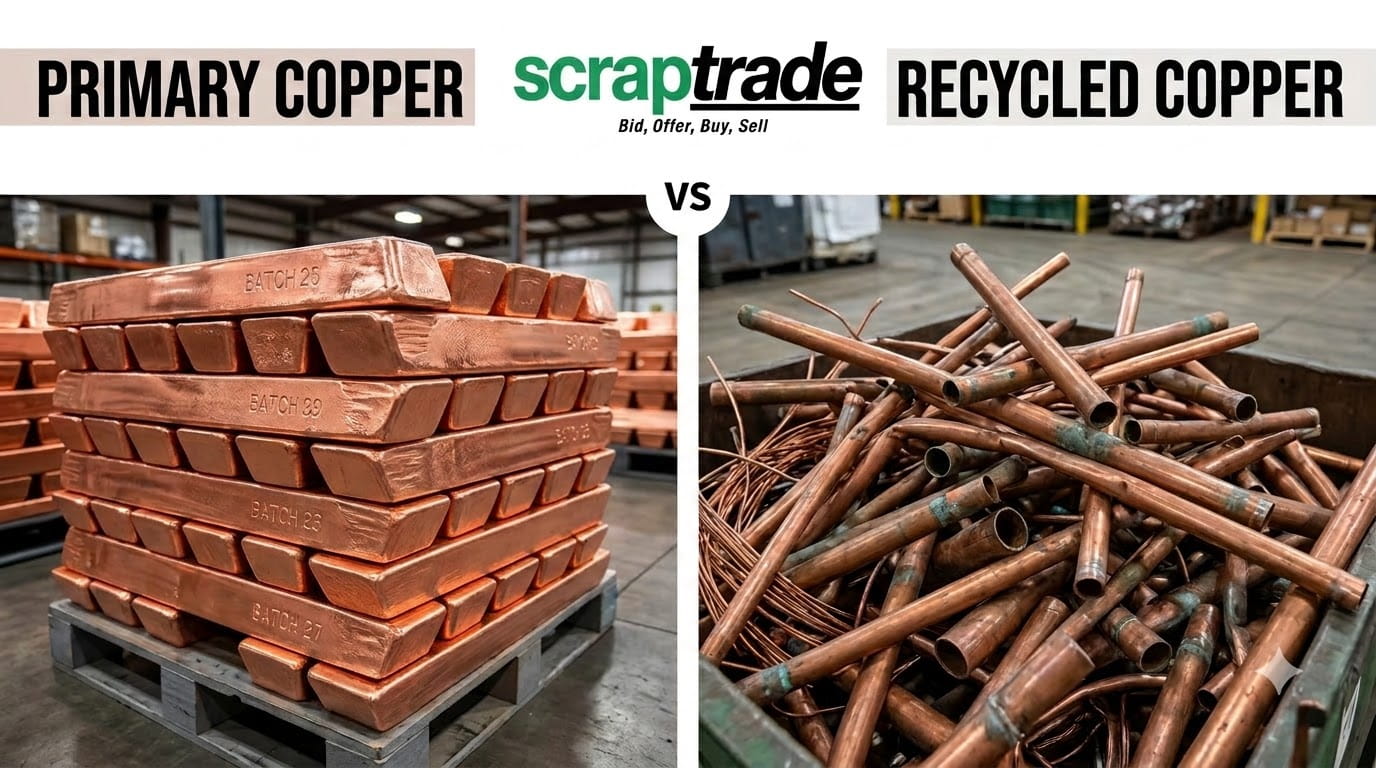
Metal manufacturers have two broad sources of raw material: primary metal produced from mined resources and secondary metal recovered from recycled scrap. Both can supply the manufacturing industry, but they follow different production routes and involve different cost, quality, and supply considerations.
For scrap buyers, recyclers, manufacturers, and traders, understanding the difference between recycled and primary metal is important when making purchasing decisions. Recycled metal can provide a valuable source of industrial feedstock, but its suitability depends on material grade, contamination, composition, and processing requirements. Primary metal, meanwhile, offers manufacturers material produced through controlled extraction and refining processes.
This guide compares recycled vs primary metal, explains what affects their costs and quality, and explores how demand from mills and manufacturers influences the scrap market.
Primary vs Secondary Metal: What the Terms Mean
Primary metal is produced from naturally occurring mineral resources. The process generally involves mining, mineral processing, extraction, and refining to produce metal suitable for industrial applications.
Secondary metal is recovered from previously used products, manufacturing waste, and industrial scrap. It is processed through recycling operations so that it can be reused as raw material or incorporated into new metal products.
For example:
- Primary aluminium is produced from bauxite through alumina refining and aluminium smelting.
- Secondary aluminium is recovered from used aluminium products, manufacturing offcuts, and other aluminium scrap.
- Primary copper is produced from copper-bearing ores through extraction and refining.
- Secondary copper is recovered from cables, electrical equipment, industrial components, and copper manufacturing scrap.
The two production routes serve the same broad objective: supplying metal to manufacturers. However, the raw material source and processing requirements differ.
It is also important to distinguish recycled scrap from finished secondary metal. Scrap is the input material collected for processing, while secondary metal is the recovered material that has been processed to meet a particular specification.
Key Differences
Recycled and primary metals differ in how they are produced, what influences their cost, and how manufacturers control their quality.
Production Route
The production route is one of the clearest differences between primary and secondary metal.
Primary metal production
Primary production begins with mining. The extracted ore is processed to concentrate the required minerals, followed by extraction and refining.
Depending on the metal, this may involve crushing, beneficiation, smelting, electrolysis, and other refining operations.
The final metal is then prepared for industrial use in forms such as ingots, billets, slabs, or other products.
Secondary metal production
Secondary production begins with scrap collection. The material is sorted, inspected, prepared, and processed through suitable recycling technologies.
The process may involve:
- Collection of industrial and post-consumer scrap.
- Sorting by metal type, grade, and condition.
- Removal of contamination and unwanted attachments.
- Shredding, cutting, or other physical preparation.
- Melting, refining, or other metal recovery processes.
- Composition adjustment and quality testing.
- Casting into suitable forms for manufacturing.
The exact route depends on the metal and scrap category. Aluminium cans, copper cables, steel scrap, and stainless steel scrap do not all follow the same recycling process.
Cost Drivers
The cost of primary and secondary metal depends on different production and supply factors. Neither route is automatically cheaper in every situation.
Primary metal costs can be influenced by:
- Mining and ore extraction expenses.
- Mineral processing and refining.
- Energy and fuel requirements.
- Labour and equipment costs.
- Transportation and logistics.
- Production capacity and market conditions.
- Availability of suitable mineral resources.
Secondary metal costs are influenced by:
- Scrap collection and purchasing prices.
- Sorting and material preparation.
- Transportation and storage.
- Contamination removal.
- Processing and melting expenses.
- Metal recovery and refining requirements.
- Quality testing and compliance.
- Availability of suitable scrap feedstock.
For example, clean aluminium manufacturing offcuts may require less preparation than mixed aluminium scrap containing plastic, steel attachments, or other contaminants.
Similarly, clean copper wire and mixed insulated cable can have different processing requirements and commercial values.
The final cost of secondary metal depends on the complete recovery route, not simply the price paid for scrap.
Quality and Consistency
Quality is another important difference between recycled and primary metal.
Primary metal is produced through controlled extraction and refining operations. Manufacturers purchase it according to established grades and specifications.
Secondary metal can also meet demanding manufacturing specifications, but its quality depends on the scrap input and the effectiveness of sorting, processing, and refining.
Important quality considerations include:
Chemical composition: The percentage of the main metal and alloying elements must match the intended application.
Contamination: Foreign metals, coatings, oils, plastics, and other unwanted materials can affect processing and final product quality.
Alloy identification: Different grades of aluminium, stainless steel, brass, and bronze may require separate handling.
Consistency: Manufacturers need reliable feedstock that meets their requirements across repeated deliveries.
Testing and inspection: Material analysis, sampling, and quality checks help confirm whether recycled metal is suitable for a particular production process.
Secondary metal should not automatically be considered lower quality than primary metal. Properly sorted, processed, and refined recycled metal can be suitable for a wide range of manufacturing applications.
The important factor is whether the material meets the required specification.
Why Mills and Manufacturers Buy Scrap
Metal mills, foundries, and manufacturers purchase scrap because it can serve as an important raw material for industrial production.
The suitability of scrap depends on the facility's equipment, production process, product specifications, and material requirements.
There are several reasons why industrial buyers source recycled metal.
Raw material availability: Scrap provides an additional source of metal feedstock for production.
Manufacturing flexibility: Buyers can source different grades and forms of scrap according to their production needs.
Material recovery: Scrap contains metal that can be processed and returned to industrial use.
Production planning: Consistent access to suitable scrap can support procurement and raw material planning.
Supply diversification: Using both primary and secondary metal can give manufacturers more options when sourcing raw materials.
Different industries purchase different scrap categories.
| Industry | Common recycled metal inputs | Potential applications |
|---|---|---|
| Steel manufacturing | HMS, steel plate, structural steel scrap | Construction steel and manufactured steel products |
| Aluminium manufacturing | UBC, extrusion scrap, aluminium wheels | Aluminium products and components |
| Copper processing | Copper wire, pipes, busbars | Electrical products and copper materials |
| Foundries | Cast iron and selected alloy scrap | Machine components and castings |
| Stainless steel production | Stainless steel grades such as 304 and 316 | Industrial and consumer stainless products |
| Brass and bronze manufacturing | Brass fittings, bronze components | Valves, connectors, bearings, and fittings |
Not every buyer accepts every scrap grade. Manufacturers and processors usually define their own specifications for material composition, size, cleanliness, and delivery conditions.
How Demand for Recycled Metal Affects Scrap Prices
Demand from mills, foundries, and manufacturers plays an important role in determining the commercial value of scrap metal.
When industrial buyers require more secondary metal, competition for suitable scrap feedstock can increase. This may influence the offers available to scrap suppliers.
However, demand is only one part of scrap pricing. Prices also depend on metal market conditions, supply availability, grade, location, processing costs, and logistics.
Several factors connect recycled metal demand with scrap prices.
Manufacturing activity: Increased production in construction, automotive, electrical, and machinery industries can influence demand for metal feedstock.
Primary metal prices: Changes in primary metal markets can affect the economics of secondary metal purchasing and the prices buyers are willing to offer.
Scrap availability: Limited availability of clean, correctly sorted scrap can influence buyer competition for particular grades.
Processing capacity: Buyers need suitable equipment and capacity to process the material. A grade that matches their operations may attract stronger interest.
Export and import conditions: Trade restrictions, freight costs, customs requirements, and international demand can affect cross-border scrap trading.
Material quality: Clean and well-identified scrap is generally easier to evaluate than mixed or contaminated loads.
Example: How Scrap Quality Influences Offers
Consider two suppliers offering aluminium scrap.
| Factor | Supplier A | Supplier B |
|---|---|---|
| Material | Sorted aluminium extrusion | Mixed aluminium scrap |
| Condition | Clean and separated | Contains attachments and mixed material |
| Identification | Clearly described | Uncertain grade |
| Preparation | Ready for buyer inspection | Requires additional sorting |
| Buyer assessment | Easier to evaluate | More processing uncertainty |
Even if both suppliers offer the same estimated weight, buyers may assess the loads differently because their preparation requirements are not the same.
This is why sellers should compare offers based on material specifications and net proceeds rather than looking only at the headline price.
For more information, read how scrap metal pricing works.
Where Recycled Metal Is Used
Secondary metal is used across many manufacturing industries. Once processed to meet the required specifications, it can become feedstock for new products and components.
Construction: Recycled steel and aluminium can be used in structural products, building components, fittings, and other construction applications.
Automotive manufacturing: Suitable recycled steel and aluminium can enter automotive material supply chains. Copper is also used in electrical and electronic systems.
Electrical industry: Recovered copper is used in applications involving electrical conductors, cables, and selected components, subject to the required material specifications.
Packaging: Recycled aluminium can be processed into material for new packaging products.
Machinery and equipment: Recycled ferrous and non-ferrous metals can supply foundries and manufacturers producing industrial components.
Plumbing and fittings: Recovered brass, bronze, copper, and other suitable alloys can be used in manufacturing valves, connectors, pipes, and fittings.
The final application depends on the recovered metal's composition, quality, and the manufacturer's technical requirements.
FAQs
What is the difference between primary and secondary metal?
Primary metal is produced from mined mineral resources through extraction and refining. Secondary metal is recovered from previously used products and manufacturing scrap through recycling processes such as sorting, melting, and refining.
Is recycled metal as good as primary metal?
Recycled metal can meet the same required specifications as primary metal when it is properly sorted, processed, and refined. Its suitability depends on chemical composition, contamination levels, alloy grade, and the quality requirements of the final application.
Is recycled metal always cheaper than primary metal?
No. Secondary metal costs depend on scrap purchasing prices, collection, transport, sorting, processing, and refining. Primary metal costs depend on mining, extraction, refining, energy, and logistics. Market conditions determine which source is more commercially attractive.
Why do manufacturers buy recycled metal?
Manufacturers buy recycled metal because it provides an additional source of industrial raw material. Suitable scrap can be processed into feedstock for steel, aluminium, copper, brass, and other metal products.
Conclusion
Recycled and primary metals both play important roles in global manufacturing. Primary metal comes from mined resources, while secondary metal is recovered from scrap and processed for reuse.
The main differences involve production routes, cost drivers, quality control, and raw material supply. Recycled metal can meet demanding manufacturing requirements when it is correctly sorted and processed, making scrap an important industrial feedstock.
For scrap sellers, this creates opportunities to supply mills, foundries, and manufacturers looking for suitable secondary metal. Accurate material identification, clean sorting, clear descriptions, and competitive buyer offers can help improve the selling process.
Explore available material categories on ScrapTrade and connect with potential buyers through a global online scrap marketplace.