

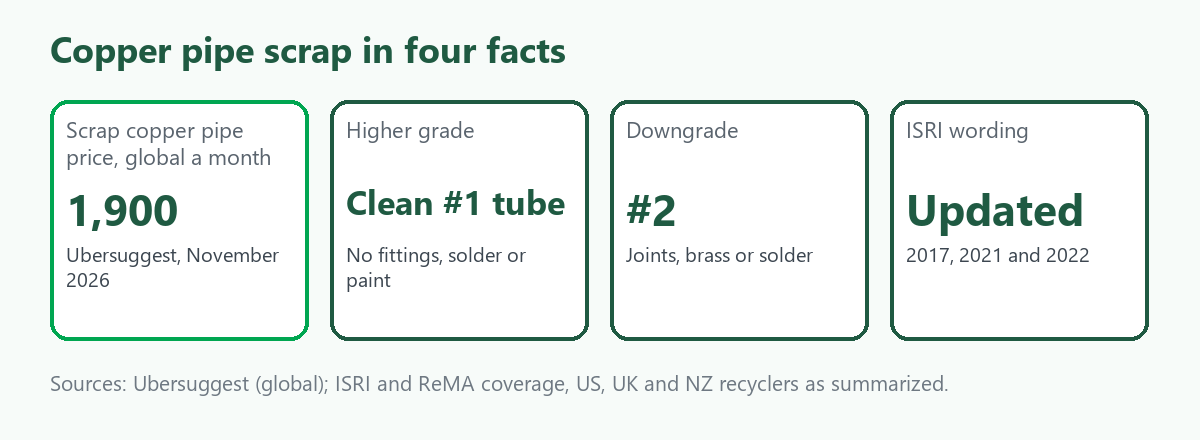
Plumbers and renovators type "scrap copper pipe price" about 1,900 times a month worldwide, according to Ubersuggest, and the answer they need is rarely a number. It is a grade. Two lengths of the same pipe can sit in different price bands depending on what is attached to them. This guide covers the two grades most sellers meet, what the American trade codes say, how to prepare a job's worth of pipe and what to ask the yard. Our sources are US, UK and New Zealand recyclers plus coverage of the US trade association's specification circular, so the terms below are a pattern and not a worldwide standard. No prices are given. ScrapTrade runs a scrap marketplace and has a commercial interest in the scrap trade.
Why the grade is the whole story
Yards sort copper tubing into a top grade and a lower one. Tube that is clean, meaning free of fittings, insulation, paint and solder, goes in the top band, commonly called number 1, and light oxidation is accepted. One source adds a thickness expectation: generally more than about one sixteenth of an inch. Tube with joints, brass fittings or leftover solder is usually pushed down to number 2, since it needs more processing before a mill can use it. Names, thickness limits and tolerances differ from yard to yard, so ask which terms yours uses.
The American trade codes
In the United States the common reference is the scrap specifications circular, published first by ISRI and now by ReMA. In coverage of its 2017 proposals, Barley is bare, uncoated, unalloyed copper wire, the bare bright of the trade. Berry is clean, untinned, uncoated copper wire and cable, without brittle burnt wire or tubing. Candy covers heavy copper solids and tubing. Cliff is miscellaneous unalloyed copper solids and tubing at a nominal 96 percent copper, 94 percent minimum, by electrolytic assay. An ASTM work item reads number 1 copper as Berry plus Candy and number 2 as Birch plus Cliff. Beware of summaries: the circular changed again in 2021 and 2022, and one commercial grade catalogue we found flatly contradicts the association's wording. For anything that matters, use the current circular. Pipe normally lands under the tubing grades, and buyers outside the US may use other names.
Getting a job's pipe ready
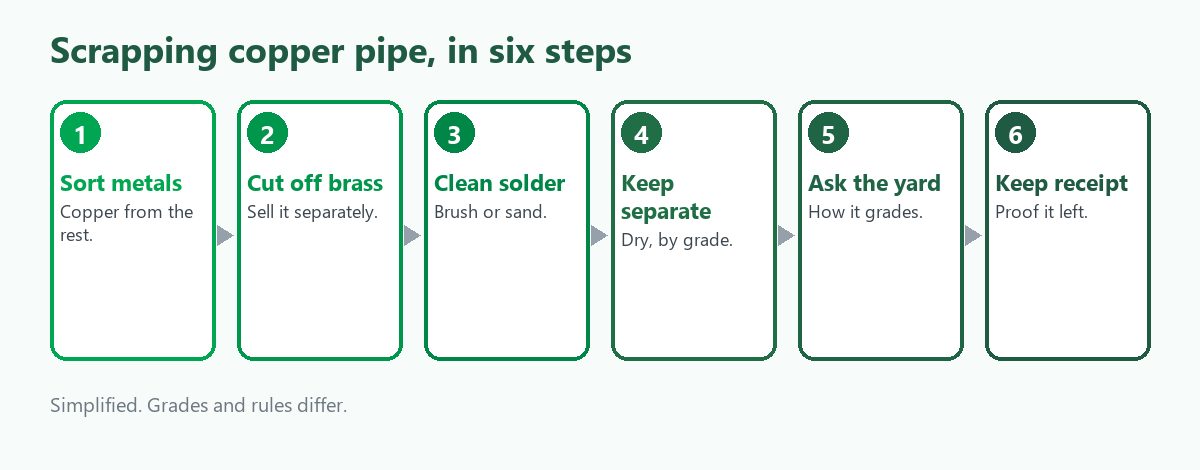
Start by separating metals, with copper away from steel, brass and plastic. Then take brass fittings off, because leaving them on lowers the grade, and sell the brass in its own pile. Next deal with solder: once the bulk is gone, a wire brush or coarse sandpaper clears the residue, one source says. Strip any insulation or non-metal parts; the same source says rubber and plastic removal makes a big difference. Finally, store the clean tube dry and by grade.
The open question is whether it pays. That depends on how far your yard's two rates sit apart and how long the work takes, and we found no figure for the gap. Ask for both rates and do the sum.
A renovation's mixed bag
A bathroom or kitchen strip-out hands you more than pipe: brass taps, chrome-plated fittings, steel and possibly lead. A pile of mixed fittings tends to be paid at the lowest rate, so piling each metal separately before you go helps. We did not research lead or plated fittings, so check with the yard. Radiators are another copper-heavy find, covered in our guide to scrap radiators.
The rules that follow copper around
Copper is stolen often enough that many jurisdictions regulate who may buy it. The examples we read, from summaries and not statutes: Louisiana forbids cash for copper and requires check, transfer or money order; North Dakota requires records and the seller's ID; England and Wales make cash payment for scrap an offense, with ID copies and three years of records; Scotland banned cash from 2016; several Australian states register dealers and restrict cash. All of it changes, so ask what your yard needs.
Questions for the yard
- Which grades do you use for tube, and how far apart are the rates?
- Do you buy brass fittings separately?
- Is there a minimum quantity?
- What ID and records do you require, and how do you pay?
Where ScrapTrade fits
Offcuts from one job suit the local yard. A plumbing firm, a contractor or a demolition crew with a clean, sorted lot of tube and a separate pile of brass could put it in front of verified buyers in more than 50 countries on ScrapTrade. Listing costs nothing and there is no commission; you agree terms in chat, and the buyer's 5 percent deposit sits in escrow after a bid is accepted. Both businesses and individuals can sell once verified. We could not confirm how pipe lots are graded on the platform, so contact cs@scraptrade.com.au first. See also the Australian companion, Scrap Copper Pipe: Grades and How to Sell It.
Open questions
- Payouts for any grade: none found, none given.
- Current ISRI wording; we read summaries of 2017 proposals.
- Grade terms outside the United States.
- Current dealer rules in any specific place.
- Whether ScrapTrade grades pipe the same way.
Quick answers
What counts as number 1 copper tube?
Clean tubing without fittings, solder, paint or insulation, per the sources. Yards define it differently.
Why does solder matter?
It is a contaminant. Pipe with solder or fittings drops to number 2.
Do the brass fittings need to come off?
Yes, per the sources. Sell the brass separately.
Is cash allowed for scrap copper?
Not everywhere. Several places ban it.
Does ScrapTrade take copper pipe?
Verified sellers can list scrap. Ask support about sorted lots.
Sources
- Ubersuggest keyword data, global, queried November 2026.
- Coverage of the ISRI and ReMA scrap specifications circular, an ASTM work item and US, UK and New Zealand recycler guides, as summarized in search results.
- State and national scrap dealer law summaries, as summarized in search results. Statutes not read.
- ScrapTrade website, accessed November 2026.
General information only, not legal or financial advice. Grades and rules differ by country.