

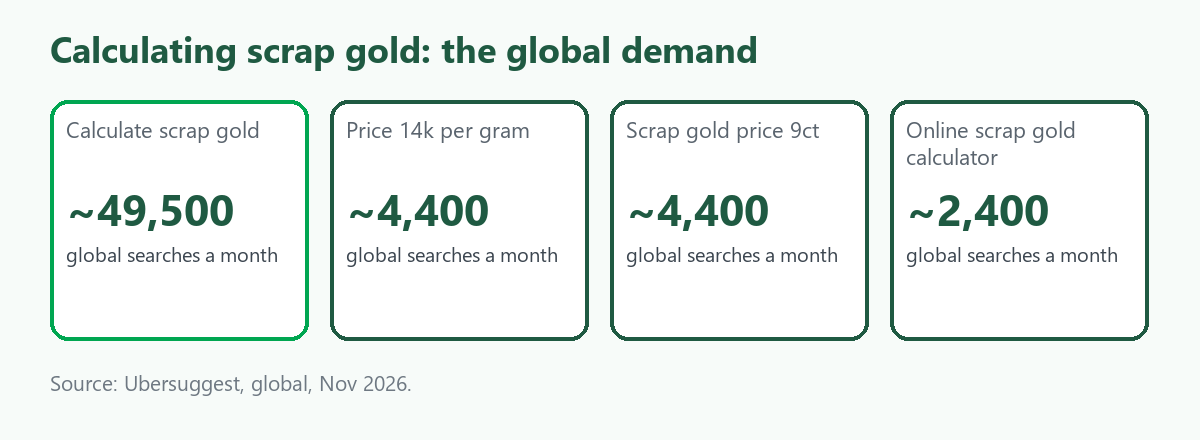
"Calculate scrap gold" is searched about 49,500 times a month worldwide, according to Ubersuggest, which makes it one of the largest searches in the scrap family. Around it sit "scrap gold price 14k per gram" and "scrap gold price 9ct" at about 4,400 each, "10k scrap gold price" at about 2,400 and "online scrap gold calculator" at about 2,400. The searchers hold a ring, a chain or a bag of broken jewelry and want a number. This guide gives the method and leaves the number blank, because gold moves daily and the only prices we found are buyers' own. It explains how to work out the gold in a piece, convert it and set it beside an offer. It belongs to our guide to selling gold, silver and scrap jewelry worldwide, and our companion on why offers sit below spot covers what buyers pay. Disclosure: ScrapTrade runs a scrap marketplace, so we benefit from scrap trading.
The three numbers you need
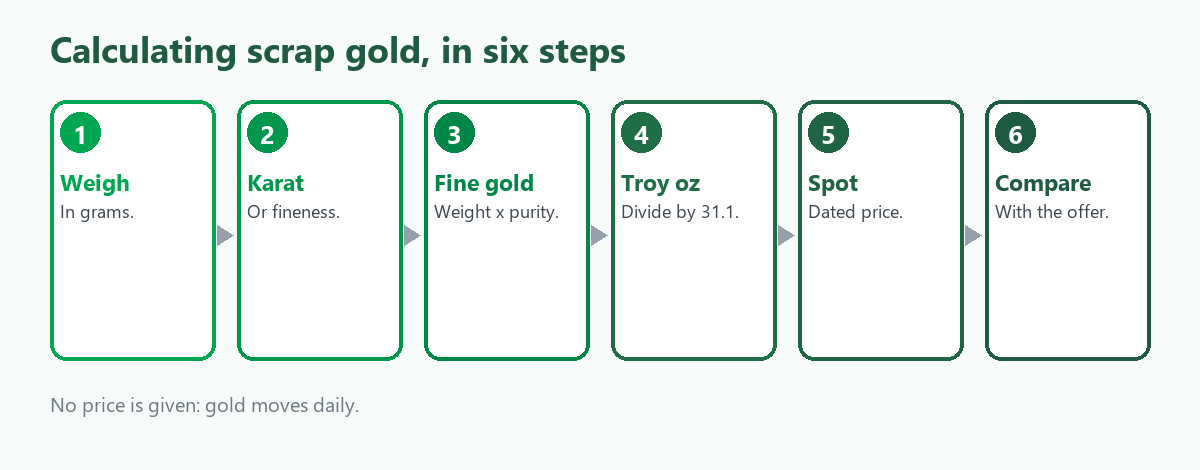
A calculator, whether a website or a sheet of paper, needs three inputs and gives one output called the melt value.
- Weight in grams. Use a scale that reads to at least a tenth of a gram, and weigh the piece on its own.
- Purity. For gold this is the karat, a count of parts out of 24, or a fineness mark in parts per thousand.
- The spot price. The market price of pure gold per troy ounce, taken from a source that shows its date and time.
Purity from the karat
Divide the karat by 24. Dealers describe the same arithmetic, and the usual results are:
| Karat | Fine gold share |
|---|---|
| 24K | about 99.9% |
| 22K | about 91.7% |
| 18K | 75% |
| 14K | about 58.3% |
| 10K | about 41.7% |
| 9K (9ct) | 37.5% |
Pieces marked in thousandths read the same way, so 750 is 75 percent and 585 is 58.5 percent. Some sources round 14 karat to the 585 mark and others use 58.3, which is a small difference but not zero, and it is one reason two calculators disagree. Our guide to what the stamps mean explains the marks.
The arithmetic, with an example
Fine gold in grams = weight × purity. A 10 gram chain marked 14K holds 10 × 0.585 = 5.85 grams of pure gold.
Troy ounces = fine gold in grams ÷ 31.1. A troy ounce is about 31.1 grams, and 5.85 ÷ 31.1 is about 0.188 troy ounces.
Melt value = troy ounces × spot price per troy ounce. We use the symbol S for the spot price, so the chain's melt value is about 0.188 × S, in whatever currency S is quoted.
To get a price per gram of a given karat, divide S by 31.1 and multiply by the purity. That is what the "price per gram for 14K" tables show, and they are only as current as their spot price. If you work in pennyweights, a trade unit, there are 20 to a troy ounce, so one is about 1.55 grams.
Where the sum goes wrong
- Stones, clasps and solder. Weigh the gold alone. A ring with a stone weighs more than the gold in it, and we found no general rule for how much to deduct, so ask the buyer how it removes the stone.
- Plated and filled pieces. The calculation assumes the whole piece is solid gold. A gold-plated piece is not, and dealer guides say the plated stamps mark pieces whose coating adds almost nothing.
- A wrong or missing mark. The mark is a claim, and a buyer will test it. If you cannot read it, use the lowest karat the piece could be for a floor figure.
- Mixed lots. Sort by karat, weigh each group and add the melt values.
- A stale spot price. A calculator that shows no date is not usable.
From melt value to an offer
Melt value is a ceiling and not an offer. Buyers pay a share of it, and the share depends on who is buying, which we cover in the price guide. To compare quotes, divide each offer by the melt value on the same spot price. If a buyer will not tell you the weight, the purity it assumed and the spot it used, you cannot check the quote.
Where ScrapTrade fits
A single chain is quicker to sell locally, and the calculator is your check on the quote. ScrapTrade becomes relevant with volume: a jeweler clearing broken stock, or a family clearing an estate, can put one sorted lot in front of several verified buyers. Precious metals is one of the twelve categories on the marketplace, buyers are spread across more than 50 countries, and nothing is charged to list or on a sale. Bids and terms are settled in chat, and once you accept one, 5 percent of the price is held from the buyer as an escrow deposit. Sellers, business or private, are verified first. Whether gold lots are accepted, and how weighing, testing and insurance work, is not confirmed, so email cs@scraptrade.com.au before you plan around it.
What we could not verify
- The spot price on any day. We give none.
- How much to deduct for stones and fittings.
- Which rounding of karat (58.3 or 58.5) any given buyer uses.
- Whether ScrapTrade accepts gold lots, and how they are weighed and tested.
Frequently asked questions
How do I calculate scrap gold?
Multiply the weight in grams by the purity (karat divided by 24), divide by 31.1 to get troy ounces, and multiply by a dated spot price.
How much pure gold is in 14K?
About 58.3 percent by the karat sum, or 58.5 percent by the 585 mark.
Is melt value what I will be paid?
No. It is a ceiling, and buyers pay a share of it.
Can I sell scrap gold on ScrapTrade?
Businesses and individuals can sell after verification, and precious metals is a category. Gold-lot handling is unconfirmed, so ask support.
Sources
- Ubersuggest keyword data, global, queried November 2026.
- Dealer and refiner guides on karat purity, melt value and plated stamps, as summarised in search results.
- ScrapTrade website, accessed November 2026.
General information only, not financial advice. ScrapTrade operates a scrap marketplace.