

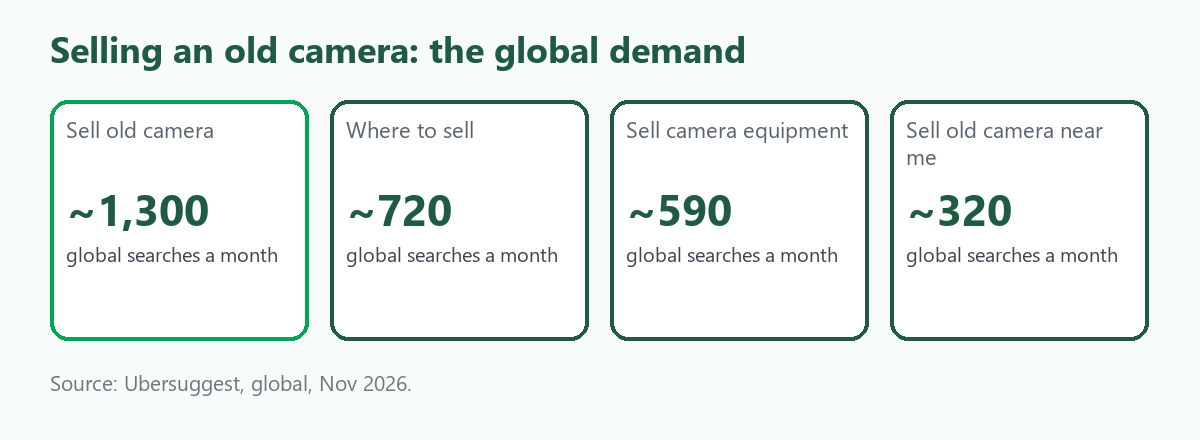
"Sell old camera" is searched about 1,300 times a month worldwide, according to Ubersuggest, with "where to sell old camera" about 720, "where to sell old camera equipment" about 590 and "sell old camera near me" about 320. The cost per click is higher than for phones, about 2 to 3 dollars, because used-gear dealers compete for these sellers. The searchers have a body and a few lenses from a drawer or an estate and want to know who will buy them and how the condition changes the answer. This guide explains what dealers look at, how to describe the gear, what to disclose and what to do with a camera that no longer works. It follows selling old electronics, and our Australian companion is Sell Faulty Consoles, Tablets and Cameras. We give no prices. ScrapTrade operates a scrap marketplace and has a commercial interest in the scrap trade.
What dealers look at
The guides we read, from camera retailers and used-gear dealers, agree on a few things:
- Shutter count. For digital bodies it works like mileage, and a very high count suggests heavy use. Dealers treat it differently: one says the count does not affect its condition rating and instead pays more for a low count and less for a high one, and another says it can seriously affect value. We found no universal threshold, and one source says consumer-grade cameras are often rated for around 100,000 shots.
- Condition of the body. Dents, worn grips, a clean sensor, working screen, buttons and ports.
- Lenses. Clear glass, working autofocus and aperture, and a secure connection to the body.
- Accessories and papers. Original box, charger, battery, strap and warranty card can add to the value, according to one value checker.
Fungus and haze
Fungus shows as white spots that look like spider webs or branches, and sources agree it hurts value, with one saying any internal fungus reduces it dramatically. Haze from degraded coatings is described as more serious, and hints that a lens was not looked after. Dealers differ on whether fungus can be tolerated: one dealer's guidance suggests thread-like growth that has not taken over the lens may not affect images, and another source says a lens with fungus needs professional cleaning before it changes hands. Do not try to fix it yourself, as one guide advises, because a DIY attempt can make it worse. Disclose it.
Describing the gear honestly
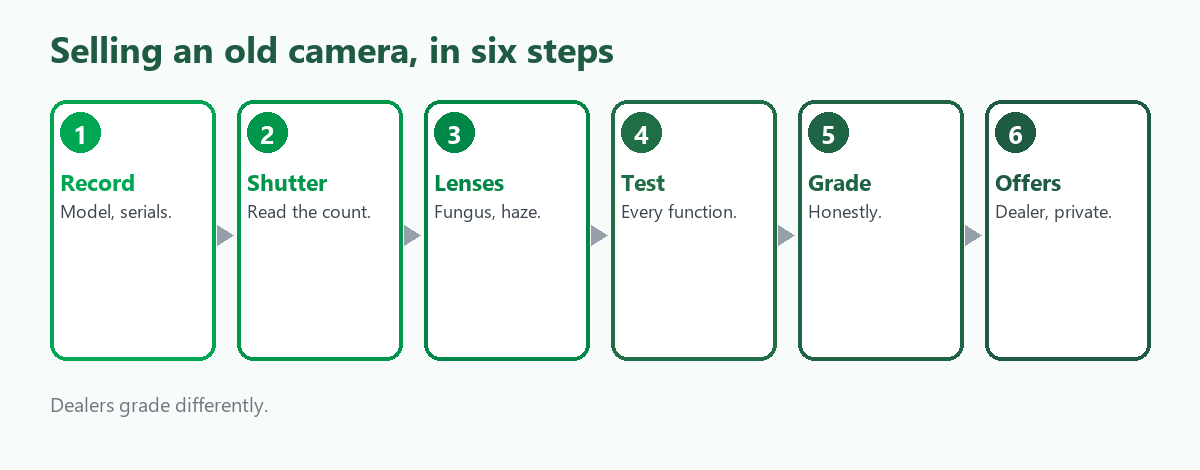
A guide recommends a condition grade with specific details and not just "great condition", and stating explicitly that the glass is fungus-free if it is. Photograph the body, each lens, the serial numbers and every accessory. Record the shutter count and how you read it. Inspect the glass under a bright, angled light. Test autofocus, aperture, the lens-body connection and every button. A buyer who finds an undisclosed fault will re-grade or reject.
Pricing and where to sell
One guide advises pricing against live sold listings and not what you paid, and another suggests matching similar active listings on a large marketplace and checking sold items. We give no figures. The options are:
- Used-gear dealers. They buy and grade, and quote on your description and the gear when it arrives. One dealer says it re-checks gear on receipt, so confirm what happens if its grade differs.
- Peer-to-peer resale. A marketplace listing or a gear-specific site, with fees and shipping on you.
- Local camera shops and classifieds. Quick, and the offer may be low.
- Recyclers. For cameras that do not work and cannot be repaired, as our guide to selling old electronics explains.
A Colombian guide claimed private sales earn 20 to 40 percent more than dealers, but the claim is local and unverified, so we do not rely on it.
Cameras that no longer work
A broken camera may still sell to a repairer for parts, and a body with a dead sensor or board may only be worth recycling. Wipe or remove any memory card, and check for personal photos on internal storage if the model has it. Our broken phone and laptop guide covers data wiping in more detail.
Where ScrapTrade fits
One camera and lens kit belongs with a used-gear dealer or a resale marketplace, and ScrapTrade is not a better route for it. The marketplace suits volume: a camera shop or repairer with a shelf of dead bodies, a studio clearing old equipment or a recycler with boards. E-waste is one of its twelve categories, and verified traders in more than 50 countries bid for lots. Listing is free with no commission, negotiation is live and the buyer's 5 percent deposit is held in escrow after a bid is accepted. Businesses and individuals can sell once verified. We could not confirm whether working camera gear can be listed, so ask cs@scraptrade.com.au first.
What we could not verify
- What any camera or lens sells for. We give no prices.
- How shutter count changes price. Dealers disagree.
- The Colombian 20 to 40 percent claim.
- Whether ScrapTrade accepts working camera gear.
Frequently asked questions
Where is the best place to sell an old camera?
A used-gear dealer, a resale marketplace or a local shop, depending on how fast you want cash. Compare at least two offers.
Does shutter count matter?
Dealers treat it differently, and there is no universal threshold. Disclose it.
Does lens fungus ruin a lens?
It reduces value, and sources agree it should be disclosed. Do not try to clean it yourself.
Can I list cameras on ScrapTrade?
Verified sellers can list e-waste, and we could not confirm working camera gear, so ask support.
Sources
- Ubersuggest keyword data, global, queried November 2026.
- Camera retailer and used-gear dealer guides on shutter count, fungus, haze and condition grading, as summarised in search results.
- ScrapTrade website, accessed November 2026.
General information only. Dealer grading and offers vary.