

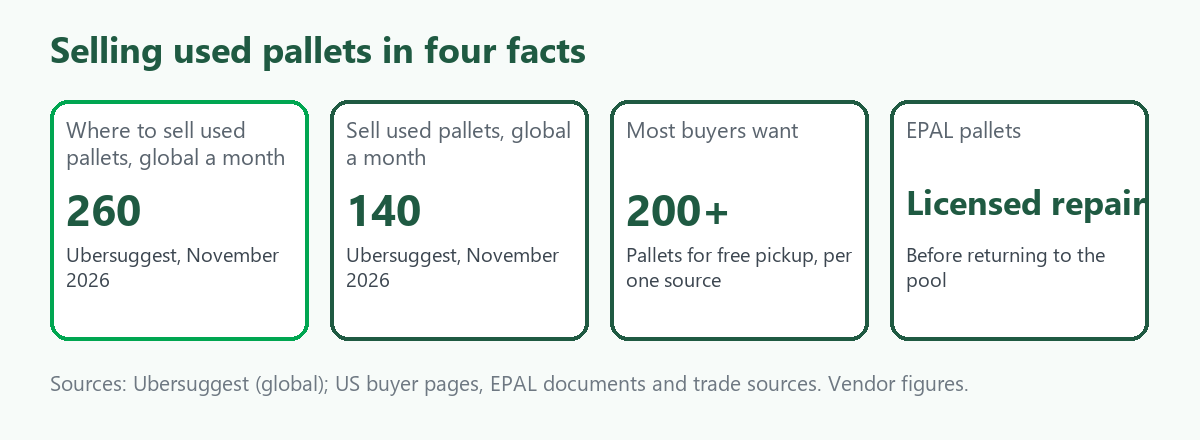
Pallets look like the simplest thing in a warehouse to sell, and then you try. "Where to sell used pallets" is searched about 260 times a month worldwide, according to Ubersuggest, with 140 for "sell used pallets" and another 140 for the near-me version. The reasons people struggle are practical: a lot of pallets are not theirs to sell, buyers want volume and grade, and a stamp on the wood can decide whether a pallet can ship abroad. This guide covers the main pallet types, the grades, the pool and exchange rules we could find, the export stamp and what to ask a buyer. Most sources are buyers, brokers and trade bodies with something to sell, so we flag their figures. ScrapTrade runs a scrap marketplace and has a commercial interest in the scrap trade.
Three kinds of pallet
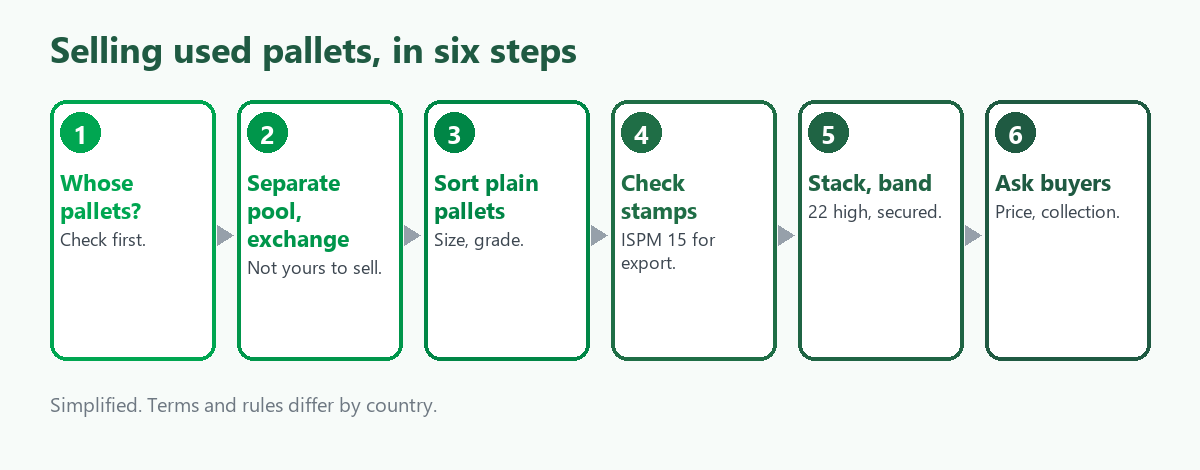
Standard American pallets. The common one in the United States is the GMA pallet, 48 by 40 inches. Euro pallets. Europe's standard is the Euro pallet, and the EPAL pallet is the licensed version. Pool pallets. Companies rent or exchange pooled pallets, and the pallet belongs to the pool and not to whoever holds it. Which type you have decides whether you can sell it at all.
Pool and exchange pallets: check before you sell
We found nothing on the rental terms of the large US and UK pools, and the search did not return them, so read your own agreement. EPAL, which runs the open exchange pool for Euro pallets and says it is the largest in the world, publishes its rules. Terms of Exchange are binding, and the quality classification gives non-binding recommendations. A pallet that fails the classification must not go back into the open pool until it is repaired, and only licensed repair firms may repair EPAL pallets, which then carry a repair nail with the EPAL mark and the repairer's licence number. More than 1,500 licensees produce and repair EPAL pallets worldwide. Only parties that follow the rules take part, EPAL says. For a seller, the lesson is that a branded or exchange pallet has rules attached, and a plain pallet that belongs to nobody else is the safe thing to sell. In Australia one pallet buyer we found refuses the two big pool brands entirely, which our Australian companion covers.
Grades
For 48 by 40 pallets, sources describe three grades. Grade A is the best and needs little or no repair. Grade B is structurally sound but has been repaired, for example plugged stringers or companion boards, and one source says a properly repaired Grade B carries the same loads as a Grade A in practice. Grade C is the lowest. Buyers pay more for graded loads, and 22 high is the standard stack, with banded or wrapped stacks loadable and loose ones not, according to one source.
What buyers pay
Every figure we found comes from a buyer or broker, so treat it as marketing. One blog puts 2026 recycler prices for 48 by 40 pallets in the low single digits of US dollars per pallet by grade, with the lowest grade under 2 dollars, and another buyer's page lists a similar spread. One source claims sales to end users pay 20 to 100 percent more than a sale to a recycler, which we could not check. Hobbyists will pay more for clean pallets, in small quantities. Most buyers want 200 or more pallets for free pickup, and smaller lots usually go to a local buyer. We found no price for Euro pallets outside the pool, and no worldwide price, so we give none.
The ISPM 15 stamp
Wooden pallets used in international shipping usually carry a stamp showing treatment under the ISPM 15 standard. What happens to the stamp when a pallet is repaired is disputed. One trade source says a repaired pallet must be re-treated, the old stamp obliterated and a new one applied. US recycler practice under one body's rule is to obliterate the original, heat-treat the whole pallet again and re-stamp it, while a pallet trade association disagrees and believes recertifying a pallet repaired with heat-treated wood should be allowed without another treatment. A vendor claims re-treatment is needed only if more than a third of components are replaced, and we could not confirm that. Several sources agree on this much: repairing with untreated wood voids compliance, and cutting through or obscuring the stamp requires re-treatment. Some countries add their own steps. We read vendor blogs and not the standard, so check the IPPC text, your export country's plant protection body and the destination's import rules before you ship pallets abroad.
Questions to ask a buyer
- Which sizes and grades do you take, and do you take pool or exchange pallets?
- What do you pay per grade, and what is your minimum?
- Do you collect, and do you need them banded and stacked?
- Do you take stamped pallets, and do you care about the stamp?
- How and when do you pay?
Where ScrapTrade fits
Pallets are timber, and ScrapTrade is a marketplace for scrap and not a pallet exchange, so a lot of plain pallets belongs with a pallet buyer. The metal from the same site, or a clear-out that includes steel, aluminum or motors, is where verified buyers in more than 50 countries might help: nothing is charged to list, no commission is taken, terms are negotiated in chat and the buyer's 5 percent deposit is held in escrow after a bid is accepted. Businesses and individuals can sell once verified. We could not confirm that pallets are accepted, so ask cs@scraptrade.com.au first. The Australian companion is Sell Used Pallets in Australia, and the surrounding clear-out is covered in our guide to selling used machinery and equipment worldwide.
What we could not verify
- Rental and pool terms for the large US and UK pools.
- What any pallet sells for outside the figures from buyers and brokers.
- The ISPM 15 text and the one-third repair rule.
- Whether recertifying repaired pallets is accepted in your country.
- Whether ScrapTrade accepts pallets.
Frequently asked questions
Can I sell pool pallets?
They belong to the pool, so read your agreement first. EPAL and Australian examples show strict rules.
What are GMA pallet grades?
Grade A needs little repair, Grade B has been repaired but is sound and Grade C is the lowest, according to the sources.
How many pallets do I need to sell?
Most buyers want 200 or more for free pickup. Smaller lots usually go local.
Does an ISPM 15 stamp matter?
For pallets going abroad, yes, and repairs can require re-treatment. Check the standard and the destination's rules.
Can I list pallets on ScrapTrade?
It is a scrap marketplace. Ask support about pallets.
Sources
- Ubersuggest keyword data, global, queried November 2026.
- US pallet buyer and broker pages on GMA grades and prices, EPAL exchange and repair documents, and vendor and trade-association coverage of ISPM 15 and pallet repair, as summarized in search results. Most are vendor sources.
- ScrapTrade website, accessed November 2026.
General information only, not legal or financial advice. Rules and terms vary by country and pool.