

Steel scrap is the volume end of the scrap trade. It is by far the heaviest category, the lowest price per kilogram, and the one where a 5% margin only matters if you move a lot of tonnes. On ScrapTrade's price index, heavy melting steel (HMS 1) is indicated at A$0.40 a kilogram, or about A$399 a tonne, while Australia declared its ferrous scrap exports at an average of about A$600 a tonne in 2025-26. This guide covers the grades, the arithmetic of a load, and where the world's steel mills get their scrap.
The same caution applies as throughout this series: the ScrapTrade Price Index is an AI-generated indicative estimate, refreshed daily, and the export values are border declarations rather than yard prices. A yard or collector will be paid less than the export value, because freight, processing and the exporter's margin sit between the two.
Steel scrap at a glance
| Measure | Figure | Source |
|---|---|---|
| HMS 1, indicative | A$0.40 per kg (A$399 a tonne) | ScrapTrade Price Index, 26 October 2026 |
| Shredded steel, indicative | A$0.43 per kg (A$427 a tonne) | ScrapTrade Price Index |
| Cast iron, indicative | A$0.26 per kg (A$256 a tonne) | ScrapTrade Price Index |
| Australian ferrous scrap exports, 2025-26 | 2.55 million tonnes worth A$1.53 billion | DCCEEW export data collation [1] |
| Share of world crude steel made in electric arc furnaces, 2025 | 30.3% | worldsteel, via EUWID [2] |
| World steel scrap use | About 630 million tonnes | EUWID [2] |
| Turkey's imports of recycled steel, 2024 | About 20.1 million tonnes | Bureau of International Recycling [3] |
Grades and indicative prices
| Grade | Description | Indicative price (A$ per kg) | Per tonne |
|---|---|---|---|
| Shredded steel | Machine-shredded auto and appliance steel, clean and compact | 0.43 | 427 |
| HMS 1 | Clean heavy steel a quarter inch and over, with no tin, galvanised or coated material | 0.40 | 399 |
| Structural steel | Beams, girders, columns, angles and channels | 0.37 | 370 |
| HMS 2 | Mixed heavy steel, may include coated or painted material | 0.34 | 342 |
| Light iron and sheet | Thin sheet steel, pressed panels, appliance skins | 0.28 | 285 |
| Cast iron | Engine blocks, pipes and machinery castings | 0.26 | 256 |
The spread is small in dollars and large in percentage. HMS 2 is indicated 14% below HMS 1, about A$57 a tonne. On a 25 tonne load that is about A$1,425 (25 x A$57), which is the entire reason to keep coated and clean steel apart. See how to grade scrap metal for how to tell them apart.
Prices over time
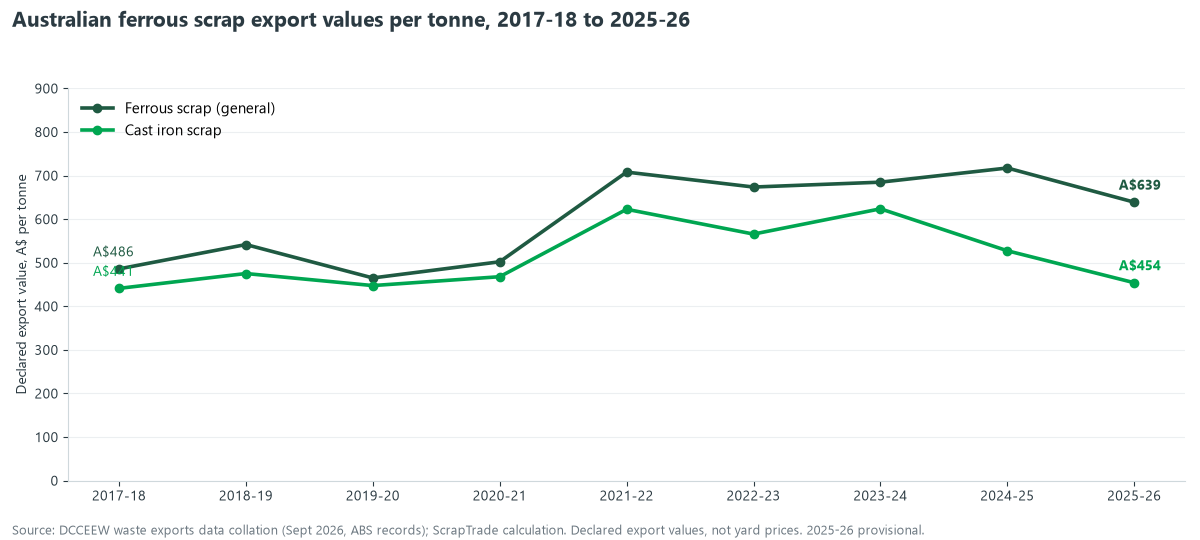
Declared export values for general ferrous scrap rose from about A$486 a tonne in 2017-18 to a peak of A$717 in 2024-25 and A$639 in 2025-26, while cast iron went from A$441 to A$454 [1]. Steel scrap prices move with the steel market, so they swing more with the cycle than with any long trend.
Quantities: why steel is a tonnage game
| Lot | Calculation | Value |
|---|---|---|
| 100 kg of HMS 1 (a small clean-out) | 100 x A$0.40 | A$40 |
| 1 tonne of HMS 1 | 1,000 x A$0.40 | A$399 |
| A 25 tonne load of HMS 1 (assumed size) | 25,000 x A$0.40 | A$9,963 |
| A 25 tonne load of shredded steel | 25,000 x A$0.43 | A$10,673 |
| A 5% margin on the 25 tonne HMS 1 load | 5% x A$9,963 | A$498 |
The last row is the lesson. A trader who earns 5% on a 25 tonne load of HMS 1 makes about A$498 before freight, handling and fees. That is a workable business only if you can repeat it often, which is why steel scrap is dominated by yards and processors with trucks, balers and shredders. For a small trader, steel is usually a by-product of a job, not the main product.
Where the demand comes from
Australia's exports. Australia exported 2.55 million tonnes of ferrous scrap in 2025-26, the most in any year since at least 2017-18. Five countries took 86.5% of the tonnage: Bangladesh (31.6%), Indonesia (19.9%), Vietnam (15.9%), India (11.4%) and Thailand (7.8%) [1].
The world's mills. Steel is increasingly made from scrap. Electric arc furnaces made 30.3% of the world's crude steel in 2025, up from 29.1% in 2024, and world steel scrap use was about 630 million tonnes, according to worldsteel figures reported by EUWID and GMK Center [2][4].
The trade between regions. The Bureau of International Recycling reported that the European Union remained the world's top exporter of recycled steel in 2024 even though its exports fell 11.4%, from over 19 million tonnes to just over 17 million tonnes, with Turkey taking more than 10.9 million tonnes of it. US exports fell from 16.26 million tonnes to about 14.4 million tonnes, with Turkey buying nearly 4.43 million tonnes and Mexico 2.14 million tonnes [5]. Turkey imported about 20.1 million tonnes of recycled steel in 2024 [3].
Europe is also changing the rules: its draft export list would stop metal scrap going to a group of non-OECD buyers, several of which also buy Australian scrap. See Europe Is Keeping Its Scrap. Who Pays? for the analysis.
Listing steel scrap on ScrapTrade
- Say which grade it is. HMS 1, HMS 2, structural, light iron, cast iron or shredded.
- Be honest about coatings, galvanising, tin and attachments, because they move a load between grades.
- Give an estimated or weighed tonnage, and the loading arrangements.
- Show the pile. Clear photos, and a GPS-verified listing for large lots.
- State the pickup location and access for trucks.
Check the live material prices, then list it on the marketplace. If you want several buyers to bid, read why reverse auctions beat a single quote.
Mistakes that cost money
- Mixing coated and clean steel. A load is graded by its worst material.
- Hiding contaminants. Tin, galvanising, tyres, fluids and non-metal attachments cause rejections and deductions.
- Underestimating freight. With a price of about 40 cents a kilogram, a haul can consume the margin.
- Reading export averages as a price list. A$600 a tonne is a national average of exports, not a bid.
Frequently asked questions
What is HMS steel scrap?
Heavy melting steel: thick steel pieces suitable for melting. HMS 1 is clean, quarter-inch and over, with no tin, galvanised or coated material. HMS 2 is a mixed grade that can include coated or painted material.
How much is a tonne of steel scrap worth?
On ScrapTrade's index on 26 October 2026, about A$399 for HMS 1 and A$427 for shredded steel, both indicative. Australia's average declared export value was about A$600 a tonne in 2025-26 [1].
Why is steel scrap so cheap per kilogram?
Because steel is a bulk commodity made and recycled in enormous quantities. Its value is in tonnage, not weight per piece.
Who buys steel scrap?
Yards and processors, then steel mills and exporters. Australia's exports go mainly to Bangladesh, Indonesia, Vietnam, India and Thailand [1].
Is steel scrap demand rising?
The electric arc furnace share of world steel production rose to 30.3% in 2025 from 29.1% in 2024 [2][4]. That is a rising pull on scrap, though trade flows and rules change from year to year.
Sources
- DCCEEW, Waste exports data collation, September 2026 (ABS records), ScrapTrade calculations. See Australia's Scrap Metal Exports: 2025-26 Data.
- EUWID Recycling and Waste Management, Scrap use in global steel production rises in 2025 (June 2026).
- Bureau of International Recycling, World Steel Recycling in Figures, 2024 update (Turkey's imports); see also Europe Is Keeping Its Scrap. Who Pays?.
- GMK Center, The share of EAF in global steel production in 2024 increased to 29.1%.
- Recycling Today, BIR steel recycling trading 2024, reporting BIR statistics.
- ScrapTrade Price Index, scrap.trade/market-prices, retrieved 26 October 2026. AI-generated indicative estimates, not a quote.
Prices and figures are indicative, as at 26 October 2026, and change daily. ScrapTrade operates the marketplace described here and has a commercial interest in the scrap trade. This article is general information, not financial or trading advice.