

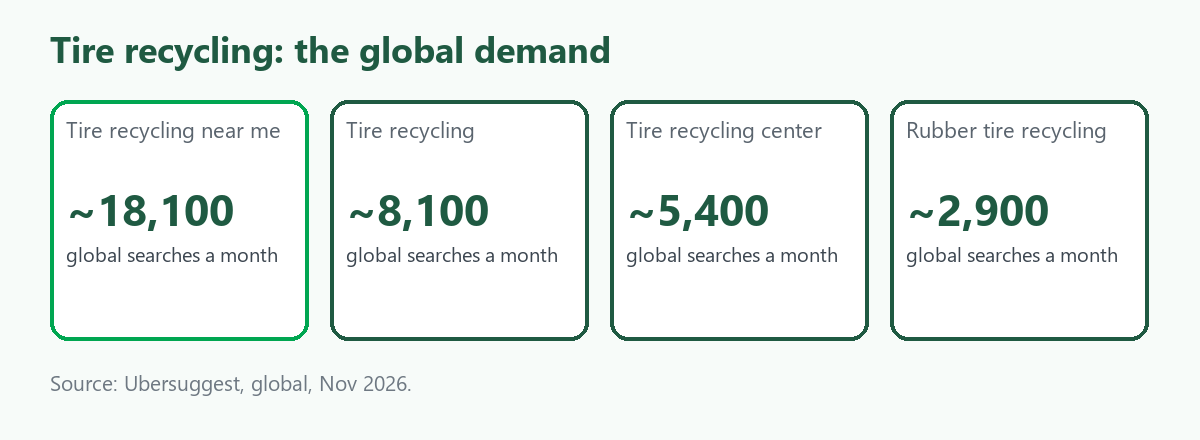
"Tire recycling" is searched about 8,100 times a month worldwide, according to Ubersuggest, and "tire recycling near me" about 18,100, with "tire recycling center" about 5,400, "rubber tire recycling" about 2,900 and "tire recycling services" and "company" about 1,900 each. Most of these searchers want a drop-off point for tires they hold, and a smaller group wants to know what happens to them. This guide covers the second question: how tires are processed, what they become and what the United States figures say about where they go. The local question is answered in our guides to who buys scrap tires and tire disposal fees. It belongs to our guide to selling scrap cars, car parts and used tires online. The statistics are American because the global ones we found were thin, and we mark where. We give no prices. We run ScrapTrade, a scrap marketplace, so we have a stake in this trade.
From a tire to crumb
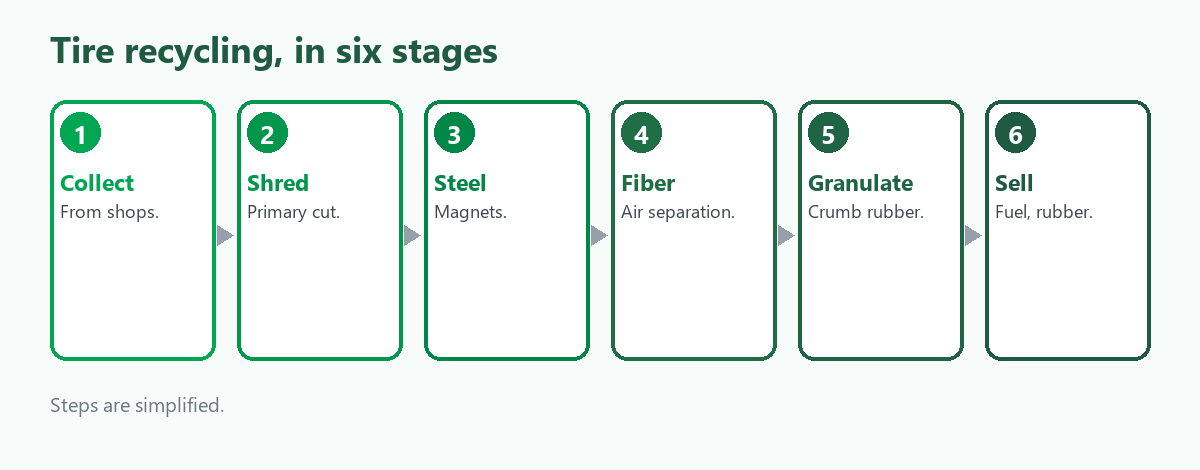
Trade sources describe a sequence that depends on the product wanted:
- Primary shredding. Tires are cut down by a shredder strong enough to cope with the steel wire and fabric in them, as one trade source puts it, without excessive blade wear.
- Granulation. The shreds are reduced further. One patent describes an initial granulate of 1 to 3 centimeters.
- Steel removal. The output is a mix of rubber chips, loose steel wire and fragments with steel still embedded. Magnets remove the metal throughout the stages.
- Fiber removal. Fabric is separated by air separators in the final stage, and wet processes can clean the crumb further.
- Sizing. Screens classify the material after each step and return oversize pieces for more grinding.
Three ways to make crumb
- Ambient grinding. A multi-step process, usually with three machines, that separates rubber, metal and fabric at normal temperature.
- Wet grinding. Used to make particles of 40 mesh and finer.
- Cryogenic grinding. The rubber is chilled with liquid nitrogen, because most rubber becomes brittle below about minus 80 degrees Celsius, and is then broken up. A source says this avoids heat damage to the rubber and yields a product largely free of fiber and steel.
We did not find a source on pyrolysis, in which tires are heated without air to make oil, gas and char, so we leave its steps aside.
Where the tires go: the United States figures
The US Tire Manufacturers Association (USTMA), as summarized in trade coverage and not read in full, reported that end markets consumed 71 percent of scrap tires generated in 2021, against 76 percent in 2019. An earlier USTMA statement put the figure at 81.4 percent by 2017, and we could not reconcile the two, which may reflect different methods. The main uses were:
- Tire-derived fuel. The largest market from 2013 to 2019, which then fell 15 percent between 2019 and 2021, with a USTMA official tying the earlier decline to competition from natural gas prices.
- Ground rubber. Estimated at about 25 percent of the market, going into new rubber products, landscaping mulch, mats and rubber-modified asphalt.
- Civil engineering. About 6 percent of all scrap tires in 2021, mainly as tire-derived aggregate for roads, landfills, septic leach fields and landfill cover.
USTMA saw room for growth in rubber-modified asphalt and tire-derived aggregate, supported by provisions of the Bipartisan Infrastructure Law, which is a trade-body expectation. We did not find comparable current figures for other countries.
What this means if you hold tires
Recycling is an industrial service with markets that change, and it is not a place where tires are bought for what they are worth. Fuel demand moves with energy prices, and crumb demand moves with what it replaces. That is one reason an ordinary scrap tire usually comes with a handling fee, as the buyers guide explains. For one or two tires, a retailer or municipal program is the sensible route. For a yard of them, ask a hauler or a processor what they take and what it costs, in writing.
Where ScrapTrade fits
ScrapTrade does not recycle tires and does not take them as a drop-off. It is a scrap marketplace for selling to verified traders in more than 50 countries, and its case for tires is limited to sound used stock and casings in lots, which we cover in our guide to selling used tires in bulk. Listing is free with no commission, negotiation is live, and an accepted bid places the buyer's 5 percent deposit in escrow. Both businesses and individuals can sell after verification. Whether tires can be listed at all is unconfirmed, so ask cs@scraptrade.com.au first.
What we could not verify
- Current recycling figures outside the United States. We found none.
- USTMA's figures in the primary report. We relied on trade-press summaries, and the 71 and 81.4 percent figures conflict.
- The steps of pyrolysis.
- Whether ScrapTrade accepts tires.
Frequently asked questions
How are tires recycled?
They are shredded, the steel and fabric are removed and the rubber is granulated into crumb, which goes into fuel, aggregate and rubber products.
What is tire-derived fuel?
Shredded tires burned as fuel. It was the largest US market from 2013 to 2019, according to USTMA, then fell 15 percent to 2021.
Where can I recycle tires near me?
Start with the retailer you buy new tires from, your municipal waste office and licensed haulers. We did not review individual sites.
Can ScrapTrade take my tires?
It is not a drop-off or disposal service. Whether tire lots can be listed is unconfirmed, so ask support.
Sources
- Ubersuggest keyword data, global, queried November 2026.
- US Tire Manufacturers Association scrap tire market reports and Recycling Today coverage of the 2021 report, as summarised in search results.
- Trade and patent descriptions of shredding, granulation and cryogenic grinding, as summarised in search results.
- ScrapTrade website, accessed November 2026.
General information only. Process steps are simplified and US figures may not apply elsewhere.