

Reading how a platform works is one thing. Seeing a deal move through it is another. This article follows four made-up deals from listing to payment, so you can see what happens at each step, what the money does and where things can go wrong. The people and numbers are invented to illustrate the process, not real customers. The steps follow ScrapTrade's own how it works and trust and safety pages as published in October 2026, and we say where those pages do not answer a question. This is general information, not financial advice, and it is part of a series that starts with How to Plan a Scrap Business: 90-Day Roadmap.
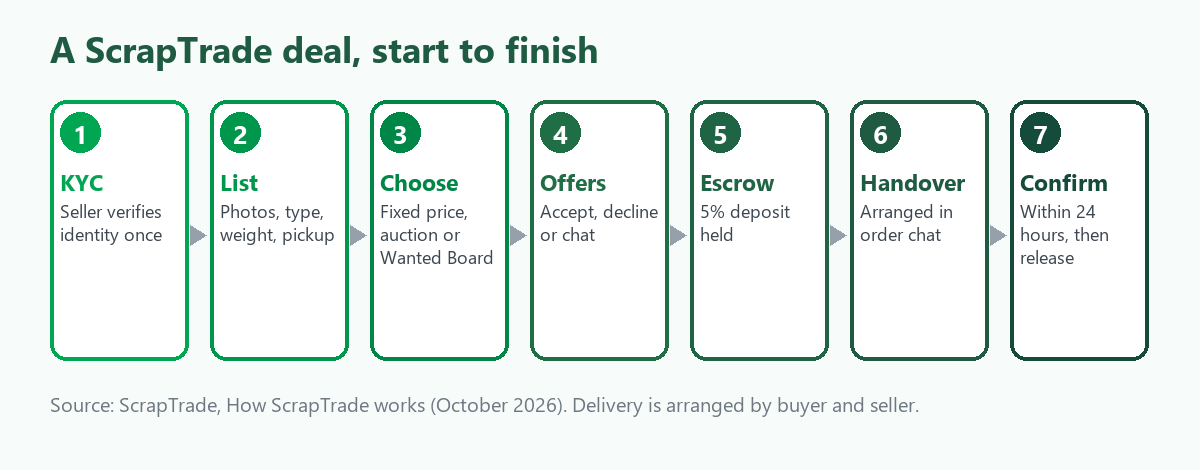
The process in one minute
The page describes the same shape for every deal [1].
- Verify your identity once. Sellers complete a KYC check before listing freely.
- Create the listing with photos, material type, estimated weight and pickup location. For higher-value lots there is an optional GPS-verified listing.
- Choose how it sells: a fixed price, a live auction or a response to a buyer's request on the Wanted Board.
- Field offers or bids, and accept, decline or negotiate in the listing's chat.
- Accept a deal. An order is created and a 5% deposit of the agreed value is collected from the buyer through Stripe and held in escrow. The seller is not paid yet.
- Arrange the handover through the order chat, which keeps a written record.
- Confirm within 24 hours. The buyer has 24 hours from receiving the material to confirm it matched the listing. Once confirmed, or once the window passes without a dispute, the held deposit releases to the seller. If a dispute is raised, the funds stay held while it is reviewed.
Two things to keep in mind. ScrapTrade does not arrange delivery, so buyer and seller do that themselves. And the trust page says escrow does not protect the physical condition of the material once it changes hands [2].
Example 1: A fixed-price sale
The seller. Marcus fits windows and has 3 tonnes of clean aluminium extrusion offcuts, separated from steel and rubber, stacked in his yard.
The listing. He completes KYC, photographs the stack from three angles and lists it as clean extrusion, 3 tonnes estimated, pickup in his yard, at a fixed price of A$7,500. He checks the live material prices first, remembering they are indicative, and says in the listing what is not included, such as glass and painted frames. Because the lot is not very high in value, he skips GPS video, but he knows buyers can see whether a listing has one.
The sale. A buyer who runs a small remelting business accepts the price the same afternoon. The order is created.
| Stage | What happens | The money |
|---|---|---|
| Order created | The buyer's deposit is collected through Stripe | 5% of A$7,500 = A$375 held in escrow |
| Pickup | They agree Friday morning in the order chat | Nothing moves |
| Handover | The buyer weighs on a public weighbridge and sends a photo of the ticket in the chat | Nothing moves |
| Confirmation | The buyer confirms within 24 hours | The held deposit releases to Marcus |
What the pages do not say. The page describes the deposit being collected and released, but not how the remaining 95% of the price is settled between buyer and seller, how long it takes after release, or any fees beyond the deposit. In a real deal you should ask ScrapTrade's support team how the balance is paid and when before you hand over material. Marcus does.
Why it went smoothly: a clear listing, honest description, written pickup details and a neutral weight record.
Example 2: A live auction
The seller. Priya's demolition crew has stripped a building and has about 6 tonnes of copper pipe and fittings, sorted by type, at a depot.
The listing. She sets up a live auction rather than a fixed price, because she is not sure what the lot is worth and expects competition. The page says the seller sets the auction's duration, commonly a few days [1]. She adds photos of the pipe in each bin, notes that brass fittings are in a separate pile and enables GPS verification, since the lot has real value.
The bidding. Three buyers bid over four days. One messages through the chat to ask about the pipe's condition and whether the brass is included. Priya answers in writing, which stays with the listing.
The close. The auction closes with a winning bid. An order is created. The 5% deposit is collected and held.
| Stage | What happens |
|---|---|
| Auction closes | A winning bid creates the order |
| Deposit | 5% of the winning price is held in escrow |
| Pickup | The winning buyer sends a driver, who loads while Priya's crew photographs the load |
| Weight | They agree a public weighbridge, with both tickets kept |
| Confirmation | The buyer confirms the pipe matched the listing within 24 hours |
What helped Priya: a competitive format for a lot whose price she did not know, plus photos and written answers that left little room for argument. What the pages do not say: reserve prices, minimum bid steps and any auction-specific fees. Check them before listing.
Example 3: A Wanted Board request
This time the deal starts with a buyer.
The buyer. Tariq runs a small foundry that needs 10 tonnes of clean cast aluminium. Nobody nearby has listed any. On the Wanted Board he states the material, quantity and grade he needs. The page says sellers with matching stock respond directly to him, and that buyer-finding support can help match him with sellers if nothing suitable is listed [1].
The response. A seller with 8 tonnes of cast aluminium wheels and housings, sorted and clean, replies, saying what is in the pile and sending photos. Tariq asks about steel inserts, and the seller answers that the housings have no inserts and the wheels' valve stems are removed. They agree on a price and the seller accepts.
The same escrow process starts: an order, a 5% deposit, pickup in the order chat, the 24-hour confirmation window and release.
What helped Tariq: he told sellers exactly what he needed, so he spent less time on unsuitable lots. The catch: 8 tonnes is less than the 10 he wanted, so he agrees to a smaller first order and asks the seller to find more. Always say what quantity you will accept.
Example 4: When the buyer disagrees
Not every deal ends neatly. Here is one that does not.
The seller. Dan lists 4 tonnes of "mixed steel offcuts" at a fixed price. The listing has photos of the top of the pile.
The problem. The buyer collects, and when the load reaches his yard he finds about a quarter of it is wet, oily turnings and some aluminium offcuts mixed in. Within 24 hours he raises a dispute.
What happens. The pages say that when a dispute is raised in the window, the funds remain held while it is reviewed, both parties can add context and the order's evidence, including chat history and any GPS evidence, determines the outcome [2]. The pages do not say how long a review takes, what outcomes are possible or what evidence is weighed most heavily.
| Whose evidence is stronger? | |
|---|---|
| Dan's | Photos of the top of the pile, a chat message saying "mixed steel offcuts" |
| The buyer's | Photos of the unloaded material, a weighbridge ticket, a record of what he found |
What each could have done differently. Dan should have photographed the pile from several places, described what was in it honestly and said how much was oily. The buyer should have inspected before loading. Both should have agreed a written grade. This is exactly what How to Verify Scrap Before You Buy or Sell and How to Secure Scrap Deals and Avoid Scams are about.
Where recurring business fits
The page says businesses can post recurring scrap volume rather than only one-off lots, and build a visible transaction history [1]. A workshop that sells the same offcuts every week could list them on a schedule, and buyers who like the material come back. The page does not describe how recurring listings are set up or priced, so ask support.
What the examples show
- The listing is your first negotiation. The clearer it is, the fewer surprises later.
- The order chat is your record. Keep the agreement and pickup details there.
- The deposit is a protection, not a price. The pages say the 5% deposit is held until confirmation, and do not describe how the balance is paid.
- You still need to verify and agree a grade. The platform helps with identity and a payment step, not with the metal.
- Delivery is yours to arrange.
What we could not confirm
- How the balance beyond the 5% deposit is settled, and how long after release.
- Any fees besides the deposit.
- How long a dispute review takes and how it is decided.
- Reserve prices and bid rules for auctions.
- How recurring listings are set up.
Where a page is silent, we have said so. Ask ScrapTrade's support team or read the pages again before relying on any of these.
Try it yourself
If you have material to sell, register (the how-it-works page invites you to create a free account), check the live material prices, and list it on the marketplace. If you are looking for material, browse listings or post a request on the Wanted Board. To choose between a fixed price, an auction and a request, read fixed price, auction or Wanted Board. And if you would rather not run the sale yourself, see Hire a scrap agent.
Frequently asked questions
How much is the deposit on ScrapTrade?
The how-it-works page says a 5% deposit of the agreed value is collected from the buyer through Stripe and held in escrow [1].
When does the seller get paid?
After the buyer confirms the material matched the listing within 24 hours, or after the window passes without a dispute [1]. The pages do not detail how the remaining balance is settled.
Does ScrapTrade arrange delivery?
No. The buyer and seller coordinate pickup through the order chat [1].
What if the material does not match the listing?
The buyer can raise a dispute within the 24-hour window. Funds stay held while it is reviewed [2].
Is escrow a guarantee of quality?
No. The trust page says escrow does not protect the physical condition of the material once it changes hands [2].
Sources
- ScrapTrade, How ScrapTrade works, as published in October 2026.
- ScrapTrade, Trust and safety, as published in October 2026.
This article describes ScrapTrade's published pages as at October 2026, which may change. The people, prices and deals are invented for illustration. It is general information, not legal or financial advice. ScrapTrade operates the marketplace described here and has a commercial interest in the scrap trade.