

Scrap deals are won on margin and lost on trust. When something goes wrong in this trade it is rarely dramatic. A cargo that was never loaded. A payment sent to the wrong bank account. A buyer who accepts a load, then decides it was lower grade than agreed and pays half. This guide is about the ordinary ways deals fail, and the habits that make them less likely. It follows How to Verify Scrap Before You Buy or Sell and How to Negotiate a Scrap Deal. The people in the scenarios are invented. It is general information, not legal advice.
Where deals actually go wrong
Industry bodies keep describing the same few patterns.
- Cargo that does not exist. The Bureau of International Recycling (BIR), the global recyclers' body, has warned scrap recyclers about offers of reduced-price scrap, sometimes with fake documents to "confirm" the quality, where the metal does not exist [1].
- Borrowed identities. Sims Metal, a large recycler, has warned that people unconnected with it use its name and its employees' names to offer scrap [2]. A real company's name on an email proves nothing.
- Advance payments. Fraudsters often ask for money before anything ships, sometimes after inviting the buyer to look at a yard. Industry commentators describe cases where a buyer advanced a deposit, and nothing was ever sent [3].
- Unchecked bank details. Recycling Today, reporting on ISRI's warnings, notes that victims often did not check whether the bank details they were given were correct [4]. Changing the account in the last email before payment is a well-known trick.
Not every bad outcome is fraud. Some are honest disagreements about grade, weight or timing. The same habits protect against both.
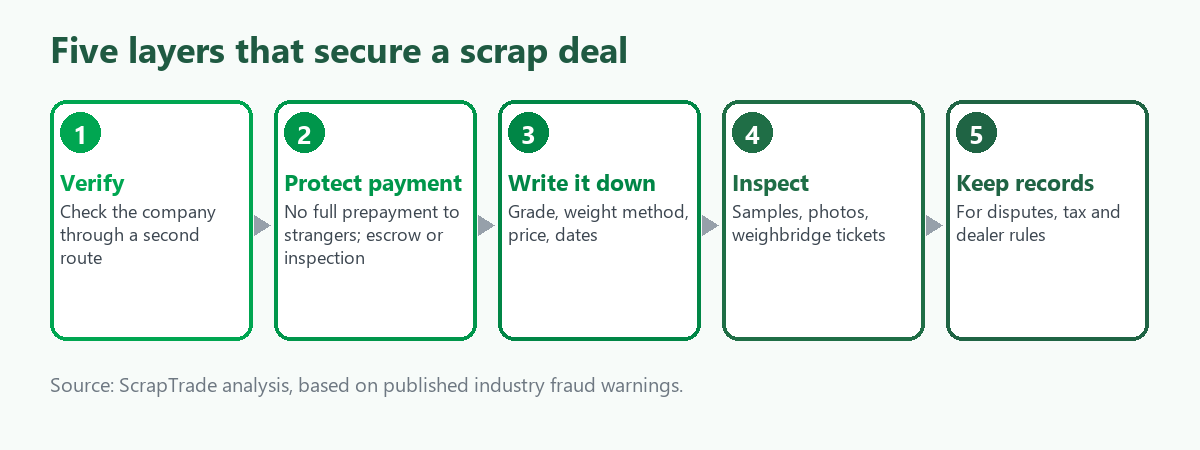
Five layers of protection
Think of it as layers. No layer is perfect, but together they cover most of the risk.
Layer 1: Know who you are dealing with
- Check the company exists, with a business registry, a website with consistent details and a phone number that is answered.
- Confirm through a second route. If you are contacted by someone claiming to represent a company you know, ring the number you already have, not the one in the message.
- Ask for references or recent deals, and speak to them.
- Be careful with brand-new contacts and big prices. Offers far below market are a classic bait [1].
On ScrapTrade, sellers go through an identity check (KYC) before listing freely, and the trust page extends this to every trader [5][6]. A check like that confirms a real person or business exists. Whether they are reliable is a separate question, so keep checking.
Layer 2: Protect the payment
How money moves is the most important protection you have.
| Situation | Safer approach |
|---|---|
| You are paying a stranger | Never pay in full in advance. Pay on delivery or after inspection, or use a protected route such as escrow |
| You are receiving payment | Confirm funds before the material leaves your control, or use escrow |
| A bank account is given | Check it by phone with a number you already know, and never accept a late change without checking |
| The deal is large or international | Ask about protected terms. Documentary payment methods and independent inspection are widely used for cross-border cargo, and your bank can explain the options |
ScrapTrade collects a 5% buyer deposit through Stripe once an offer is accepted or an auction closes, and holds it in escrow. It releases to the seller when the buyer confirms the load matches the listing, or when 24 hours go by with no dispute [5]. That covers the first stage of the deal. It is not a guarantee of quality, because the trust page is explicit that the escrow says nothing about the condition of the material after handover [6]. The pages also leave out other fees, release timing and how disputes are decided.
Scenario: the changed account. Ravi agrees to buy 4 tonnes of copper from a supplier he has used twice. On payment day an email arrives, apparently from the supplier: "Our bank has changed, please use this account." Ravi rings the supplier on the number he has had for a year. The supplier knows nothing about it. The email came from someone who had broken into the supplier's account. A thirty-second call saved him thousands. (Invented example.)
Layer 3: Write it down
A good record is the best evidence in any dispute. Keep these for every deal.
- The agreement: material, grade, quantity, price basis, weight method, deductions, payment terms and dates.
- Photos of the material and the load, with date and location.
- Weighbridge tickets or scale readings.
- Messages and emails showing agreement.
- Proof of payment.
ScrapTrade's dispute process attaches the order's chat history and any GPS evidence to a dispute, and the order's evidence determines the outcome [6]. That is a reason to keep your negotiating inside the order chat.
Layer 4: Inspect before you release
Where you can, look at the material before you pay and before you release it.
- Buying: check a sample from different parts of the load and weigh it. Do not accept a quick glance at the top of the pile.
- Selling: photograph the load as it is loaded and note the weight. If the buyer's yard says the grade differs, you have evidence of what left your site.
- Distance deals: consider an independent inspection company at loading. It is a common practice in international trade, and the cost can be small compared with the value of the cargo.
Layer 5: Keep records and know the rules
Many places require dealers to verify seller identity, keep transaction records and avoid cash. In New South Wales and Victoria, for example, paying cash for scrap is banned. See Scrap Business Rules and Documents by Country. Breaking a rule can cost you far more than any single deal. It is also security: records show where material came from, which protects you if something turns out to be stolen.
Scenario: the cargo that was never there
An overseas "trader" emails Chloe offering 50 tonnes of clean aluminium at 30% below market, with a glossy inspection certificate and photos. He asks for 20% upfront "to secure the cargo" and will send a site visit invitation afterwards. Chloe checks his company name. The registry shows a company with a similar name, but the directors are different, and the phone number rings out. She tells him she will only deal through a protected payment, with inspection at loading. He disappears. (Invented example, built from the patterns described in industry warnings.)
Warning signs
- A price too good to be true.
- Pressure to decide or pay today.
- A request for money before anything can be inspected.
- Bank details that change, or that belong to a person or a country unconnected with the company.
- Documents that look polished but cannot be checked.
- A story about customs or regulatory problems that suddenly needs more money.
- Reluctance to speak by phone or video, or to let an independent inspector visit.
One sign is a reason to slow down. Two is a reason to stop.
If something goes wrong
- Stop sending money, and do not send more to "fix" the problem.
- Gather evidence: messages, documents, payment records, bank details.
- Contact your bank at once. Fast action can sometimes help.
- Report it to the police and, where relevant, to your national scam-reporting body and your industry association, such as BIR [1].
- Warn the people you trade with, and the platform if the person found you there.
- If you are dealing on ScrapTrade, use the order's dispute process within the 24-hour window [6].
A checklist before the truck moves
| Check | Done? |
|---|---|
| Company and person confirmed through a second route | |
| Bank details confirmed by phone | |
| Payment protected: delivery, inspection or escrow | |
| Grade, weight method and payment terms in writing | |
| Photos and weights recorded | |
| Dealer rules and records understood | |
| Walk-away plan if something looks wrong |
For a worked example of how a protected deal runs, see A Scrap Deal on ScrapTrade: Worked Examples. When you are ready, see the marketplace, the trust and safety page, or register.
Frequently asked questions
Is it safe to pay in advance for scrap?
Not to a stranger. Pay on delivery, after inspection or through a protected route such as escrow. Prepayment is a standard warning sign in industry fraud alerts [1][3].
How do I check a buyer or seller is real?
Check the registry and a working phone number, confirm through a contact you already trust and ask for recent references.
Does escrow protect me from a bad load?
Only partly. On ScrapTrade it protects the payment step, but the trust page says escrow does not protect the physical condition of the material once it changes hands [6].
What if the bank details change at the last minute?
Treat it as a red flag. Ring a number you already know and confirm before paying.
Who do I report a scam to?
Your bank first, then the police and your national scam body, and the industry association such as BIR.
Sources
- Recycling Today, BIR issues recyclers warning on fraud, as summarised in search results. We could not open the full article.
- Sims Limited, warning about misuse of its name, as summarised in search results.
- Recycling Today, Scrap metal recycling trading fraud prevention techniques, as summarised in search results.
- Recycling Today, Aluminum recycling wheels fraud: ISRI alert, as summarised in search results.
- ScrapTrade, How ScrapTrade works, as published in October 2026.
- ScrapTrade, Trust and safety, as published in October 2026.
This article is general information, not legal or financial advice. The people and scenarios are invented and built from patterns in published industry warnings. ScrapTrade operates a scrap marketplace and has a commercial interest in the scrap trade.