

Most scrap businesses do not fail because the owner picked the wrong metal. They fail because the owner bought something they could not sell at a margin: material that was worse than described, a lot that was too heavy to move or tie up cash, or a buyer who changed the terms after the truck had loaded. A plan is the thing that stops that happening. It does not need to be thirty pages. It needs to answer six questions before you spend money, and then give you a 90-day schedule for finding out whether the answers were right.
This guide sets out those six decisions, how a deal runs on a marketplace such as ScrapTrade, and what separates people who keep growing from people who stall. It builds on our guides to starting a scrap business with little capital, what you need to start and how much money you need, so we do not repeat them here. The rules differ by country, so check them first with Scrap Business Rules and Documents by Country. This is general information, not legal or financial advice.
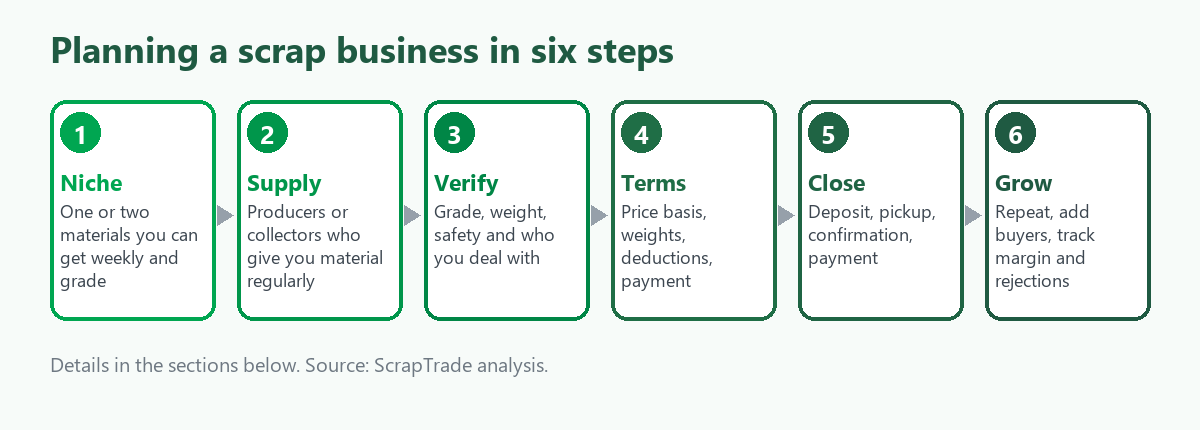
The six decisions
| Decision | The question to answer | If you skip it |
|---|---|---|
| Niche | Which one or two materials will I handle first? | You compete on everything and know nothing well |
| Supply | Who will give me material, how often, and how do I know? | You have a buyer and nothing to sell |
| Verification | How will I check what I am buying and selling? | You absorb every grading mistake |
| Terms | What price basis, weights, deductions and payment terms do I accept? | The buyer sets them after loading |
| Route to market | Who buys it, and through which channel? | You hold stock waiting for an offer |
| Capital and risk | How much can I tie up, and what do I lose if the price falls 10%? | One bad lot ends the business |
The sections below take them in order.
1. Choose a niche that fits your supply and your cash
A niche is not a favourite metal. It is the material you can reliably get, grade correctly and sell. Four tests help.
Can you get it every week? A material you can only find twice a year is a hobby. Look at what the people around you generate: workshops produce offcuts and swarf, builders produce copper pipe and cable, window fitters produce aluminium extrusions, electricians produce cable. The best first niche is usually the scrap your existing contacts already throw away.
What is a lot worth? On ScrapTrade's indicative price index on 26 October 2026, heavy melting steel was around A$0.40 a kilogram, clean aluminium extrusion A$2.63 and Copper 2 A$9.68. A 20 tonne lot of extrusion is therefore about A$52,654, and a 20 tonne lot of Copper 2 about A$193,538. The index is an AI-generated indicative estimate that changes daily, not a quote, but the scale is the point: a heavy, cheap material needs a lot of tonnes and a lot of freight to make money, while a dense, valuable one needs capital and trust. Our guides to aluminium and copper scrap show the grades in each.
How hard is it to grade? Mixed alloys, coated metals and electronics are harder than clean offcuts of a single material. Start where you can tell the grades apart. Our guide to how to grade scrap metal covers the practical tests.
What does it cost to be wrong? Copper gives more value per kilogram and so more value at risk per grading error. Steel punishes you through freight and weight. Choose the failure you can afford while you learn.
Pick one or two materials for the first 90 days. You can widen later, and the buyers you build up in one niche often take the next.
2. Line up supply before you look for buyers
A buyer without supply is a phone number. Supply comes first, and the useful question is who produces the material regularly, not who might sell it once.
- Producers who throw it away: trades, factories, demolition and refurbishment contractors, workshops, property managers.
- Collectors and small yards who sell once they have a load.
- Other traders who have supply but no buyer for it.
Visit in person, tell them what you can take and how you pay, and ask about volumes and timing, not just prices. Agree how loading works and who weighs. Our guides to starting with supply, starting small and building connections and how to start a recycling company and find scrap go deeper on finding the first sources.
If you do not want to hold the material at all, the alternative is to work with the supply someone else already has. See Become a Scrap Broker or Agent: How to Start, and note that ScrapTrade's pages do not say registration is free, so check current fees.
3. Verify the material, the weight and the people
Verification is where small traders earn or lose their margin. Three things need checking.
The material. Do not take a description on trust, including your own. Check the grade against a written definition, look for contamination and mixed metals, and weigh it on a scale you can document. The Scrap Specifications Circular published by ReMA, the US recycling industry association, is widely used as a common vocabulary for grades. It is a starting point for discussion between buyer and seller rather than a complete contract, and some grades leave final terms to be agreed, so write down what you mean in the deal itself [1].
Safety. Scrap can hold hazards that do not show on a photo: sealed containers, gas cylinders, fuel tanks, batteries and, rarely, radioactive sources. New Zealand's health regulator notes that sources that fall out of regulatory control, called orphan sources, have ended up in scrap and in steel made from it, and advises scrap yards to install gate portal monitors [2]. A small trader may not own a monitor, but you can refuse sealed or unidentified items, ask where industrial equipment came from and ask your buyer what screening they use.
The people. Know who you are dealing with. ScrapTrade's pages describe identity verification (KYC) for sellers before they list freely, and its trust page says every trader completes it [3][4]. For larger lots ScrapTrade offers optional GPS video verification, which its page says ties the material to the location it was recorded in [3]. These help establish who and where. They do not settle grade. The trust page states that escrow does not protect the physical condition of the material once it changes hands [4], so inspect before you pay and write down what the buyer will accept.
4. Agree terms you can live with
A price is only one line of a deal. Before you agree, settle these in writing.
- Price basis. A fixed price per tonne, a price linked to an index with an agreed discount, or an auction. Say which index and which date.
- Quantity and weighing. Whose scale, whether weight is taken at loading or at delivery, and the tolerance either way.
- Grade and rejection. The written grade, how contamination is deducted and what happens if the buyer disputes the grade on arrival.
- Who loads and ships, at whose cost and risk, and by what date.
- Payment. When, how much upfront, and what triggers the balance.
- What happens if it goes wrong. Cancellation, re-grading and who pays for return freight.
Negotiate on the whole package, not just the headline price. A slightly lower price with weight taken at your scale and a short payment term can be worth more than a higher price with weight at the buyer's scale and 60 days to pay. Know your walk-away number before you start, and never agree on the phone what you have not written down. When you have an alternative buyer you negotiate better, which is one reason to list your material where several buyers can see it.
5. How a deal runs on ScrapTrade, with an example
The steps below follow ScrapTrade's own description of how the platform works [3]. The numbers are an invented illustration, not a real transaction.
- The seller lists the material with photos, material type, estimated weight and pickup location, and chooses a fixed price, a live auction or a response to a buyer's request on the Wanted Board. Sellers complete KYC first.
- The buyer makes an offer or bids, and the two can negotiate in the listing's built-in chat.
- An order is created when an offer is accepted or an auction closes.
- The buyer pays a 5% deposit of the agreed value through Stripe, held in escrow. The seller is not paid yet.
- The two arrange pickup through the order chat. ScrapTrade does not arrange delivery.
- The buyer confirms the material matches the listing, or raises a dispute, within 24 hours. If the buyer neither confirms nor disputes, the page says support reviews the order.
- The seller is paid after the buyer confirms receipt or after the 24 hour window passes without a dispute.
An illustration. A window fitter lists 5 tonnes of clean extrusion at an agreed A$13,000. A buyer accepts, and the order is created. The buyer pays a 5% deposit, A$650, which sits in escrow. The fitter and buyer agree a Friday pickup in the order chat. The buyer loads, weighs on their scale and confirms the material matches the listing, and the fitter is paid. If the load had contained steel fittings the listing did not mention, the buyer could dispute within 24 hours, the funds would stay held and the order's chat and any GPS evidence would be reviewed.
What the pages do not say, so we do not claim it: any fees other than the deposit, how the other 95% of the price is settled, how long payment takes after release, how disputes are decided or how long they take, or any refund beyond cancellation. Read the how it works and trust and safety pages for the current wording before you rely on them. If you are choosing between a fixed price, an auction and the Wanted Board, read fixed price, auction or Wanted Board.
6. Use partner recyclers before you commit
You do not have to guess whether a lot is sellable. A local recycler, processor or yard can tell you things you cannot easily learn alone, and a call before you buy is cheap.
- Ask what they would pay and for what grade, so you know the margin before you commit.
- Ask what they reject. Their rejection list is the cheapest education in grading you will find.
- Ask about minimum quantities and how they weigh, so you know whether your lot qualifies.
- Ask about screening. A yard that checks loads for radioactivity and hazards will tell you what it will refuse.
- Ask who else buys, because mills and exporters often take what a yard will not.
Be honest about the relationship. A yard is also a competitor for your supply, and a partner who sees your sources may try to buy from them directly. Share what you need to, build the relationship with more than one yard, and keep your own supplier relationships. If you want to learn from the buyer's side first, a stint working through an agent or broker can show you the lots buyers want. See Scrap Agent vs Scrap Broker.
7. Growing faster, and what a marketplace can and cannot do
Growth in scrap is mostly repetition done well. A trader who buys the same material from the same sources every week, and sells to buyers who know them, grows faster than one who chases new lots. A few things speed it up.
- Track three numbers: margin per tonne after freight, days from purchase to cash, and share of lots rejected or re-graded. If rejections rise, fix the grading before adding volume.
- Add one buyer for every material, so one buyer's change of mind does not stop you. See Side Hustle to Scrap Business: How It Grows.
- Use demand signals. Buyers on ScrapTrade can post what they need, with material, quantity and grade, on the Wanted Board. Reading it shows what is worth sourcing before you buy.
- Build a record. ScrapTrade's page says businesses can post recurring listings and build a visible transaction history, which makes repeat buyers easier to win.
- Check market prices on the live material prices page before setting a price, remembering they are indicative.
- Widen carefully. Once one material is steady, add an adjacent one, or work internationally with trading scrap internationally.
A marketplace can widen your buyer list, let you compare offers and put a payment step between you and a stranger. It cannot grade your material, deliver it, guarantee a buyer's honesty about condition or stop you buying badly. Treat it as one channel, not a substitute for your own checks.
Your 90-day plan
| Weeks | Focus | Output |
|---|---|---|
| 1 to 2 | Rules, niche and capital limit | One or two materials, a maximum lot size and a loss limit you can afford |
| 3 to 4 | Supply | Three producers or collectors who will give you material, with volumes and timing |
| 5 to 6 | Buyers and verification | Two buyers per material, a grading checklist and a scale you can document |
| 7 to 8 | First small deals | One or two small lots, fully recorded from purchase to payment |
| 9 to 10 | Review | Margin per tonne, days to cash and rejection rate for each lot |
| 11 to 12 | Decide | Scale one niche, change supply, or stop: with numbers, not feelings |
Go deeper: the full series
Each part of this plan has its own guide with worked scenarios.
- How to Choose Your Scrap Niche
- How to Source Scrap for Your Business
- How to Verify Scrap Before You Buy or Sell
- How to Negotiate a Scrap Deal
- How to Secure Scrap Deals and Avoid Scams
- How Partner Recyclers Help You Before a Deal
- A Scrap Deal on ScrapTrade: Worked Examples
- Become a Pro Scrap Trader and Grow Faster
Frequently asked questions
How do I start planning a scrap business?
Choose one or two materials, find who can supply them regularly, find who buys them, and set a maximum amount you can lose on one lot. Then test with small lots.
How do I verify scrap before buying?
Check the material against a written grade, weigh it on a scale you can document, look for contamination and sealed or hazardous items, and confirm who you are dealing with.
How much can I earn?
It depends on grade, volume, freight and how well you buy. Our article Can a Scrap Business Make You Rich? goes through the arithmetic and the risk.
Does ScrapTrade guarantee the quality of material?
No. Its trust page says escrow does not protect the physical condition of the material once it changes hands, so inspect and agree the grade in writing.
Do I need a licence?
In many places yes. See the rules guide above and ask your regulator.
Sources
- ReMA, Scrap Specifications Circular update, describing the circular as guidelines and a starting point for buyers and sellers.
- New Zealand Ministry of Health, Radioactive material in scrap metal recycling.
- ScrapTrade, How ScrapTrade works, as published in October 2026.
- ScrapTrade, Trust and safety, as published in October 2026.
- ScrapTrade Price Index, scrap.trade/market-prices, retrieved 26 October 2026. AI-generated indicative estimates, not a quote.
This article is general information, not legal, tax or financial advice. Prices are indicative and change daily, and the deal example is invented for illustration. ScrapTrade operates the marketplace described here and has a commercial interest in the scrap trade.