

Here is a cheap trick that many successful traders use, and many beginners skip. Before you buy a lot of scrap, ring the people who will eventually buy it. A recycler, yard or processor can tell you in five minutes what they would pay, what they would reject and what they would need to see. That call can be the difference between a good week and an expensive lesson.
This guide explains what a partner recycler is, what to ask them and how to build the relationship without giving away your business. It uses made-up scenarios. It is general information, and part of a series that starts with How to Plan a Scrap Business: 90-Day Roadmap.
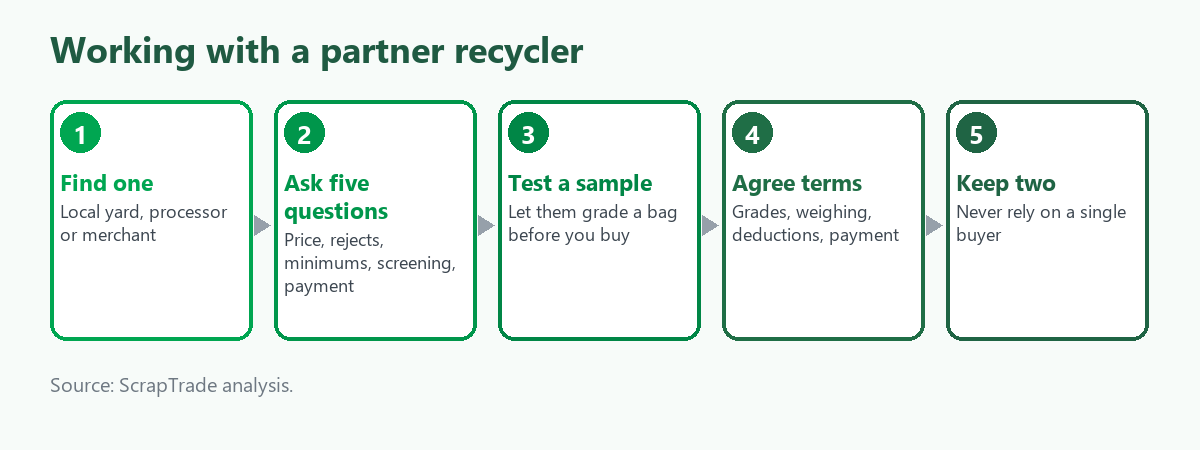
What is a "partner recycler"?
For this guide, a partner recycler is any established buyer you work with regularly: a local scrap yard, a processor that sorts and shreds, a metal merchant or an exporter. They are not your boss and not a formal partner. They are the people downstream of you who know what a sellable lot looks like.
Traders often work with several, because each buys different things, at different quantities and on different terms.
What they can tell you before you buy
1. What they would pay, and for exactly what
Describe the material and ask: "What would you pay for a tonne of this, delivered?" Then ask what that assumes. Many price lists are for clean, sorted material and drop sharply for contamination.
2. What they reject or mark down
This is the most valuable question. Ask: "What do you reject, and what do you deduct for?" A good yard will tell you about steel on aluminium, plastics on copper, wet loads or mixed alloys. Their answer is a free grading course.
3. Their minimum quantity and how they weigh
If a yard needs at least a tonne and you have 300 kilograms, you know to aggregate. Ask whose scale counts, where weight is taken and what tolerance they allow. In Australia a trade weighbridge must be approved and verified, and public weighbridges are open to anyone, so ask whether they will accept a public weighbridge ticket [1].
4. How they screen loads
Ask whether they check for radioactivity and hazardous items. Good yards do. New Zealand's health regulator, for instance, advises scrap yards to use portal monitors at the gate [2]. A yard that tells you what it refuses is also telling you what to avoid buying.
5. How they pay
When, how and on what basis? Do they pay on the day, in a week or at month end? Do they need an account, an ABN or proof of identity? What happens if a load is disputed?
6. Who else buys what they cannot
Mills, smelters and exporters often take what a local yard will not. A yard may be happy to tell you if it does not want a material.
Scenario: the five-minute call that saved a margin
Hana has a chance to buy 4 tonnes of "mixed aluminium" from a demolition site for A$2,000 a tonne. She rings a yard and describes it. The yard says clean extrusion would fetch more than that, but windows with glass and rubber still attached drop to a much lower grade, and it deducts for steel and glazing. Hana asks to send photos. The yard looks and says: "That is window frames with glass in. We would pay well under what you are paying." Hana passes. Her call cost her nothing. (Invented example.)
Scenario: the sample that proved the grade
Luis is offered 2 tonnes of "copper pipe". He takes a sample bag of 10 kilograms to a yard, which tests it and finds some is brass fittings. The yard shows him the readings and says what it would pay for each grade. Luis goes back to the seller with the facts, agrees on a price that reflects the mix and signs off a written grade. He buys, sells at a margin and learns to ask for a sample every time. (Invented example.)
How to approach a recycler
Recyclers are busy and often hear from people who want to waste their time. A good approach is short, honest and respectful.
- Visit or call with a specific question, not "can we work together?" Ask what they buy and at what minimum.
- Be clear that you are a small trader and what you plan to bring, with rough volumes.
- Offer to bring a sample before you commit.
- Ask about the process, such as opening an account and what identification they need.
- Say thank you, and follow through. If you say you will bring a load on Friday, bring it on Friday.
Do not ask for secrets such as their customers or margins. Do not waste their time with "just checking" calls every day.
What to give them in return
A good partner relationship is two-sided. Yards want regular, clean material they can rely on. You can offer:
- Consistent quality, so their grader trusts your loads.
- Reliable timing, so they can plan.
- Honesty about what is in the load. Tell them about the odd item up front.
- Prompt pick-up or delivery.
- Respect for their rules, such as opening hours, safety and paperwork.
Protect yourself
Partnering is useful but not risk-free.
- A yard is also a competitor for your supply. If you tell a yard where your best source is, it can approach that source directly. Share what you need to, not where it comes from.
- Do not depend on one partner. Keep at least two buyers for each material so no one controls your price.
- Get prices in writing when you can, with a date.
- Beware of exclusivity unless you are getting something real for it, such as a better price or guaranteed pickup.
- Keep your own records of every load, weight and payment.
If a relationship starts to feel one-sided, test it by getting a quote from another yard.
When a formal agreement helps
Once a partner takes regular loads from you, write down a short agreement so you both know where you stand. It can cover:
| Term | Example |
|---|---|
| Grades and definitions | A written description of each grade you supply |
| Price basis | A price list or a benchmark less a discount, and how often it is reviewed |
| Weighing | Whose scale and tolerance |
| Deductions | How contamination is measured and charged |
| Delivery and timing | Pick-up days, delivery windows |
| Payment | How soon, how and what triggers delay |
| Disputes | A simple way to settle disagreements |
It does not have to be a long contract. A clear email, agreed by both, is better than nothing. For a legal agreement, ask a lawyer.
Partner recyclers and ScrapTrade
A marketplace can widen your list of possible buyers. On ScrapTrade, sellers can list material at a fixed price, hold a live auction or answer a buyer's request on the Wanted Board [3]. If you sell to yards, processors or exporters, a listing can let you compare more than one offer. It does not replace the relationship with a local partner who gives you a firm quote and reliable payment. Use both. See How to Negotiate a Scrap Deal and A Scrap Deal on ScrapTrade: Worked Examples. Browse the marketplace or register.
Frequently asked questions
Why call a recycler before buying scrap?
They can tell you what they would pay, what they reject and what quantity they need, so you know your margin before you spend money.
Will a yard really help a small trader?
Many will, because they want regular, clean material. Be clear, honest and reliable.
Should I tell a yard where I get my scrap?
Not necessarily. Share what you need to, but keep your supplier relationships your own.
How many buyers should I have?
At least two for each material, so one cannot control your price.
Can I get a price from a recycler in writing?
Often, yes. A dated price list or email helps.
Sources
- National Measurement Institute, Weighbridges used for trade (Department of Industry, Science and Resources).
- New Zealand Ministry of Health, Radioactive material in scrap metal recycling.
- ScrapTrade, How ScrapTrade works, as published in October 2026.
This article is general information, not legal or financial advice. The people and scenarios are invented. ScrapTrade operates a scrap marketplace and has a commercial interest in the scrap trade.