

In scrap, the hard part is not selling. There are buyers for most metals. The hard part is getting enough material, often enough, at a price that leaves you a margin. Traders who last build supply the way a shop builds regular customers: one relationship at a time. This guide shows where to look, what to say, what to offer and how to keep people sending you scrap. The people in the scenarios are made up, and all of this is general information. It follows How to Choose Your Scrap Niche.
Who has scrap, and what kind
Think in terms of who produces it regularly, not who happens to have a pile.
| Source | Typical material | What they care about |
|---|---|---|
| Workshops and factories | Offcuts, swarf, sheet, sometimes stainless | Clearing the floor, safety, a regular pick-up |
| Building and demolition crews | Steel, copper pipe and cable, aluminium windows | Speed and tidy sites |
| Electricians and plumbers | Copper cable, pipe, brass fittings | Convenience, quick cash |
| Window and door fitters | Aluminium extrusion | Space in the yard |
| Mechanics and wreckers | Mixed metals, cast iron, batteries and parts | Removing clutter and legal disposal |
| Property managers and councils | Fittings, fencing, bins, mixed metal | Compliance, paperwork |
| Offices and retailers | Cardboard, e-waste | Convenient, clean disposal |
| Other traders and small yards | Mixed lots | Moving stock without finding a buyer |
For more on early sources see Want to Start in Scrap? Start With Supply. and How to Start a Recycling Company and Find Scrap.
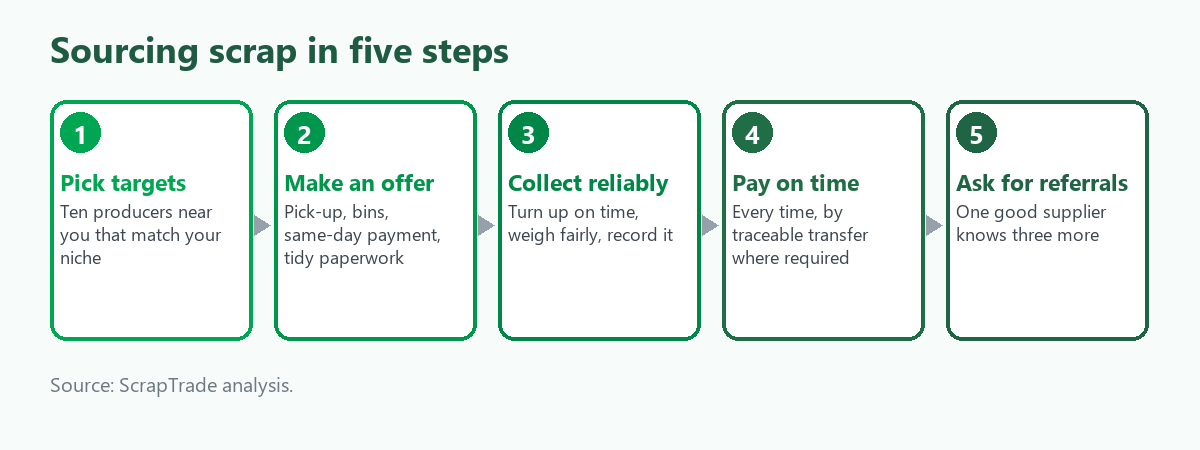
Step one: pick a short list
Do not try to approach everyone. Choose ten sources within a short drive that match your niche, and visit them in person. A visit tells you what they throw away, how much and how often. Ten good prospects are worth more than a hundred cold calls.
Step two: make a simple offer
Business owners are busy and often do not know what their scrap is worth. They are not looking for the highest possible price. They want it gone without hassle. So lead with what you can do for them.
A short pitch can be as plain as this:
"Hi, I buy clean aluminium and copper offcuts. I can collect weekly or when you call, I pay by bank transfer on the day, and I will leave the area tidy. Could I have a look at what you have?"
Notice what is in there: what you buy, how it works, how you pay and that you are reliable. Notice what is not: a promise of a big price you have not worked out.
What to offer
- A regular pick-up, weekly, fortnightly or on request.
- Containers, even simple bins or a cage, for sorted material.
- Payment on the day, by traceable transfer where the rules require it.
- Paperwork they can keep, such as a simple record of what you took, the weight and the payment.
- Reliability. Turning up on time matters more than a few cents a kilogram.
Step three: keep your side of the bargain
Suppliers stick with people who are easy to deal with.
- Turn up when you said you would.
- Weigh fairly and show them the reading.
- Pay on time, every time.
- Leave the area clean and take what you said you would.
- Tell them honestly when the price has moved.
A supplier who trusts you will tell you when a big job is coming up, and will often not shop around.
Step four: ask for referrals
Satisfied suppliers know other people with scrap. After a few good pick-ups, ask: "Do you know anyone else around here with offcuts they want collected?" A single referral can open three more sources.
Scenarios
The people below are invented, but these are the kinds of situations you will meet.
Scenario 1: the workshop with a messy bin
Dev walks into a metal fabrication shop and sees a skip full of mixed steel and aluminium offcuts. The owner says a contractor takes it away for free, but it is always full. Dev offers weekly pick-up of the sorted aluminium if the owner puts it in a separate bin, and pays a fair price per kilogram on the day. After three weeks the owner also asks him to take the steel. Dev now has two materials from one source.
What worked: offering to make the owner's life easier, and a simple separation rule.
Scenario 2: the demolition crew that sells to the highest bidder
Sam approaches a demolition company, but the site manager says they sell to whoever pays the most and do not want loyalty. Sam does not argue. He says: "Call me when you have something and I will give you a number you can compare." He gives quick, honest quotes, pays promptly and rarely quibbles about small deductions. After two months the crew calls him first on small jobs because it is less hassle.
What worked: meeting the supplier's rule instead of fighting it, and being fast and fair.
Scenario 3: the lot that looked great
Aisha is offered 8 tonnes of "mixed copper" cheaply from someone she has not met. She asks to see it first, and finds it is mostly insulated cable and brass fittings, not the clean copper described. She offers a lower price based on a sample and a clear grade, but the seller refuses. She walks away, and the next week finds a regular source of clean pipe from a plumber. See How to Verify Scrap Before You Buy or Sell.
What worked: checking first, and not letting a low price pull her into a bad lot.
A four-week sourcing plan
| Week | What to do | Aim |
|---|---|---|
| 1 | List ten possible sources near you and visit five | Find out what they have and how it is handled now |
| 2 | Visit the other five, make your offer to each | At least three agree to a first pick-up |
| 3 | Do the first pick-ups, record weight and grade, pay promptly | Prove you are reliable |
| 4 | Review the numbers, ask each supplier for a referral | One recurring source and two new leads |
Keep a simple record: who, what, how much, what you paid, what you sold it for. After four weeks you will see which sources are worth the drive.
Sourcing online
You can also look for supply on a marketplace. On ScrapTrade, sellers list material with photos, material type, estimated weight and pickup location, and a buyer can read the listing and make an offer or, for some, bid at auction [1]. Buyers can also post what they need on the Wanted Board, and sellers with matching stock respond directly [1]. If you have a buyer who needs a grade and quantity, you can post it and see who has it.
Online sourcing works best as an extra to your local relationships. Treat it the same way as any new source: check the material, the weight and the seller before you pay. See How to Secure Scrap Deals and Avoid Scams. Browse the ScrapTrade marketplace or register.
Working with others' supply
If you cannot get supply yourself, you can work with people who have it. A scrap broker sources material from an original seller and resells it, and a scrap agent works for a seller or buyer who hires them for a commission. See Become a Scrap Broker or Agent: How to Start. Neither route is free of effort or cost, and ScrapTrade's pages do not say registration is free.
The rules you need to follow
Buying scrap from the public is regulated in many places. You may need to register, check and record seller identification, keep records for a set period and pay by traceable means. In New South Wales and Victoria, for example, cash for scrap is banned. Check Scrap Business Rules and Documents by Country and ask your regulator. Records also protect you if something later turns out to be stolen.
Common mistakes
- Chasing price instead of reliability. Suppliers move on when you are late or unpredictable.
- Taking everything. Mixed or dirty loads cost you in grading and deductions.
- Not recording the source. You may need it for the rules, for disputes or for your own margins.
- Depending on one source. If it dries up, so do you.
- Underpaying a good supplier until they find someone else.
Frequently asked questions
Where do I find scrap to buy?
From people who produce it regularly: workshops, building and demolition crews, electricians, fitters, mechanics and property managers. Start with a short list near you and visit in person.
Do I have to pay suppliers cash?
In many places you must not. Check your local rules, and use traceable payment where required.
How do I find my first supplier?
Pick a niche, list ten local businesses that produce it, visit them and offer a simple, reliable pick-up service.
How often should I collect?
As often as the supplier's volume needs. Weekly or fortnightly is common, but ask.
Can I source scrap online?
Yes, through marketplaces and buyer-request boards, but check the material, the weight and the seller as you would for any source.
Sources
- ScrapTrade, How ScrapTrade works, as published in October 2026.
This article is general information, not legal or financial advice. The people and scenarios are invented. ScrapTrade operates a scrap marketplace and has a commercial interest in the scrap trade.