

When people start in scrap, the first question is usually "which metal makes the most money?" It is the wrong question. Copper pays more per kilogram than steel, but a beginner who cannot get copper every week, cannot tell it from brass and cannot afford a mistake on it will lose money faster than a beginner who sells steel steadily. A good niche is the material you can reliably get, correctly grade and sell, at a size of lot your cash can carry. This guide shows you how to choose, using real export data and three made-up starting scenarios. It is general information, not financial advice, and part of a series that starts with How to Plan a Scrap Business: 90-Day Roadmap.
What a niche is, and why you want one
A niche is one or two materials you focus on for your first months. It helps because:
- You learn grades faster. Ten kinds of aluminium are enough to master before you touch brass.
- Your buyers get to know you. A buyer who sees consistent copper from you will call you when they need it.
- Your supply is easier to organise. You know what to ask for.
- Your mistakes are cheaper. One category, one set of risks.
You can widen later. Most traders add an adjacent material once the first one is steady.
What does the data say about value?
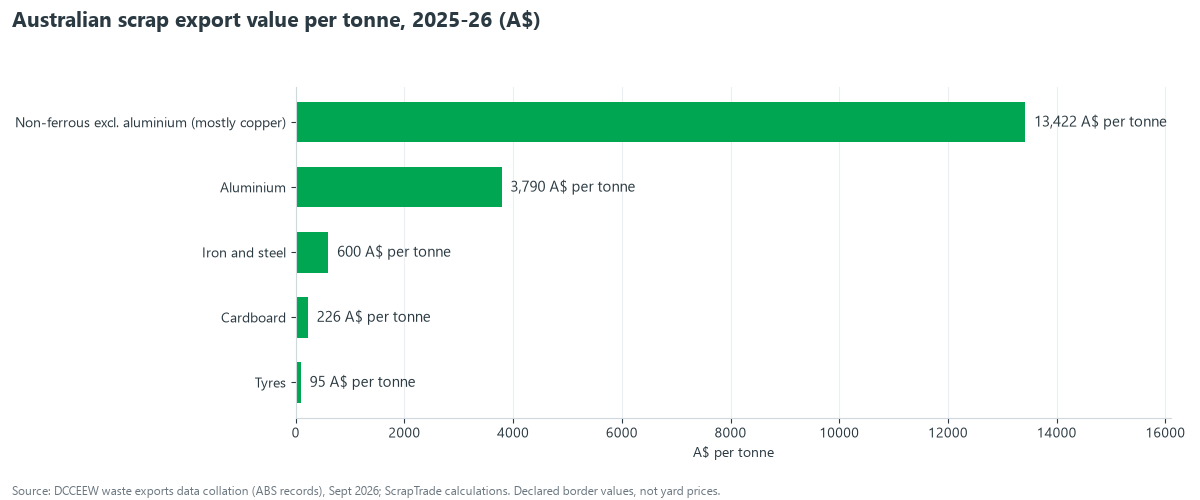
Here is what Australia's export records show for 2025-26. These are declared export values for mixed shipments at the border, so they are not what a collector is paid. They do show how different the materials are.
| Material | Tonnes exported | Declared value | Average per tonne |
|---|---|---|---|
| Non-ferrous metals excluding aluminium (mostly copper) | 120,685 | A$1.62 billion | about A$13,400 |
| Aluminium | 377,501 | A$1.43 billion | about A$3,790 |
| Iron and steel | 2,547,805 | A$1.53 billion | about A$600 |
| Cardboard | 957,344 | A$216 million | about A$226 |
Source: Department of Climate Change, Energy, the Environment and Water (DCCEEW) waste exports data collation, September 2026 (ABS records), ScrapTrade calculations. For where aluminium and copper go see Who Buys Australia's Aluminium and Copper Scrap.
Three things stand out.
- Steel is the volume business. Australia exported over 2.5 million tonnes, about 20 times the weight of copper, at roughly a twentieth of the value per tonne. You need many tonnes, good freight and thin margins.
- Copper is the value-per-kilogram business. A small amount of copper carries a lot of money, which means small lots are worth chasing, but a grading mistake costs far more.
- Aluminium sits in the middle. Plenty of volume, decent value, and a lot of variety in grades.
Six questions that pick your niche
1. Can you get it every week?
Supply beats price. Look at who around you produces which metal.
- Workshops and factories: steel offcuts, swarf, sometimes stainless or aluminium.
- Builders and demolition: steel, copper pipe, cable, aluminium windows.
- Electricians and electrical wholesalers: copper cable.
- Window and door fitters: aluminium extrusion.
- Car repairers and wreckers: a mix, including catalytic converters, which are heavily regulated in some places.
- Offices and retailers: cardboard, e-waste.
A material you could only collect twice a year is not a niche.
2. What is one lot worth, and can you carry it?
ScrapTrade's indicative price index on 26 October 2026 put heavy melting steel at around A$0.40 a kilogram, aluminium extrusion at about A$2.63 and Copper 2 at about A$9.68. The index is an AI-generated rough guide that changes daily, so use it for scale, not for quoting. At those levels:
- A 5 tonne lot of steel is about A$2,000.
- A 5 tonne lot of aluminium extrusion is about A$13,000.
- A 5 tonne lot of Copper 2 is about A$48,000, and that is before you pay freight.
Your capital decides which of these you can fund, and how many you can hold at once. Read How Much Money to Start a Scrap Business?.
3. How hard is it to grade?
Clean offcuts of one metal are easy. Mixed alloys, coated metal and electronics are hard. Pick the level where you are right most of the time and learn from there. See how to grade scrap metal.
4. How much does a mistake cost?
Think of the worst lot you might get wrong. With steel it is mostly freight and weight. With copper it is a large chunk of the lot's value. Start where a mistake will not end your business.
5. How easy is it to find buyers?
Steel and aluminium have many buyers. Some materials, such as mixed e-waste or certain alloys, have fewer, and some need specific handling or permits. Call two buyers before you commit to a niche and ask what they take and at what minimum quantity.
6. What are the rules?
Some materials are more tightly regulated than others, because of theft or hazards. Catalytic converters, batteries, e-waste and anything from industrial sites can carry rules. Check them in Scrap Business Rules and Documents by Country and ask your regulator.
Seven niches compared
These are general tendencies, not guarantees.
| Niche | Typical strength | Typical challenge |
|---|---|---|
| Steel and iron | Plenty of supply and buyers | Thin margin per tonne, freight matters, needs volume |
| Aluminium | Good value and demand, many buyers | Many grades, attachments and coatings reduce price |
| Copper | High value per kilogram, small lots matter | High cost of a grading error, theft rules, capital per lot |
| Brass and mixed non-ferrous | Good value | Hard to tell apart without experience |
| Stainless steel | Better value than mild steel | Sorting grades needs care, magnet tests can mislead |
| Cardboard and paper | Steady supply from businesses | Very low value per tonne, needs baling and volume |
| E-waste and batteries | Growing volume | Regulated, hazardous, needs proper handling and permits |
For grade guides see aluminium and copper.
Three starting scenarios
The people below are invented, but the situations are common.
Scenario 1: Jess, a fitter's apprentice, with A$3,000
Jess works for a window business that throws away aluminium offcuts every week. She asks the owner if she can take them. She sorts extrusion from sheet, keeps steel and rubber out and sells to a local yard. Her niche is aluminium offcuts, because supply is weekly and free, grading is simple and her cash covers a few hundred kilograms. She expects to move to nearby window businesses next.
Why it works: supply, low capital, easy grading. Risk: one buyer sets her price, so she needs a second.
Scenario 2: Omar, a truck owner with a free weekday
Omar has a truck and spare time but little knowledge of metals. He asks building sites and workshops what they scrap. They produce mostly steel. His niche is heavy steel and cast iron, because the volume is steady and mistakes are cheap. His margin depends on freight and weighing, so he uses a public weighbridge and pays attention to fuel costs.
Why it works: volume, simple grades, his truck is an asset. Risk: thin margin, so he has to run lean and add loads.
Scenario 3: Nina, with some savings and an electrician friend
Nina has A$25,000 and a friend who runs electrical jobs and generates copper cable and offcuts. She decides to start with copper wire and pipe, buys a magnet and an insulation stripper, and asks a yard to test her samples until she can grade by eye. She buys small lots at first and avoids large ones until her grading is reliable.
Why it works: high value per kilogram, a source she trusts. Risk: one wrong grade is expensive, so she grades carefully and writes down what she has.
A simple scoring method
Score each material from 1 to 5 on the six questions: supply, lot size you can fund, grading ease, cost of mistakes, buyers and rules. Add them up. Choose the top one or two, not the top five. If two are close, pick the one where you can get a first lot this month.
How ScrapTrade can help you test a niche
You can read the Wanted Board to see what buyers are asking for, in what quantity and grade, before you commit to buying. You can also compare listings on the marketplace and check live material prices. These help you test demand, though none of them replace calling a real buyer. If you want to work with someone else's supply instead of buying, see Become a Scrap Broker or Agent: How to Start.
Next in the series: How to Source Scrap for Your Business.
Frequently asked questions
What is the most profitable scrap to collect?
Per kilogram, copper pays the most among common metals. Per day, the answer depends on what you can get, grade and sell. The best niche is the one that fits your supply and your cash.
Should I start with steel or copper?
If you want low risk and volume and have a truck, steel. If you want higher value and can get copper reliably and learn grading, copper. Many people start with aluminium as a middle step.
Can I deal in more than one metal?
Yes, but start with one or two. Add more once your grading and buyers are solid.
Is e-waste a good niche?
It is growing but regulated, so check the rules and the handling requirements before you start.
How do I know a niche has buyers?
Call two buyers and ask what they take and the minimum quantity, and read the buyer requests on the Wanted Board.
Sources
- Department of Climate Change, Energy, the Environment and Water (DCCEEW), Waste exports data collation, September 2026 (Australian Bureau of Statistics records), ScrapTrade calculations.
- ScrapTrade Price Index, scrap.trade/market-prices, retrieved 26 October 2026. AI-generated indicative estimates, not a quote.
Figures are as reported by the sources named. Export values are border declarations for mixed shipments, not yard prices. The scenarios are invented. This article is general information, not financial advice. ScrapTrade operates a scrap marketplace and has a commercial interest in the scrap trade.