

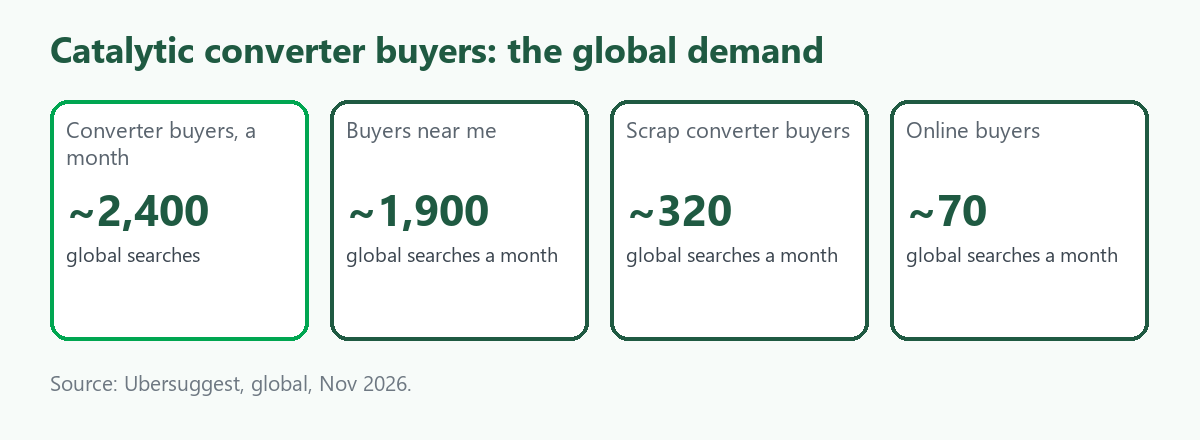
"Catalytic converter buyers" is searched about 2,400 times a month worldwide, according to Ubersuggest, with "catalytic converter buyers near me" about 1,900, "scrap catalytic converter buyers" about 320 and "online catalytic converter buyers" about 70. The cost per click is about 2 dollars, and the results are crowded with buyers advertising for sellers. Choosing among them matters more than for ordinary scrap, for two reasons: the price depends on how the buyer grades and assays a hidden coating, and converters are stolen, so legitimate buyers are expected to keep records and many places require it. This guide explains the kinds of buyer, what to ask, what the law often requires and the payment rules that have appeared. It belongs to our guide to selling scrap cars, car parts and used tires online, and pairs with Where to Sell a Catalytic Converter. ScrapTrade runs a scrap marketplace and has a commercial interest in the scrap trade.
The kinds of buyer
A buyer's business model shapes its quote, so it helps to know which you are talking to.
- Counter buyers. Scrap yards and recyclers who buy across the counter, grade by eye or serial number and resell upward.
- Specialist buyers. Businesses that deal mainly in converters, with grading experience by make and model.
- Refiners and aggregators. The ones who mill and assay, which is where the metal is actually measured. They often buy lots and work through collectors.
- Online buyers. They quote from photos or serial numbers and take the unit by courier.
- Exporters. They gather converters for shipment to refiners abroad. See our AU companion on where an old catalytic converter goes for what Australian customs data shows.
What to ask a buyer
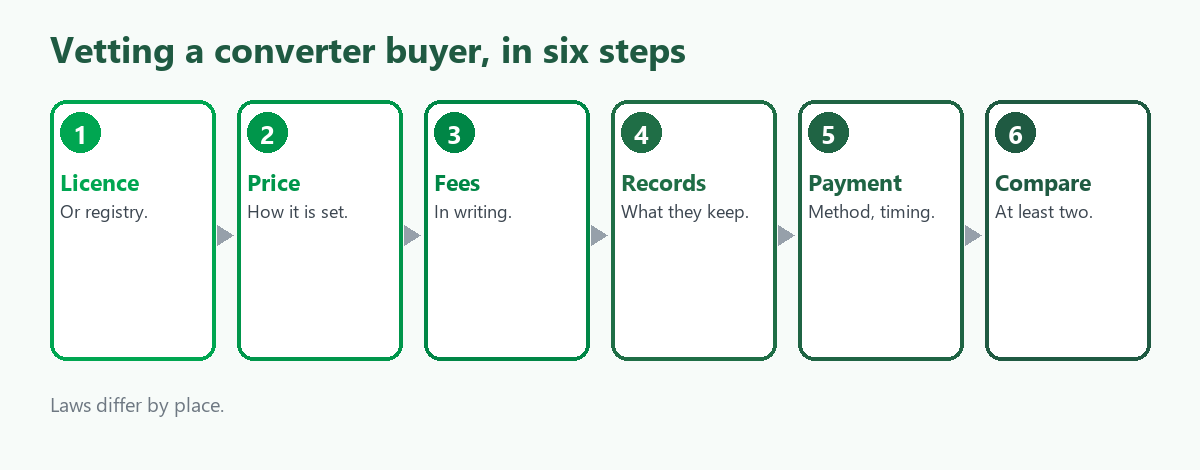
- Are you licensed or registered? Where a licensing scheme or registry exists, ask for the number and check it. We did not review each country's scheme.
- How is the price set? Unit price or assay, and whether the quote is firm, as our guide to how a scrap price is set explains.
- What are the fees and deductions? In writing, and in your currency.
- What records do you keep, and what do you need from me? A buyer who does not ask where the converter came from is a warning sign.
- How and when do I get paid? Method, timing, and whether payment comes before the converter leaves your hands.
- What happens if you grade it differently? Ask whether a quote can change after inspection, and what the process for a dispute is.
Get at least two quotes. We found no source showing that specialist buyers pay more or less than yards, and a single offer tells you little.
What the law often requires of buyers
This is the part with the most variation, so treat it as an example of the pattern. The MOST Policy Initiative's January 2024 summary of United States state policies says most states require detailed recordkeeping on detached converter sales. The records it describes include the seller's name, address and a copy of ID, details of the vehicle the converter came from, a photo and description of the converter and the amount paid, and in some states a signed statement that it was lawfully obtained. Some states also require the buyer to report sales electronically, from 24 hours to 60 days after the sale. We could not verify the page's per-state table, so check your state's current statute.
Individual examples that came up in our search results, each as summarized and not read in full:
- Minnesota (2023). Scrap dealers must keep records of converter purchases for three years, and, according to a bill summary, may not move a converter off their premises for seven days. A 2024 bill proposed dropping a vehicle-number requirement, and we do not know its outcome.
- Delaware (2023). A bill text says converters may not be bought with cash, and payment is by check to the licensed seller.
- Manitoba, Canada. Reports say dealers must keep transaction records for two years, and that cash payments over 50 dollars are not allowed.
For Australia, which we cover separately, see Catalytic Converters: Value, Theft and Exports. We did not review the United Kingdom, the European Union or other markets.
What this means for you as a seller
Expect to be asked for ID and proof of where the converter came from, to be paid by a method that leaves a record, and to wait for a hold period in places that impose one. If a buyer says none of that is needed, ask why, because they may not be following the rules where they operate, and a sale to them could come back on you. Do not sell a converter you do not own, and do not take one off a vehicle that is not yours.
Where ScrapTrade fits
A local counter buyer is the quickest way to sell a single converter. ScrapTrade suits sellers with lots who want several verified buyers to bid. It is a scrap marketplace with traders in more than 50 countries, no listing fee or commission, live negotiation and a 5 percent buyer deposit held in escrow once you accept a bid. Verified businesses and individuals can sell, and precious metals is one of its categories. Whether converters can be listed, and how assay and record-keeping would work for them, is unconfirmed, so ask cs@scraptrade.com.au first. ScrapTrade does not replace your own legal obligations as a seller.
What we could not verify
- Current status of converter laws. The state examples come from summaries and bill texts, not from the statutes themselves.
- Licensing schemes and rules outside the United States and Canada.
- Any individual buyer's reliability. Check each one yourself.
- Whether ScrapTrade lists converters.
Frequently asked questions
How do I find a reputable catalytic converter buyer?
Ask for a licence or registration where one exists, how the price is set, the fees in writing, and what records the buyer keeps. Compare at least two.
Do catalytic converter buyers need to see ID?
In many places, yes. A 2024 policy summary says most United States states require detailed records including the seller's identification.
Can I be paid cash for a catalytic converter?
It depends on where you are. Some jurisdictions restrict cash or require a check, so ask the buyer and check local rules.
Can I sell to catalytic converter buyers on ScrapTrade?
Verified businesses and individuals can sell, and precious metals is a category. We could not confirm that converters can be listed, so ask first.
Sources
- Ubersuggest keyword data, global, queried November 2026.
- MOST Policy Initiative, "State Policies on Catalytic Converter Sales," 30 January 2024, as summarised in search results.
- Minnesota 2023 session law and bill summaries, Delaware HB 78 (2023) and Manitoba scrap metal reporting, as summarised in search results.
- ScrapTrade website, accessed November 2026.
General information only, not legal advice. Laws change and differ by jurisdiction. ScrapTrade is a scrap marketplace.