

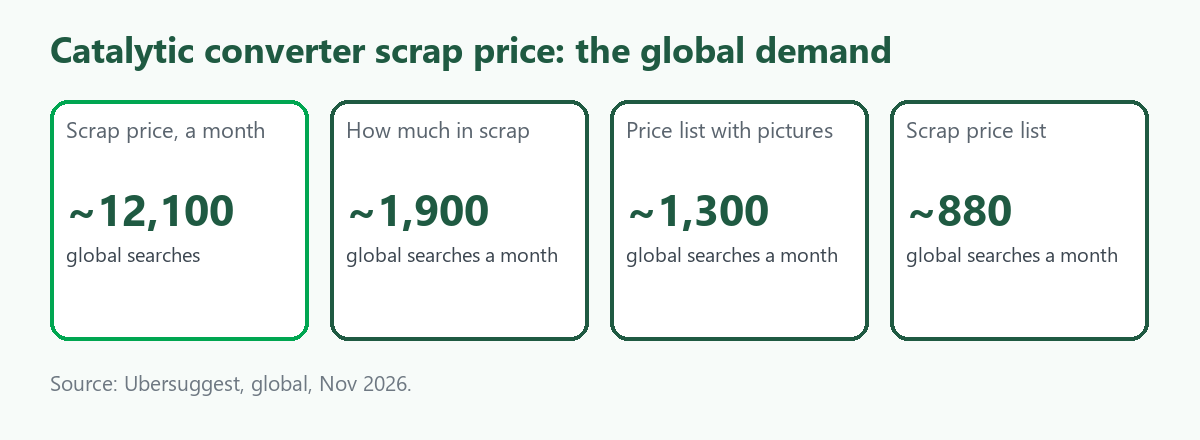
"Catalytic converter scrap price" is one of the largest searches in the whole scrap family, about 12,100 times a month worldwide, according to Ubersuggest, with "how much is a catalytic converter worth in scrap" about 1,900, "catalytic converter scrap price list" about 880 and a version that asks for pictures about 1,300. Almost all of those searchers want a number, and this guide does not give one. The sources that publish numbers are buyers advertising, the figures are undated, and a converter's value moves with the metal markets and with the particular unit. What the guide does give is the method: what decides the price, how the arithmetic works, and how to test a quote. It belongs to our guide to selling scrap cars, car parts and used tires online, and it sits beside Where to Sell a Catalytic Converter. ScrapTrade runs a scrap marketplace and has a commercial interest in the scrap trade.
What the price is made of
A converter holds three metals that matter: platinum, palladium and rhodium. They are coated on a ceramic honeycomb inside a steel shell, and the steel is worth little beside them. Which metal dominates differs by engine and era, and because the three trade at very different prices, two converters of similar size can be worth very different amounts. Weight does not show how much metal is present, so the price comes from one of two things:
- A unit price. The buyer identifies the converter by make, model or serial number, looks it up in an internal table and quotes a flat figure. Trade sources say this is common for single and small lots.
- An assay price. The buyer, or a refiner behind it, removes the shell, mills the ceramic to powder, takes a sample and measures the metals in the powder. The lab result sets the value.
A unit price is an average of what units of that type tend to contain. An assay price reflects what your batch contains. Which one favors you depends on the batch, which is why larger sellers ask for an assay.
The arithmetic of an assay price
Assay results are reported in parts per million (ppm) or grams per tonne, which are the same thing. For each metal, the metal in a lot is:
grams of metal = kilograms of powder × ppm ÷ 1,000
So a lot with N kilograms of powder at G ppm of palladium holds N × G ÷ 1,000 grams of palladium. Platinum group metals are priced in troy ounces, and one troy ounce is 31.1 grams, so the value of that palladium is grams ÷ 31.1 × the palladium price per troy ounce on the settlement date. The same sum is done for platinum and rhodium and the three are added. That is the gross value. Settlement then applies the contract terms, which a refiner or buyer sets: the share of each metal paid, the processing charge and any other deductions, and the price basis. One trade guide makes the point that a precise lab result does not by itself give the payment, because two refiners with similar assays can settle differently.
What a seller should check in a quote
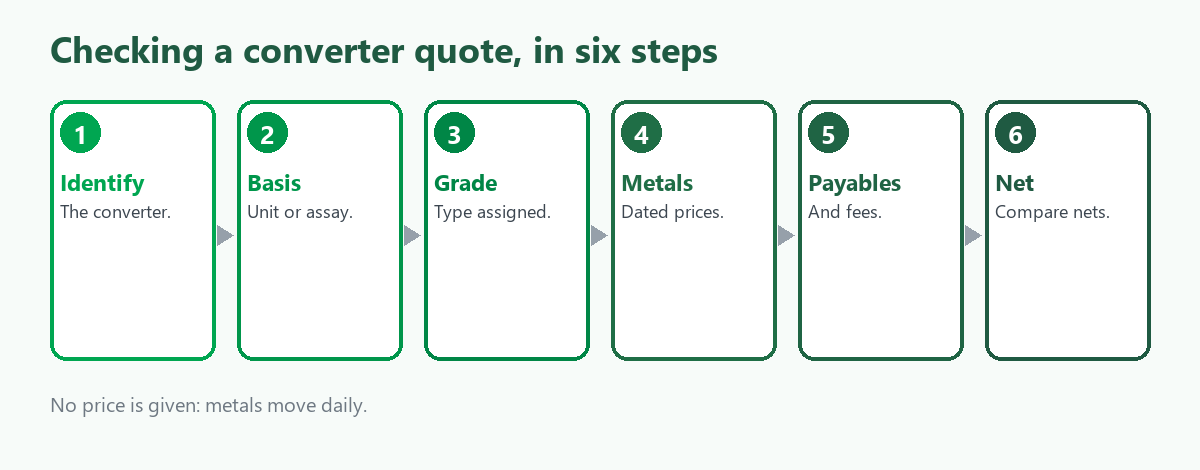
- Is it a unit price or an assay price? If a unit price, how the converter was identified.
- What grade did the buyer assign? The type, such as original-equipment, aftermarket, diesel filter or metal-foil, drives the figure.
- Which metal prices, and from what date? A quote is only good for a short time, because the market moves. Our view of the platinum group markets is in Platinum and Palladium: Analysis and Outlook.
- What share of the metal is paid, and what are the fees? Ask for both in writing. We found no reliable published figure for payable shares.
- When and how is payment made? And whether the figure can change after the buyer's inspection.
- What is the net figure? After fees and deductions, in your currency. Compare nets, not headline numbers.
Why published price lists mislead
The price lists with pictures that many buyers publish are useful for one thing, which is learning what types exist. They are not offers. They are undated or dated by the buyer, they assume the buyer's grade and fee, and they usually describe one type of converter in one condition. One dealer guide lists typical ranges for original gasoline units and for recent aftermarket units, and those ranges are unsourced and likely out of date, so we do not repeat them. Use a list as a sanity check against a quote, not as the quote.
Three other things move the number. Aftermarket converters usually carry less metal than original ones, according to recycler guides. Metal-foil converters are in some cases priced by weight, according to one recycler. And damage matters: a crushed or cut converter may be harder to identify, and recyclers advise not cutting an intact one open just to find out. See how to identify a converter before you sell.
Where ScrapTrade fits
The price a local buyer quotes for one converter is the price to beat, and ScrapTrade is not a way to see a number for a single unit. It suits sellers with lots, where comparing several buyers is worth the time. It is a scrap marketplace with verified traders in more than 50 countries and precious metals among its twelve categories. You list for free with no commission, negotiate in real time in AUD or USD, and an accepted bid places the buyer's 5 percent deposit in escrow. Businesses and individuals can sell after verification. How converters and assay are handled is unconfirmed, so ask cs@scraptrade.com.au first.
What we could not verify
- What any converter sells for. We found no reliable price source.
- Payable shares, fees and recovery rates in practice. Refiners do not publish them in a form we could check.
- How buyers' unit tables are built.
- How ScrapTrade handles converters and assay.
Frequently asked questions
How much is a catalytic converter worth in scrap?
It depends on its metal content, the day's platinum, palladium and rhodium prices and the buyer's fees. We give no figure because we found no reliable source. Compare two or more firm quotes.
Why do two buyers quote different prices?
They may grade the unit differently, price by unit or by assay, use different metal prices and take different fees.
What is assay?
A laboratory measurement of the platinum, palladium and rhodium in a sample of the milled ceramic, reported in parts per million.
Is a scrap price list reliable?
Only as a guide to types. It is a buyer's marketing page, not an offer.
Sources
- Ubersuggest keyword data, global, queried November 2026.
- Recycling Today, Scrap Monster and refiner and equipment-vendor guides on assay, unit pricing and settlement, as summarised in search results.
- Recycler and dealer guides on aftermarket and metal-foil converters, as summarised in search results.
- ScrapTrade website, accessed November 2026.
General information only, not financial advice. ScrapTrade is a scrap marketplace.