

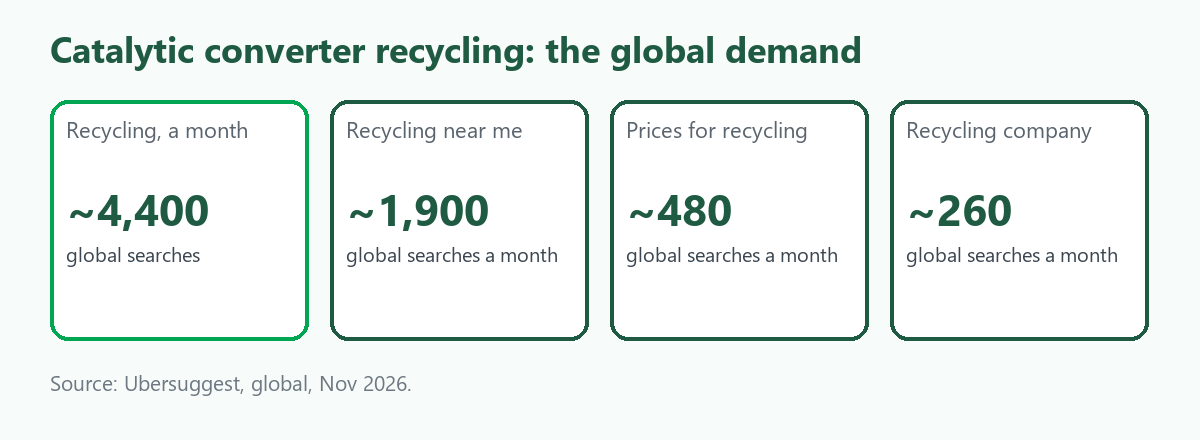
"Catalytic converter recycling" is searched about 4,400 times a month worldwide, according to Ubersuggest, with "catalytic converter recycling near me" about 1,900, "prices for catalytic converter recycling" about 480 and "catalytic converter recycling company" and "plant" about 260 each. The searchers are mixed: some want to dispose of a converter, some want to be paid for it, and a few want to know how the metals come back. This guide explains what recycling means here, the two industrial routes, what laboratory studies report on how much metal is recovered, and what the process means for a seller. We cover the Australian chain, with customs data, in Where an Old Catalytic Converter Goes, and this guide is the global overview. It belongs to our guide to selling scrap cars, car parts and used tires online. We give no prices. ScrapTrade runs a scrap marketplace and has a commercial interest in the scrap trade.
What recycling means for a converter
The steel shell is recycled like any steel, and the ceramic honeycomb is the point. It carries platinum, palladium and rhodium, and recycling means getting those metals back as pure metal, which goes into new catalysts and other products. The ceramic itself ends up as slag. This is different from selling a converter to be fitted again: some buyers resell units for reuse, and we found no source on how often that is allowed, so we leave it aside.
From the car to the furnace
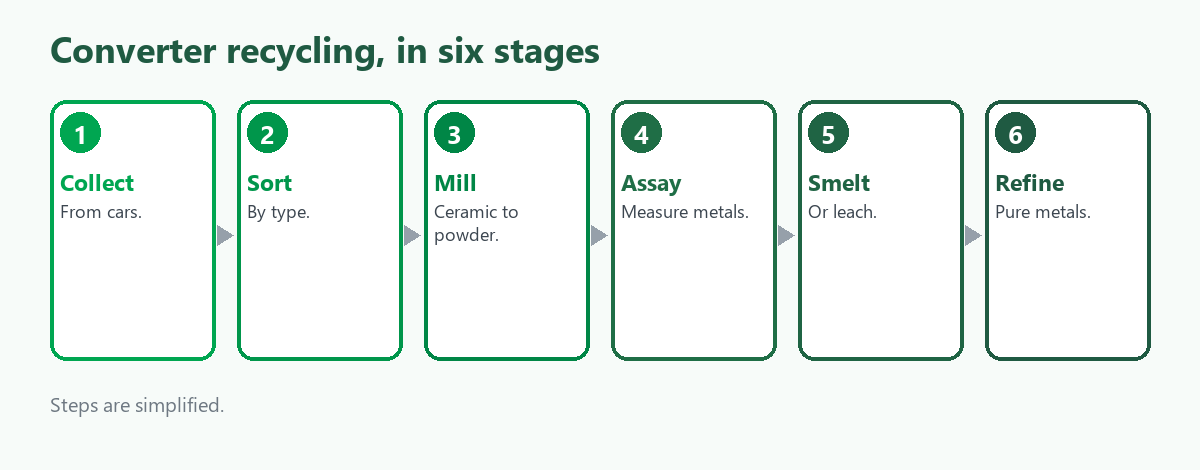
Refiners describe the same stages, in this order:
- Collection. Converters are removed from cars by workshops and wreckers, and gathered by yards and collectors.
- Sorting. They are graded by type, because original, aftermarket, diesel filter and metal-foil units differ in metal content.
- Decanning and milling. The shell is removed and the ceramic ground to an even powder, so that a small sample represents the lot.
- Assay. A laboratory measures the metals in the powder, which sets the value.
- Smelting or leaching. The metals are separated from the ceramic, as the next section describes.
- Refining. The collected metals are purified to sellable platinum, palladium and rhodium.
The two industrial routes
A review of spent-catalyst processing, as summarized in search results, says the metals are commonly recovered by a combination of thermal treatment followed by leaching and solvent extraction. It describes smelting, in which the powder is melted with a collector metal that picks up the platinum group metals to form an alloy, as the more promising route. The collector can be iron, copper, lead, matte or even scrap circuit boards, and the choice affects how well the process performs. A review also notes that traditional smelting is energy-intensive and needs large quantities of collector and slag-forming reagents. Chemical dissolution (hydrometallurgy) is the other route, and one study we found focused on the Johnson Matthey process as the commercial example.
What laboratory studies report on recovery
Reported figures are from laboratory and pilot studies, not from commercial plants, so they show what is possible and not what a seller will be paid:
- An iron-matte study reported recovery of 99 percent of platinum, 99 percent of palladium and 97 percent of rhodium at 950 degrees Celsius over 75 minutes.
- A study co-smelting converters with circuit boards reported recoveries of 96.8, 97.2 and 98.1 percent for platinum, palladium and rhodium.
- A study of a smelting-and-electrolysis route reported platinum group metal recovery close to 100 percent.
One refiner describes its own commercial results as high-90s percent for platinum and palladium and lower for rhodium, which is a vendor claim we could not check. The important point for a seller is that the metal paid for is not the metal recovered, because settlement applies payable shares and fees, as our price guide explains.
Where the recycling actually happens
The refining stage needs furnaces, chemistry and assay laboratories, so it is concentrated in a small number of specialist plants. In our reading, many of the "recycling centers" a search shows are buyers and collectors that send converters on to those plants, and a few are refiners themselves. That is an inference from how refiners and yards describe themselves, and it is why a nearby yard may be a good place to hand over a converter without being the one that recycles it. Where plants sit differs by country, and we did not review them. Converters often cross borders to reach refiners, and shipments of this kind may fall under rules for moving waste, which we also did not review.
What this means for a seller
You do not need to choose a recycling method, but three things follow. The value is set by assay or by a buyer's table based on assay, so ask how the price is set. The price you are quoted already has the refiner's costs inside it, so compare net figures. And a nearby buyer is fine for one converter, while a lot repays a call to several. Our guide on where to sell lists the options.
Where ScrapTrade fits
ScrapTrade is not a refiner and does not recycle converters. It is a scrap marketplace for selling to verified traders in more than 50 countries, with precious metals and e-waste among its twelve categories. Listing is free with no commission, price and terms are negotiated live, and accepting a bid puts the buyer's 5 percent deposit in escrow. Both businesses and individuals can sell after verification. We could not confirm whether converters can be listed, so ask cs@scraptrade.com.au first.
What we could not verify
- Commercial recovery rates. The figures we found are laboratory studies and one vendor claim.
- How much converter reuse occurs, and the rules on it.
- Where plants are in each country, and the shipment rules for converters.
- Whether ScrapTrade lists converters.
Frequently asked questions
How are catalytic converters recycled?
The shell is removed, the ceramic is milled and assayed, and the platinum, palladium and rhodium are separated by smelting or chemical leaching, then refined to pure metal.
How much metal is recovered?
Laboratory studies report recoveries of about 95 to 99 percent for some processes. Commercial plants do not publish comparable figures we could check.
Is there a catalytic converter recycling center near me?
There may be a buyer or yard that collects converters. In our reading, most refining happens at a few specialist plants.
Can I sell converters for recycling on ScrapTrade?
Verified businesses and individuals can sell, and precious metals is a category. We could not confirm that converters can be listed, so ask first.
Sources
- Ubersuggest keyword data, global, queried November 2026.
- Peer-reviewed studies and reviews of platinum group metal recovery from spent catalysts, including collector-metal, iron-matte and co-smelting work, as summarised in search results.
- Refiner descriptions of converter processing and recovery, as summarised in search results.
- ScrapTrade website, accessed November 2026.
General information only. Process steps are simplified and refiners differ. ScrapTrade is a scrap marketplace.