

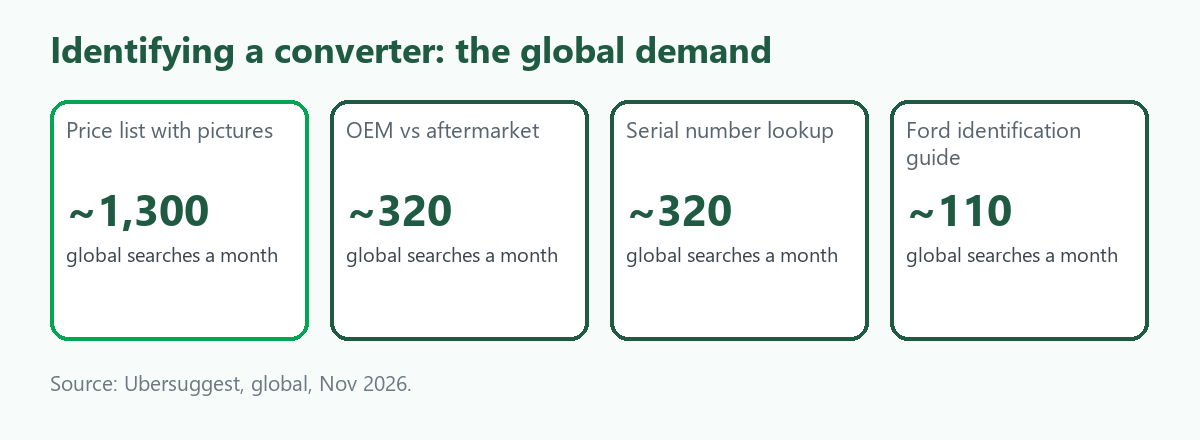
"OEM vs aftermarket catalytic converter" is searched about 320 times a month worldwide, according to Ubersuggest, "catalytic converter serial number lookup" about 320, a Ford identification guide about 110, and the price lists with pictures that people use to identify converters about 1,300. The searchers are trying to work out what they are holding before they ask what it is worth. This guide explains what the markings mean, how original and aftermarket units differ, the two kinds of substrate, and what to photograph and record so a buyer can grade the unit. It pairs with how a scrap price is set and where to sell a converter, and it belongs to our guide to selling scrap cars, car parts and used tires online. We give no prices. ScrapTrade runs a scrap marketplace and has a commercial interest in the scrap trade.
Why identification comes first
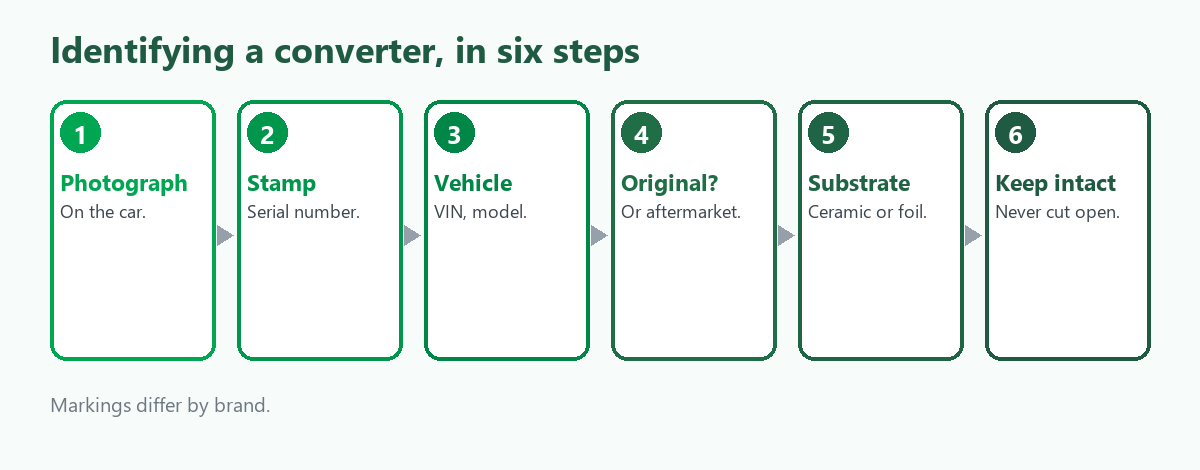
Converters of similar size can hold very different amounts of metal, and weight does not reveal it, according to recycler guides. A buyer who prices by unit looks up the converter by its markings, and a buyer who assays still grades it first. So the seller who can say what the unit is, and show it, gets a firmer quote. The first step is to photograph the converter on the car before removal, so it can be tied to the vehicle.
Reading the markings
Most converters carry a stamped or labeled number on the shell. According to trade guides:
- Part or serial numbers. These can be cross-checked against manufacturer or buyer databases to confirm the application and the likely metal loading. A "serial number lookup" on a buyer's site usually returns that buyer's estimate, not a price you are owed.
- Aftermarket prefixes. One recycler guide says generic aftermarket units often have serial numbers beginning with letters such as N, NT, NAT, NCE or NGE, and that an emissions-approved aftermarket unit may show an Executive Order number from a regulator such as the California Air Resources Board.
- Suffixes that change grade. The same guide says some Toyota serial numbers carry an L or R suffix that makes a large difference to price, and we could not check that against a manufacturer.
- No single clue is proof. A scrap-industry guide says markings, serial numbers, vehicle information, construction and condition should be combined, and that no single visual clue proves a converter is original or aftermarket.
These are brand-specific, vendor-published rules of thumb, so we treat them as examples of what to look for.
Original or aftermarket
An original-equipment converter (OEM) is the one the vehicle was built with, and an aftermarket converter is a replacement from another maker. Recycler guides say aftermarket units usually hold less platinum group metal than originals, and are therefore usually worth less as scrap. Because a vehicle may have had a replacement fitted, the converter you hold is not necessarily the one the model came with, which is why the vehicle details help but do not settle it.
Ceramic or metal foil
Most converters have a ceramic honeycomb. Some, including pre-converters and certain high-performance units, use a metal foil substrate, typically an iron-chromium-aluminum alloy according to one guide. A recycler says some foil units are valued by weight, using a particular sports-car brand as its example. Diesel particulate filters are a separate type again. Photograph both ends of the converter, and do not cut a sound one open to find out, which recyclers advise against.
What to record before selling
- Photos in place and out. The unit on the car, the shell from all sides and both ends.
- The stamp or serial number. A sharp close-up, with a ruler or coin for scale.
- The vehicle. Make, model, year, engine, VIN and registration.
- Condition. Damage, cuts, missing parts or contamination.
- The paperwork. Repair order or proof of ownership, which buyers may require, as Catalytic Converter Buyers: What to Check describes.
- How many. If you have several, keep them in separate lots by type, and count them.
Why price lists with pictures are only a guide
Buyers publish lists with pictures to help sellers match a unit and see a figure. The lists help you learn the types and compare a quote with the buyer's own table. They are not independent: they are dated by the buyer, assume its fees and grade, and we found no source that audits them. A list may help you identify the unit, and only then does the question of price arise.
Where ScrapTrade fits
ScrapTrade is not an identification service and does not grade converters. A seller with a box of them can use these steps to prepare a lot and then offer it to verified traders in more than 50 countries on a scrap marketplace with precious metals and e-waste among its twelve categories. Listing is free, with no commission, and negotiation is in real time. After you accept a bid, the buyer's 5 percent deposit is held in escrow. Businesses and individuals can both sell after verification. Whether converters can be listed is unconfirmed, so ask cs@scraptrade.com.au first.
What we could not verify
- Brand-specific serial number rules. The prefixes and suffixes come from vendor guides and we could not check them against manufacturers.
- How buyers classify units as domestic or foreign, or by fill. We found no source.
- What any converter is worth.
- Whether ScrapTrade lists converters.
Frequently asked questions
How can I tell if my catalytic converter is OEM or aftermarket?
Look at the stamp and serial number, the vehicle details and the construction. No single clue is proof, and a buyer can often confirm from a clear photo of the stamp.
Can I look up a catalytic converter by serial number?
Buyers offer lookups, and the result is that buyer's estimate for that type, not a guaranteed price.
Should I cut open a converter to check?
Recyclers advise against cutting a sound converter open just to identify it.
Can I list converters on ScrapTrade?
Verified businesses and individuals can sell and precious metals is a category. We could not confirm converters can be listed, so ask first.
Sources
- Ubersuggest keyword data, global, queried November 2026.
- Recycler and scrap-industry guides on converter identification, OEM and aftermarket units, serial prefixes and substrate types, as summarised in search results.
- ScrapTrade website, accessed November 2026.
General information only. Identification rules vary by brand and buyer. ScrapTrade is a scrap marketplace.