

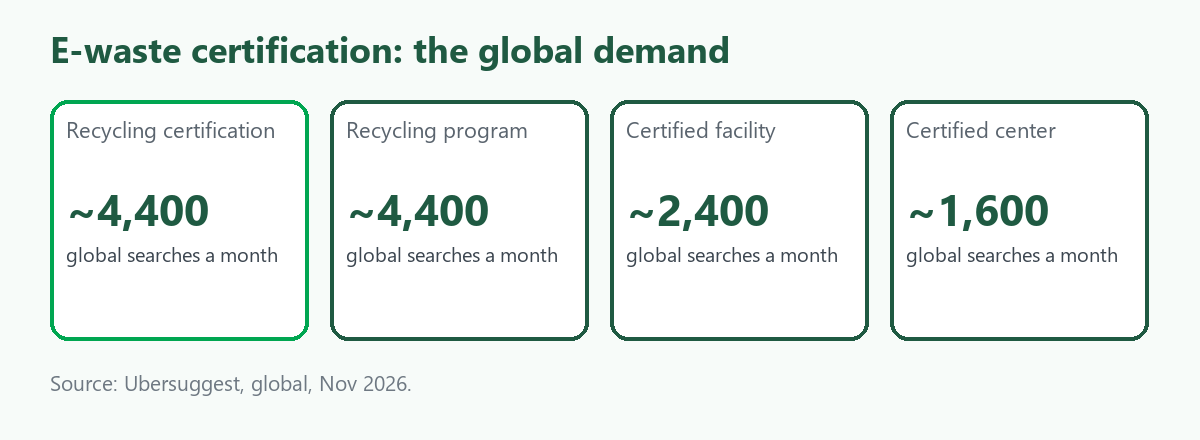
"E waste recycling certification" is searched about 4,400 times a month worldwide, according to Ubersuggest, with "e waste recycling program" about 4,400, "certified e waste recycling facility" about 2,400 and "certified e waste recycling center" about 1,600. These searchers are choosing a recycler, often for a business, and they have a practical worry: whether the devices and the data on them will be handled properly. This guide explains the two best-known certifications, how they differ, what they leave to separate checks and how to verify a claim. It is a companion to how e-waste recycling works, and it sits beside our guide to selling used and broken electronics worldwide. Nearly all the sources we found are recyclers' own blogs, and we say where they conflict. We have a stake here: ScrapTrade is a scrap marketplace.
The two standards
- R2. R2v3 is the current version of the R2 standard, which one vendor calls a structural overhaul of the earlier one. Audits are done by accredited bodies.
- e-Stewards. Run by the Basel Action Network, it also depends on accredited audits. One source says e-Stewards bans export of e-waste altogether, while R2 allows some overseas export, which we could not check against the standards.
Both ask for oversight of the recycler's downstream vendors, the firms it passes material to. Sources disagree on how many facilities hold each certification, so do not rely on counts.
What a certificate does not settle
Data security. Sources conflict. One says R2v3 includes detailed data sanitization and destruction requirements aligned with a NIST guideline, and another says the standards certify environmental handling and that data destruction capability must be verified separately. Several say e-Stewards relies on NAID AAA, a data destruction certification, and a common recommendation is to pair an environmental certificate with a NAID AAA certificate. If your devices hold sensitive data, ask the recycler for its data destruction certificate and method in writing, and do not infer it from an environmental one.
Downstream. One source warns that verification applies to a recycler's direct downstream vendors, so you may need to ask about vendors further along. Another says a certified facility may ship material onward to a processor that is not itself certified, which is why the scope of the certificate matters. Ask where circuit boards, batteries and glass go, and whether each destination is certified.
How to verify a recycler
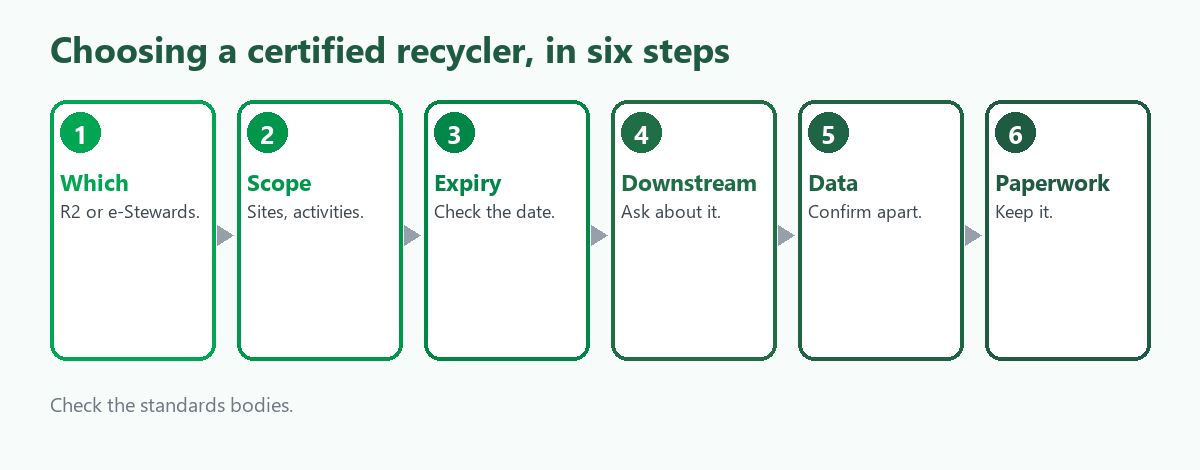
- Ask which certification and which version. R2v3 or e-Stewards, and the certificate number.
- Check the scope. A certificate covers named sites and activities. A different site or a different process may not be covered.
- Check the expiry date. Sources point to the certification bodies' directories, the SERI directory for R2 and the Basel Action Network's directory for e-Stewards, where scope and dates can be checked. We did not review the directories ourselves.
- Ask about downstream vendors. Beyond the first tier, where you can.
- Confirm data destruction separately. And confirm any NAID AAA claim with NAID directly.
- Keep the paperwork. A certified recycler should provide transparent reporting and documented proof of how your material was handled.
What to ask for in writing
These are our suggestions, not requirements from either standard. Before a business hands over retired equipment, ask the recycler for the certificate and its scope, a written description of how data on each storage device will be destroyed, a record of what was received and how many units, and a statement of where each material stream goes. After the job, ask for a certificate of destruction or recycling that matches the count you handed over. If a recycler will not put these in writing, that is information about how it will handle your devices.
Is certification required?
Not necessarily. Whether you must use a certified recycler depends on your place, your contracts and your industry, and we did not review those obligations. Some producer take-back schemes and corporate policies may require certified recyclers, which we did not check, and many individuals use municipal programs. For a few personal devices, wiping the data and using a local scheme is common, and for a business with retired equipment, certification and a data destruction certificate are worth asking for.
Where ScrapTrade fits
ScrapTrade is not a certifier and does not recycle e-waste. It is a marketplace where verified traders in more than 50 countries bid for scrap, e-waste is one of its twelve categories, and it suits businesses with lots to sell. There is no listing fee or commission, negotiation is live, and accepting a bid holds the buyer's 5 percent deposit in escrow. Sellers, business or private, are verified first. We could not confirm whether the marketplace checks buyers' certifications or how data destruction is handled, so ask cs@scraptrade.com.au first, and do your own checks on any buyer.
What we could not verify
- The standards' exact requirements. We relied on recycler blogs, which conflict on data security.
- Facility counts, and whether e-Stewards bans all export.
- The certification directories' current contents.
- Whether ScrapTrade checks buyers' certifications.
Frequently asked questions
What is the difference between R2 and e-Stewards?
Both are audited standards for electronics recyclers. e-Stewards is run by the Basel Action Network, and one source says it bans all export, while R2 allows some. Check the standards themselves.
Does certification mean my data is destroyed?
Not necessarily. Sources conflict, and many advise confirming data destruction separately, for example with a NAID AAA certificate.
How do I check a recycler's certificate?
Ask for the number and check scope and expiry in the certification body's directory.
Does ScrapTrade verify buyers' certifications?
We could not confirm that, so ask support, and check any buyer's credentials yourself.
Sources
- Ubersuggest keyword data, global, queried November 2026.
- Recycler and ITAD vendor guides on R2v3, e-Stewards, NAID AAA and downstream oversight, and a US EPA fact sheet on the implementation study, as summarised in search results.
- ScrapTrade website, accessed November 2026.
General information only, not legal or compliance advice. Certification details change, so check the standards bodies.