

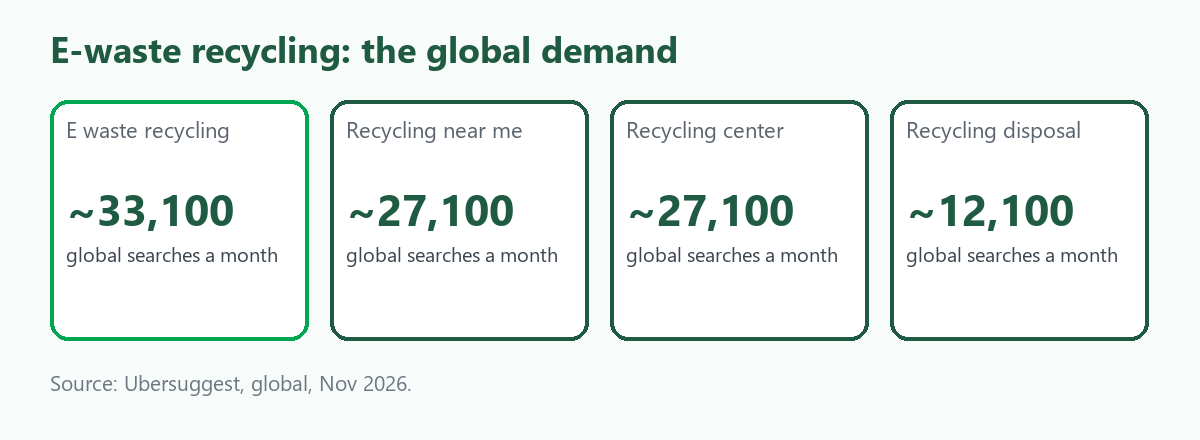
"E waste recycling" is searched about 33,100 times a month worldwide, according to Ubersuggest, and the local versions are nearly as large: "e waste recycling near me" and "e waste recycling center" about 27,100 each, "e waste recycling disposal" about 12,100 and "e waste recycling program" about 4,400. Most of those searchers want a drop-off point for something broken, and a global guide cannot list one. This guide covers what happens after the drop-off: how electronics are processed, where the valuable part goes and what the United Nations' 2024 monitor reports on how much is recycled. For the rules on moving e-waste across borders, see our guide to selling used and broken electronics worldwide, and our Australian companion follows where old electronics go. We quote no prices. ScrapTrade operates a scrap marketplace and gains from scrap trading, which you should weigh.
How much is recycled
The Global E-waste Monitor 2024, from UNITAR and the ITU, as summarized in the coverage we read and not in the full report, put world e-waste at a record 62 million tonnes in 2022, up 82 percent from 2010. About 22.3 percent of that mass was documented as formally collected and recycled in an environmentally sound way, and the report estimated that metals embedded in e-waste weighed about 31 million tonnes. The rest is unaccounted for, and in many places it is dumped, burned or handled informally. The summaries gave two different dollar values, about 62 billion dollars of recoverable resources left unaccounted for and about 28 billion dollars of secondary raw materials, mostly iron, reclaimed, and we could not tell which the report states, so we give neither as fact.
What happens to a device
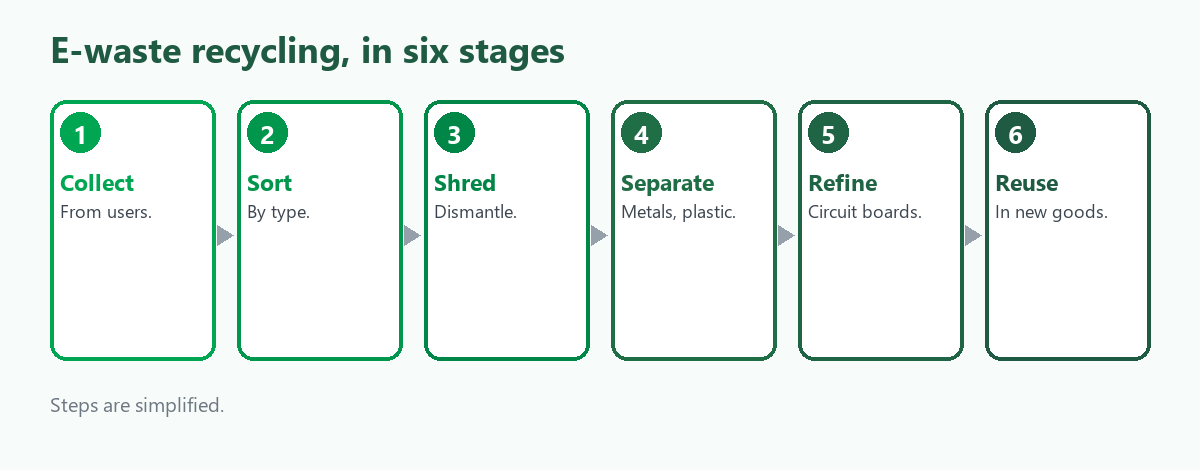
A recycler's own process page, which is one operator's description, lists the stages:
- Collection and sorting. Devices arrive from households, businesses and collection schemes, and are sorted by type.
- Dismantling and shredding. Crushers and shredders break devices into pieces. We found no source on how batteries and other hazardous parts are removed beforehand.
- Separation. Magnets and eddy currents separate iron and non-ferrous metals, density separators split lighter materials and X-ray sorting picks out others, giving fractions of plastics, glass, circuit boards and metals.
- Each fraction goes its own way. Steel, copper and aluminum go to scrap metal buyers, plastics are granulated and remolded, and glass from old television tubes, which contains lead, goes to lead smelters.
- Circuit boards go to precious-metal refiners. This is the step that most often crosses borders, and we cover it in our guide to what scrap electronics are worth.
Who is responsible for paying for it
The rules differ by place, and the summaries we read were thin, so these are pointers and not a map. The European Union's WEEE Directive has been transposed by all member states, and the current collection targets sit in the recast text, which we did not check. In the United States there is no single federal e-waste law, and compliance sources count more than 25 states with producer-funded take-back programs, a count that varies by source. India's e-waste rules set targets for producers under extended producer responsibility, and one source gives 80 percent by 2025, which we could not verify. The common idea is that the makers of electronics fund collection, so a drop-off may be free to you where such a scheme exists. We did not review individual programs.
What this means for you
If you have a few devices, the practical route is the retailer, municipal or manufacturer scheme in your place, and a certified recycler if data matters, which our guide to e-waste certification explains. Wipe or remove data first, as our guide to selling a broken phone or laptop describes. If you hold a pallet of devices or a stock of boards, they are goods with value and several buyers may bid for them.
Where ScrapTrade fits
ScrapTrade does not recycle electronics and does not run drop-off points. It is a marketplace where verified traders in more than 50 countries buy scrap, and e-waste is one of its twelve categories. It suits businesses with lots, such as an IT reseller, a repairer or a recycler with surplus boards, who want several buyers to compete. Listing is free with no commission, price and terms are negotiated live and an accepted bid places the buyer's 5 percent deposit in escrow. Businesses and individuals can both sell after verification. How testing, data security and cross-border compliance are handled for e-waste lots is unconfirmed, so email cs@scraptrade.com.au before you plan around it.
What we could not verify
- The report's own figures. We relied on press and agency summaries of the 2024 monitor, and its two dollar values conflict.
- Recycling steps beyond one operator's description.
- Current rules and targets in the EU, the US states and India.
- How ScrapTrade handles testing and data security for e-waste lots.
Frequently asked questions
How is e-waste recycled?
Devices are sorted, dismantled and shredded, then separated into metals, plastics, glass and circuit boards, which go to specialist processors and refiners.
How much e-waste is recycled?
The UN's 2024 monitor reported that about 22.3 percent of the 62 million tonnes produced in 2022 was documented as formally collected and recycled.
Where can I recycle e-waste near me?
Start with the retailer, municipal or producer scheme where you live. We did not review individual sites.
Can I list e-waste on ScrapTrade?
Verified businesses and individuals can sell, and e-waste is a category. We could not confirm how testing and data security are handled, so ask support.
Sources
- Ubersuggest keyword data, global, queried November 2026.
- Global E-waste Monitor 2024 (UNITAR and ITU) press releases and coverage, as summarised in search results.
- A recycler's process description and national scheme reports on e-waste fractions, as summarised in earlier research for our Australian guide.
- Compliance and law-firm summaries of WEEE, US state and Indian e-waste rules, as summarised in search results.
- ScrapTrade website, accessed November 2026.
General information only, not legal advice. Process steps are simplified and recyclers differ.