

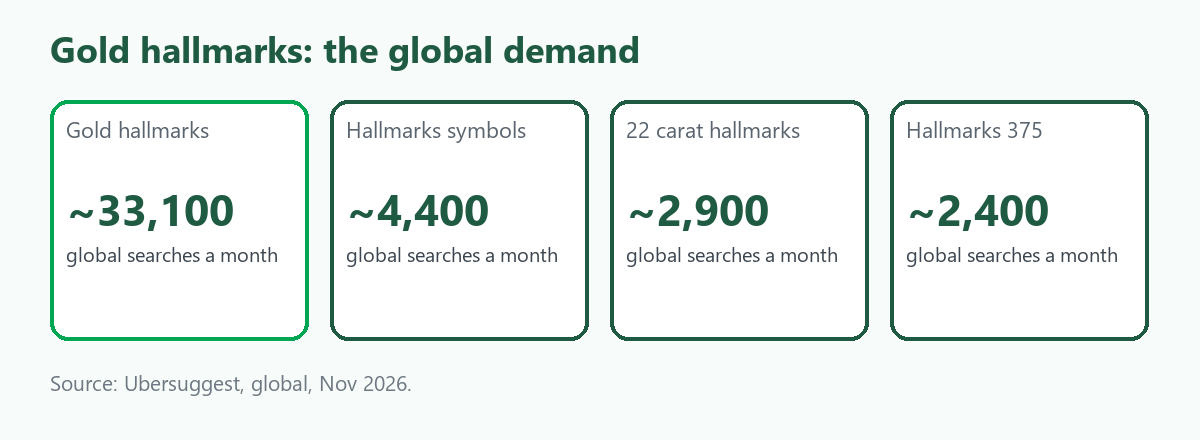
"Gold hallmarks" is searched about 33,100 times a month worldwide, according to Ubersuggest, with "gold hallmarks symbols" about 4,400, "22 carat gold hallmarks" about 2,900, "gold hallmarks 375" about 2,400 and "gold hallmarks 750" about 1,600. Most searchers are trying to read a stamp on something they own, and a good share of them are deciding whether it is worth selling. This guide explains what the numbers and letters mean, how they link to karat, which stamps signal plating and what a stamp does not prove. It supports our guide to calculating scrap gold value, and belongs to our guide to selling gold, silver and scrap jewelry worldwide. For silver stamps, see our sterling silver guide. ScrapTrade runs a scrap marketplace and has a commercial interest in the scrap trade.
The two kinds of mark
A karat stamp says how many parts of 24 are gold: 9K, 10K, 14K, 18K, 22K. A fineness mark gives the same thing in parts per thousand, so dividing it by 10 gives the percentage of gold. A hallmark in the strict sense is a mark applied by an assay office, and it can include more than the fineness. Many people say "hallmark" for any stamp, and this guide uses it loosely, as the searches do.
The numbers
According to the jewelry and bullion guides we found:
| Mark | Karat | Gold share |
|---|---|---|
| 375 | 9K | 37.5% |
| 417 | 10K | 41.7% |
| 585 | 14K | 58.5% |
| 750 | 18K | 75% |
| 916 | 22K | 91.6% |
| 999 | 24K | 99.9% |
Fourteen karat is 58.33 percent by arithmetic and is rounded to 585 in the mark, which is why calculators differ slightly. Other standards exist: a Hong Kong ordinance lists 333, 375, 500, 585, 625, 750 and 916.6, and one Indian-market source says national jewelry standards also include 958 for 23K and 995 for 24K. Sources conflict on whether 999 is used on jewelry, so treat that as unresolved.
What a United Kingdom hallmark adds
The United Kingdom has four assay offices that apply hallmarks: London, Edinburgh, Birmingham and Sheffield. A council trading-standards page says items under 1 gram of gold are exempt, and a compliance guide says gold items of 1 gram or more must be hallmarked, which are two ways of stating the same boundary. We did not read the Act, so check the exact wording for a borderline piece. One antique-jewellery site dates the legal standards, with 375 legal since 1854, 585 since 1932 and the switch to numeric marks in 1975, and we could not confirm those dates from a second source. Older pieces may carry marks that predate the numeric system, so a jeweler who deals in antiques can read them better than a table.
Stamps that mean the piece is not solid gold
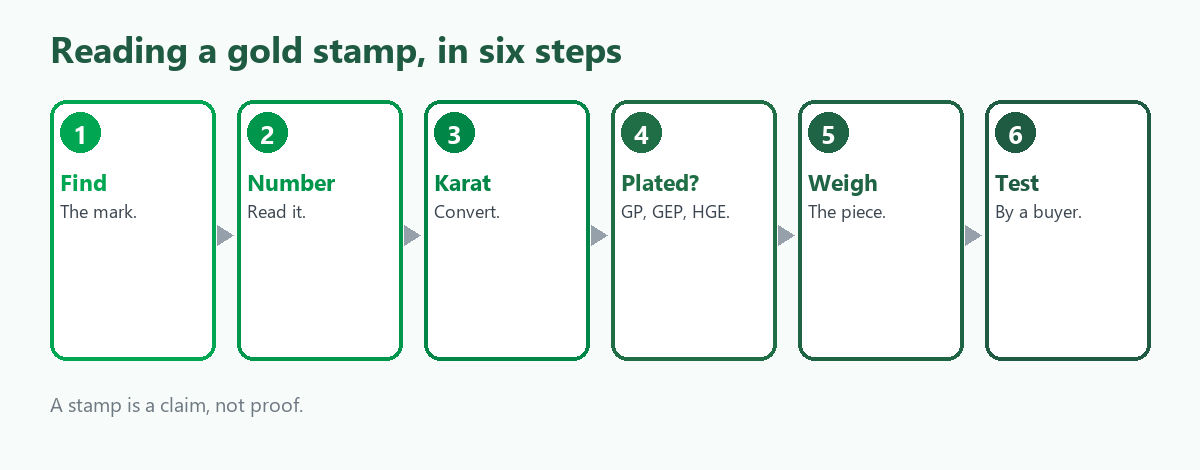
- GP, GEP, HGE. Gold plated, gold electroplated and heavy gold electroplate, according to dealer guides. The coating contributes very little to scrap value.
- GF. Gold filled. It has more gold than plating, but only a fraction of the value of solid gold, according to the same sources.
- Vermeil. A gold layer over sterling silver, usually stamped 925 or STERLING.
Solid gold with a clear karat stamp is the main candidate for scrap, according to those guides, and plated pieces are better kept for wear.
What a stamp does not prove
A stamp is a claim by the maker or an office. It can be worn off, misread or, on poor pieces, wrong, and a buyer will test the metal before it pays, as our guide to home testing explains. A stamp also does not show the weight of gold, because it gives a share and not a quantity. Weigh the piece, and note that stones and fittings add weight that is not gold.
Where ScrapTrade fits
A stamp helps you sort a lot, and it does not replace a buyer's test. ScrapTrade is neither an assay service nor a gold buyer. It is a marketplace of verified traders in more than 50 countries, with precious metals as one category, and it suits sellers with quantity, such as dealers, jewelers and estate clearers. Listing carries no fee or commission, price is negotiated live, and accepting a bid places the buyer's 5 percent deposit in escrow. Private sellers and businesses can both take part after verification. How gold is tested and insured there is unconfirmed, so email cs@scraptrade.com.au before you rely on it.
What we could not verify
- The exact text of the hallmarking laws in each country. We relied on council and compliance summaries.
- The dates of the United Kingdom standards. One secondary source.
- Whether 999 is used on jewelry.
- Gold testing and insurance on ScrapTrade.
Frequently asked questions
What does 750 mean on gold jewelry?
It means 75 percent gold, which is 18 karat.
What does 375 mean?
37.5 percent gold, which is 9 karat or 9ct.
Does a stamp prove the gold is real?
No. A stamp is a claim, and a buyer will test it.
Can I sell stamped gold on ScrapTrade?
Precious metals is a category and verified sellers can list. Whether gold lots are accepted is unconfirmed, so ask support.
Sources
- Ubersuggest keyword data, global, queried November 2026.
- Jewelry, bullion and refiner guides on fineness marks and plated stamps, a Hong Kong ordinance and an Indian-market guide, as summarised in search results.
- UK trading-standards and compliance guides on the Hallmarking Act 1973, as summarised in search results.
- ScrapTrade website, accessed November 2026.
Not legal advice. Hallmarking rules differ by country, and we run a scrap marketplace.