

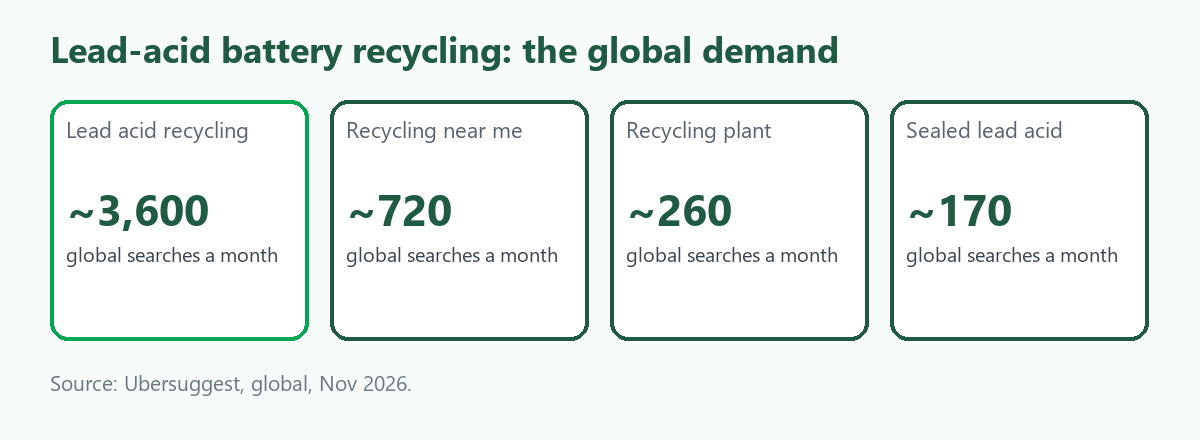
"Lead acid battery recycling" is searched about 3,600 times a month worldwide, according to Ubersuggest, with "near me" about 720, "plant" about 260, "sealed lead acid battery recycling" about 170 and "price" about 90. It costs about 3 dollars a click, because recyclers advertise for it. Most searchers hold a battery from a car, a boat, a backup power system or a mobility scooter and want to dispose of it properly. This guide explains how the industry processes a lead-acid battery, what its much-quoted recycling rate means and how to hand one over. It follows scrap car battery price: how it works, and belongs to our guide to selling scrap cars, car parts and used tires online. We give no prices. We operate ScrapTrade, a scrap marketplace, so we have a stake in this trade.
From a used battery to a new one
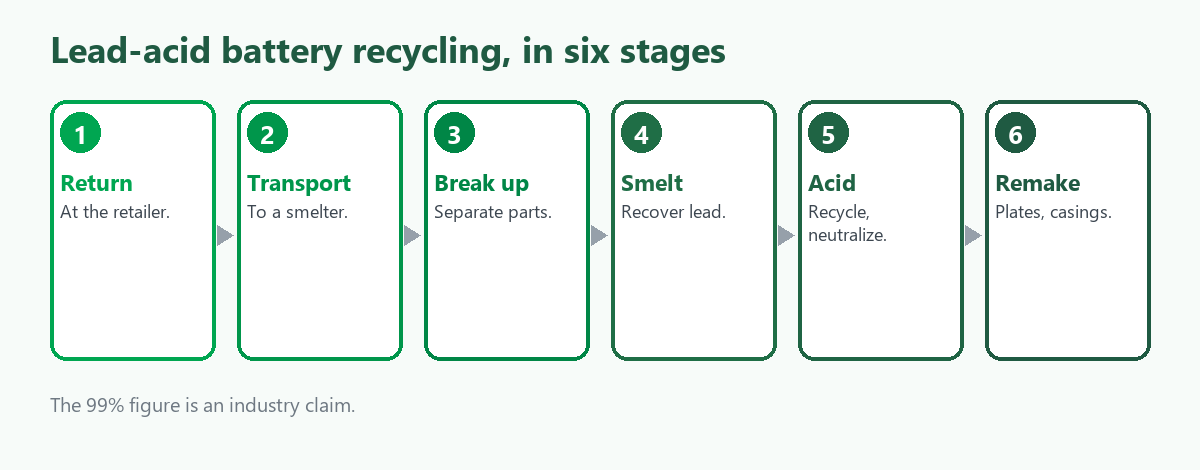
Industry descriptions, as summarized in the coverage we read, run in this order:
- Return. Used batteries usually come back at the point of sale, and fleets owned or run by battery manufacturers or secondary smelters carry the "junk" batteries to secondary lead smelters.
- Break and separate. The battery is broken up so the lead, acid and plastic can be handled separately. We did not find a source describing the mechanical details.
- Smelting. The lead is melted and recovered at a secondary smelter, and goes into lead plates and other battery parts.
- Acid. The sulfuric acid is collected and either recycled or neutralized.
- Plastic. Polypropylene casings are processed and made back into new casings.
What the 99 percent figure means
The Battery Council International, the industry body, reports a recycling rate of about 99 percent for lead-acid batteries, based on studies over many years. A later study covering 2017 to 2021 gave 101.0 percent with a margin of 0.3 percent, which the council attributes to timing, since it compares expected end-of-life batteries, based on sales in earlier years, with current lead production. It reported a sustained 99 percent by averaging studies from 2011 to 2021. All of these figures come from the industry group itself, we did not see the underlying studies, and the rate is a US figure, so do not read it as a global one. A waste-industry profile credits the high return rate to easy returns at the point of sale and the value of the lead and plastic.
Where to take one
- The retailer where you buy a new battery. One source says most US states oblige retailers to accept old batteries from buyers of new ones, and rules elsewhere differ, so ask.
- Scrap yards and battery collectors. Many take batteries, sometimes for a payment, as our price guide explains.
- Municipal or recycling sites. Some take batteries, and we did not review any.
- Specialist recyclers. For sealed lead-acid batteries from backup power, mobility equipment or alarms, which appear separately in searches.
We found no source on whether payment or a fee applies to small sealed units, so ask.
Cross-border movement
Used lead-acid batteries move across borders to smelters, and they are controlled as hazardous waste under the Basel Convention, as our earlier research for our guide to selling scrap cars and parts online covers, with prior-consent rules for some entries. We did not re-verify the current entries for this guide, so check with the authority in your country before you ship a lot.
What this means for you
You do not need to choose a recycling method. Take the battery to a retailer, a yard or a collector, keep it upright and intact and get a receipt. For a lot, such as a garage's pallet or a fleet's change-out, ask for a written quote by weight or per unit and check the buyer's authorization to handle batteries.
Where ScrapTrade fits
ScrapTrade does not recycle batteries and does not take drop-offs. It is a marketplace for selling to verified traders in more than 50 countries, and Batteries is one of its twelve categories, which suits lots from garages, fleets and collectors. Listing is free with no commission, price and terms are negotiated live and the buyer's 5 percent deposit is held in escrow once a bid is accepted. Both businesses and individuals can sell after verification. Packing, shipping and the hazardous-waste rules for batteries are unconfirmed for the marketplace, so email cs@scraptrade.com.au first.
What we could not verify
- The recycling rate's underlying studies. We relied on industry summaries.
- The mechanical steps of breaking a battery.
- Current Basel entries for used batteries.
- How ScrapTrade handles packing and shipping of batteries.
Frequently asked questions
How are lead-acid batteries recycled?
They are collected, broken up, and the lead is smelted into new plates, the acid is recycled or neutralized and the plastic is made into new casings.
Is it true that 99 percent of lead-acid batteries are recycled?
That is the US industry body's figure, from its own studies. It is an industry claim and a US one.
Where can I recycle a lead-acid battery?
At the retailer where you buy a new one, a scrap yard, a collector or a municipal site. Check local rules.
Can I list batteries on ScrapTrade?
Batteries is a category and verified sellers can list. We could not confirm packing and shipping, so ask support.
Sources
- Ubersuggest keyword data, global, queried November 2026.
- Battery Council International recycling-rate studies, as reported by Power Systems Design, Energy-Storage.news, Recycling Product News and BEST Magazine, as summarised in search results.
- A Waste360 profile of lead-acid batteries, as summarised in search results.
- ScrapTrade website, accessed November 2026.
General information only, not safety or legal advice. Battery rules differ by place.